Introduction
The difference between a forgettable testimonial and one that actually converts viewers rarely comes down to production budget. It comes down to the questions asked.
Research from Forrester confirms that B2B buyers rank industry peers among their top five most trusted sources — and customer voices carry weight precisely because they aren't beholden to the seller's point of view. But that credibility only transfers when the subject tells a real story, not when they recite talking points.
Most testimonial interviews fail for one of two reasons: the interviewer asks too few questions and gets shallow, rehearsed-sounding answers, or they ask too many and the subject never settles into a natural rhythm.
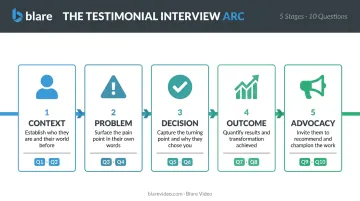
The 10 questions below are sequenced deliberately, moving subjects from context and credibility through problem, decision, and outcome. That arc helps people tell their story naturally — which means editors get usable footage and viewers get something they can actually trust.
Key Takeaways
- Questions should follow a narrative arc: context → problem → decision → outcome → advocacy
- Share questions with subjects beforehand so they have time to reflect — not rehearse a script
- The strongest answers come from questions that invite specific details, not general praise
- Keep every question focused on publishable content, not internal feedback or process critique
- Production quality matters as much as question quality — strong answers need clean footage and clear audio to land
Before You Ask: Setting the Stage
Film Where the Subject Works
The single most effective thing you can do before asking a single question is choose the right location — and the right location is almost always theirs.
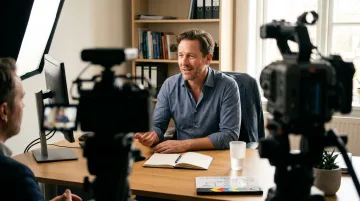
Blare Video's approach is straightforward: go to the client's office or facility. It reduces friction, increases participation, and adds an authenticity a rented studio backdrop can't match. When viewers see a subject in their own workspace — at their desk, on their shop floor, in their conference room — the testimonial reads as transparent rather than staged.
Avoid over-designed setups with colored light splashes behind the subject. These make testimonials feel manufactured. A clean, well-lit corner of the client's actual environment signals far more credibility.
Prepare Without Over-Scripting
Content Marketing Institute recommends a 15-to-20-minute pre-interview to establish rapport, test a few questions, and make the subject comfortable — without locking them into scripted answers.
Share the questions in advance so subjects can reflect — that's different from handing them a script. Blare Video's directors coach specifically against scripted delivery: the goal is conversation, not performance.
A subject who sounds like they're reading talking points loses credibility the moment they open their mouth.
Match Technical Quality to Content Quality
Good conversation isn't enough on its own. Even the most compelling answer loses impact when audio cuts out, framing shifts, or the background pulls focus.
Minimum technical requirements for a usable testimonial:
- Audio: Wired or wireless lavalier mic on the subject (boom mic as backup)
- Lighting: Dedicated LED panels; avoid relying on office overhead lighting
- Camera: Locked-off primary angle with a second camera for cutaways
- B-roll: Footage of the subject working, their facility, or their product — editors need it
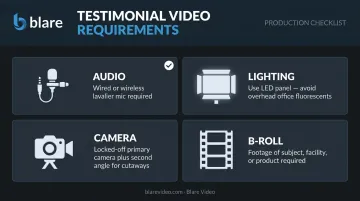
Blare Video shoots testimonial interviews with Sony FX6 or FX3 cameras as the primary, typically running a two-camera setup, with professional LED lighting and dual-mic audio as standard. The technical baseline exists for one reason: keep viewers watching long enough to hear the message.
Questions 1–3: Context and Credibility
Question 1: Can you tell us a bit about yourself and what your role involves?
This opener does more than break the ice. It gives viewers a frame of reference for who is speaking, which determines whether the testimonial feels relevant to them personally.
The Demand Gen Report's 2024 Content Preferences Benchmark Survey found that 51% of B2B buyers say content is too generic or irrelevant. A subject who identifies their industry, company size, and role immediately signals to similar viewers: this person is like me.
It also gives the subject an easy entry point. After a minute of talking about their job, they're relaxed enough that the next answer lands naturally on camera rather than feeling rehearsed.
Question 2: How did you first hear about us, and what prompted you to reach out?
Discovery questions reveal the buying journey at its earliest stage. A subject who found you through a colleague's referral adds an extra credibility layer — word-of-mouth proof, built right into the testimonial.
The second half of the question matters as much as the first. "What prompted you to reach out" moves the answer beyond "I saw you on LinkedIn" into motivation and urgency. Those answers are the clips that land with prospects who haven't committed yet — people still deciding whether their problem is worth solving.
Question 3: What were you trying to solve or accomplish before you found us?
This establishes the "before state" — without it, the outcome has no context. Ask it in neutral, open language. You want the subject describing their problem in their own words, not echoing your marketing copy.
The more specific their answer, the more useful the clip. A subject who says "we were losing about eight hours a week to manual reporting" gives viewers something to measure against their own situation. A subject who says "we were losing about eight hours a week to manual reporting" gives viewers a concrete benchmark — and makes the eventual outcome feel earned, not generic.
Questions 4–6: Problem, Discovery, and Decision
Question 4: Had you tried other solutions before us? What was missing?
This question surfaces competitive context without asking the subject to name competitors directly, since most people are reluctant to do that on camera anyway.
What it does accomplish: it validates that the subject's problem was real and that they made an informed decision, not a default one. The phrase "what was missing" invites specific criticism of prior solutions, which implicitly positions your offering as the answer. Let the subject's words do that work. Don't do it for them.
Question 5: What were your biggest hesitations before getting started with us?
This is often the question that produces the most unscripted, authentic moments in the entire interview.
Subjects recall real doubt here — concerns about:
Subjects recall real doubt here. Common hesitations include:
- Cost and whether the investment would pay off
- Implementation complexity and internal bandwidth
- Whether the outcome would actually justify the effort
Prospects watching the video share many of those same concerns. When they hear a real person articulate and then overcome them, it's more persuasive than any brand dismissing objections itself.
One practical note: if the subject pauses after this question, don't fill the silence. Wait. The pause usually precedes the most honest answer.
Question 6: What was it about us specifically that made you decide to move forward?
This is the decision-point question. It asks the subject to articulate your differentiators in their own language, which is far more credible than a brand listing its own advantages.
Resist the urge to suggest answers if the subject takes a moment to think. Whatever they land on naturally — however simple — will sound more authentic on camera than anything prompted.
A subject who says "honestly, it came down to how fast you responded when we had questions" tells prospects something no marketing brief could.
Questions 7–10: Results, Advocacy, and the Open Floor
Question 7: What's the biggest result or change you've experienced since working with us?
Outcome questions are the most persuasive element of any testimonial. The Demand Gen Report found that 43% of B2B buyers want vendors to focus less on product specifics and more on business value — and testimonials are where that value gets expressed most concretely.
Push for specifics. If a subject says "things are running a lot smoother," follow up with: "Can you give me a number or a specific example?" That follow-up often unlocks the quote that ends up being the centerpiece of the final edit.
A subject who says "we cut our onboarding time from three weeks to five days" gives skeptical viewers something concrete to evaluate. Vague positivity, by contrast, gets forgotten.
Question 8: Was there a moment when we exceeded your expectations?
This question generates the emotionally memorable clips that make testimonials worth sharing. A subject recalling a specific moment — a team member who stayed late, a faster-than-expected turnaround, a solution they didn't anticipate — creates a specific, memorable scene rather than a generic endorsement.
These moments work especially well in B2B contexts or long-term client relationships where personal interactions shaped the experience. For Blare Video's LeanData testimonial production, for example, subjects were asked to reflect on specific interactions and outcomes from a client event — the resulting clips were concise enough for social cutdowns while being specific enough to feel credible.
Question 9: Would you recommend us to someone facing the same challenge, and what would you say to them?
Framing the recommendation around a shared challenge transforms a sales endorsement into peer advice. The subject isn't pitching your product — they're talking to someone who has the same problem they used to have.
That framing resonates because it matches exactly how prospects think when they're evaluating a vendor. It's also where the most quotable sound bites tend to surface — direct, practitioner-level language that no marketing copy can replicate.
Question 10: Is there anything else you'd like to share that we haven't covered?
Never skip this one. It respects the subject's full experience and often surfaces details, anecdotes, or compliments the interviewer never thought to ask about.
CMI specifically recommends ending interviews with questions like "What haven't I asked that you wish I did?" — noting that these often produce the most powerful quotes of the session.
Stay visibly engaged during this answer. Genuine curiosity keeps subjects talking; any sign of impatience and they'll wrap up with a polite "no, I think that covers it." The best unexpected quotes come from subjects who feel like they have an audience, not a checklist to get through.
Questions 7 through 10 complete the arc of a strong testimonial: quantified outcomes, a human moment, peer-to-peer advocacy, and space for anything the structure missed. Together, they move a viewer from skeptical to convinced — and give an editor the material to make that happen.
Conclusion
These 10 questions work because they follow a story arc — context, problem, decision, outcome, advocacy — rather than a random checklist. When subjects move through that arc naturally, editors have everything they need: an opening that establishes credibility, a middle that builds tension, and an ending that delivers proof.
The questions are only half the equation, though. Even the most candid answer falls flat if the lighting is wrong, the location is distracting, or the subject never relaxes on camera. Production quality and on-site direction are what turn good answers into footage people actually watch.
Blare Video offers full-service testimonial video production across 23 US markets — from pre-interview preparation and on-site direction through editing, color correction, and social media cutdowns. If you want the story, the camera work, and the final edit handled by a team with credits across Google, Taco Bell, and Williams-Sonoma, reach out to discuss your next testimonial project.
Frequently Asked Questions
How do I ask a client for a video testimonial?
Ask right after a positive outcome or milestone, while the results are fresh. Keep the request brief and direct, reference specific results the client achieved, and offer to handle all logistics — scheduling, location, production. That combination makes the ask feel personal rather than transactional.
What are good questions to ask in a video testimonial?
The best questions are open-ended and follow a narrative arc from problem to outcome. Share them with the subject before filming so they can identify specific moments and results worth mentioning. Questions that invite concrete details produce far stronger answers than questions that invite general praise.
What should I say in a video testimonial?
Focus on three things: the specific problem you had before, why you chose this solution, and the concrete result you achieved. Keep it conversational, as if speaking to someone facing the same situation you were in. The more specific you are, the more useful the testimonial becomes.
What are common video interview questions?
Most effective testimonials draw from five categories: background and role, the problem or challenge, the decision process, the results, and a recommendation. Three to five well-chosen questions from these categories outperform an exhaustive list — subjects give better answers when they aren't fatigued by question 12.
How long should a video testimonial be?
For most website and social media uses, 60–90 seconds is the target. Wistia's analysis of 13 million videos found testimonials under one minute average 46% engagement — hitting that length typically requires filming 5–10 minutes of footage for editors to work with.