Introduction
According to a peer-reviewed review, roughly 30 million health-related videos are watched on YouTube every single day. Patients aren't waiting for their next appointment to research symptoms, compare providers, or understand procedures — they're doing it on their phones right now.
That creates both an opportunity and a challenge for healthcare marketers. Video works differently here than in any other industry — you're not selling a software subscription or a pair of sneakers. You're asking someone to trust you with their health.
Every frame has to balance patient sensitivity, regulatory compliance, clinical accuracy, and genuine emotional connection at once.
This guide covers the video types that actually convert patients, the production secrets that separate high-performing healthcare content from generic content, and the distribution and compliance frameworks that keep your organization protected and visible.
Key Takeaways
- 30M+ health-related videos are watched on YouTube daily — your patients are already there
- Patient testimonials, educational explainers, and physician intros outperform nearly every other healthcare video format
- Repurpose one long-form video into clips, quotes, blog posts, and page embeds for the highest ROI
- HIPAA compliance requires written patient authorization — a general media release is not enough
- Track view time and watch rate for awareness; track appointment bookings for actual ROI
Why Video Is a Non-Negotiable Tool in Healthcare Marketing
Healthcare consumers have changed how they make decisions. A Google/Compete study of hospital researchers found that 30% of patients who watched an online video booked an appointment — and YouTube accounted for 29% of where those video-watching patients went during their research.
Patients are watching videos about general hospital information (64%) and complex treatments or procedures (56%) before they ever pick up the phone. Video research is now the default step before calling a clinic or booking online.
Three Reasons Video Wins in Healthcare
The gap between large health systems and smaller practices is widest on YouTube. Two channels illustrate how much ground has been built:
| Health System | Subscribers | Videos Published | Channel Started |
|---|---|---|---|
| Mayo Clinic | 1.25M+ | 12,000+ | 2006 |
| Cleveland Clinic | 737,000 | 6,300+ | — |
Those numbers represent years of compounding organic reach — each video adding to a library that surfaces whenever patients search a condition or procedure. For mid-size practices without a content strategy, every search that lands on a competitor's channel is a patient who never called.
The Most Effective Video Types for Healthcare Marketing
Patient Testimonials
Patient testimonials are the highest-trust format in healthcare video. They work because they mirror exactly how patients research providers: by asking other patients what their experience was like.
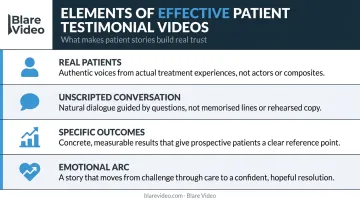
What separates effective testimonials from forgettable ones:
- Real patients, not actors (viewers can tell the difference instantly)
- Unscripted conversation : asking patients to read from a script kills credibility; a skilled director draws out genuine answers through natural dialogue
- Specific outcomes : "my pain went from a 9 to a 2" outperforms "I felt so much better"
- Emotional arc : fear before treatment, relief after, gratitude in between
Blare Video's testimonial production approach prioritizes this exact dynamic: an unscripted, two-camera setup with a director whose primary job is making the patient forget there's a camera in the room. For healthcare clients like Community Medical Centers and Kern Family Health Care, that authenticity-first approach shapes how the interview is structured from the first pre-production call.
Educational and Explainer Videos
Educational videos answer the questions patients are already typing into YouTube and Google: "what is an MRI," "how does bariatric surgery work," "what are the side effects of metformin." They generate consistent organic traffic long after publication.
The clinical evidence supports this investment beyond marketing value. A 2023 systematic review in JMIR covering 22 studies and 4,479 participants found that video-based educational interventions significantly improved medication adherence compared to standard care (odds ratio 2.14; 95% CI 1.43–3.19).
Results aren't universal, though. A separate JAMA Network Open trial on atrial fibrillation found knowledge benefits but no statistically significant adherence improvement, so video education works best as part of a broader patient engagement strategy rather than a standalone fix.
Physician and Staff Introduction Videos
A patient's first appointment is less intimidating when they already know the doctor's name, face, and communication style. Physician intro videos reduce no-show rates, lower pre-appointment anxiety, and differentiate a practice from competitors who are still just listing credentials in text bios.
Production considerations specific to physician intros:
- Film in the provider's actual workspace (exam room, office), not a generic backdrop
- Keep it under 90 seconds; patients want familiarity, not a full biography
- Coach providers the same way you'd coach any interview subject: casual conversation, not a script
Behind-the-Scenes and Facility Tour Videos
Showing an operating suite, imaging center, or patient lounge before a procedure does something static content cannot: it removes the unknown. Fear of medical environments often comes from unfamiliarity. A two-minute facility walk-through preempts that anxiety.
For healthcare clients, Blare Video approaches facility tours with a few consistent techniques:
- Drone footage to establish scale and environment
- Multi-angle editing to walk viewers through a logical sequence
- Structured narration built around questions patients actually ask
That same methodology translates directly to clinical settings, from imaging centers to outpatient surgical suites.
Live Q&A Sessions and Webinars
Live formats create urgency that pre-recorded content can't replicate. When a cardiologist goes live to answer questions about heart disease prevention during Heart Month, viewers engage in real time, and those who can't attend live watch the replay. The format establishes thought leadership, creates a natural moment to encourage follow-up appointments, and generates evergreen content that can be clipped and repurposed afterward.
Healthcare Video Marketing Secrets That Drive Results
Secret 1: Hook Viewers in the First 10–15 Seconds
You don't have minutes to warm up the audience. Wistia's engagement data shows that the sharpest drop-off in viewership happens in the first 10–15 seconds — and if those seconds don't deliver on what the title or thumbnail promised, viewers leave.
What works as a healthcare hook:
- A bold, direct question: "What would you do if you found a lump?"
- An unexpected statistic that reframes a familiar topic
- An emotional visual — a patient's face, a procedure in progress, a before-and-after
What kills it: opening with a logo animation, a corporate intro, or a slow-building preamble. Start in the middle of the story.
Secret 2: Match Length to the Patient Journey Stage
Not every video should be the same length. Match format to intent:
| Funnel Stage | Format | Length | Platform |
|---|---|---|---|
| Awareness | Short-form clips | 15–30 seconds | Reels, Shorts, TikTok |
| Education | Explainer or story | 1–2 minutes | YouTube, Facebook |
| Conversion | CTA-focused | Under 60 seconds | Website, email, YouTube |
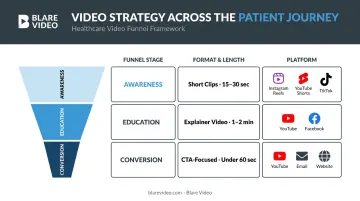
A 3-minute patient story video belongs on YouTube and a service page — not as a paid social ad where the viewer hasn't opted in yet.
Secret 3: Use Narrative Structure, Not Just Information
The difference between a video patients share and one they skip isn't production quality — it's story. Viewers connect with a problem they recognize, empathy they feel, and a resolution they can imagine for themselves.
Structure: problem → empathy → solution
Center the patient's experience, not the organization's capabilities. "I was terrified of the surgery" lands harder than "Our surgical team has performed over 10,000 procedures." Lead with the human; let the institution's credibility emerge from the story.
Secret 4: Treat YouTube SEO as Seriously as Website SEO
YouTube draws on massive health-related search volume daily — and with 85% of U.S. adults reporting they use YouTube, it functions as a search engine for health questions as much as an entertainment platform.
Key optimization tactics:
- Titles in question format: "What Happens During a Hip Replacement?" outperforms "Hip Replacement Video"
- Detailed descriptions: 200+ words with secondary keywords, timestamps, and a CTA
- Organize videos into playlists by specialty or condition to keep viewers in your channel longer
- End cards: guide viewers to the next logical video rather than letting YouTube decide
Blare Video plans distribution before the shoot, not after. That means deliverables arrive already formatted, captioned, and structured for the platforms where they'll actually live.
Secret 5: Repurpose One Video Into a Content Ecosystem
A single 3-minute patient story video can become:
- A 30-second Reel for Instagram awareness
- A quote card graphic for Facebook
- A transcript formatted as a blog post
- A video embed on the relevant service page
- A clip for an email newsletter
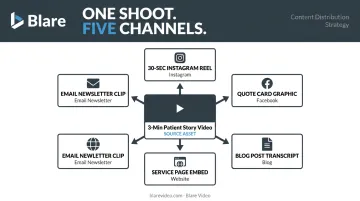
For healthcare marketing teams working with limited budgets, this is one of the highest-ROI moves available. A single shoot day produces content assets across four or five channels — with one crew, one approval cycle, and one location. Blare Video's social media production workflow handles exactly this: capturing multiple deliverables in horizontal, vertical, and square formats from a single shoot.
Staying HIPAA-Compliant in Healthcare Video Marketing
Patient Authorization Requirements
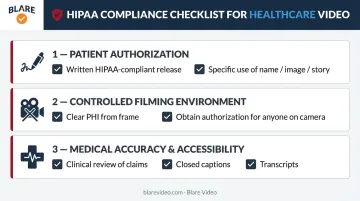
The most common compliance mistake in healthcare video: assuming a standard media release is enough.
According to HHS, healthcare providers may not invite or arrange for media access to areas where patients' protected health information (PHI) is accessible without prior written authorization from each affected patient — and that authorization must meet specific HIPAA requirements, not just a general consent form.
What a proper HIPAA authorization covers:
- The specific use of the patient's name, image, and story
- The marketing purpose of the content
- Whether any third-party remuneration is involved (for sponsored content)
A blanket treatment consent or a basic media release that doesn't meet HIPAA authorization standards is not sufficient.
Background Capture and Incidental PHI
Filming in clinical environments creates a specific risk: background patients whose PHI could be captured incidentally. Under HHS guidance, incidental disclosures are only permissible when they're secondary to a permitted use and can't reasonably be prevented. Planned filming for marketing purposes doesn't get the incidental disclosure exception.
To reduce that risk: film in controlled environments, clear the frame of any patient-identifiable information (charts, wristbands, monitor screens), and obtain authorization from anyone who may appear on camera.
Medical Accuracy and Accessibility
All clinical claims — outcomes, treatment descriptions, statistics — should go through clinical or legal review before publication. Unsubstantiated outcome claims can trigger regulatory scrutiny and erode patient trust faster than no video at all.
Accuracy isn't the only compliance box to check. Accessibility requirements carry equal weight — and equal risk if ignored.
HHS recipients with 15 or more employees must conform to WCAG 2.1 Level AA by May 11, 2026. That means:
- Accurate closed captions (not just auto-generated)
- Audio descriptions for visual content
- Full transcripts for all video
Accessible video also gets indexed more thoroughly by search engines, so compliance and SEO point in the same direction.
Where and How to Distribute Your Healthcare Videos
Platform Selection by Goal
| Platform | Best Use | Audience |
|---|---|---|
| YouTube | Long-form education, SEO discovery | All ages researching health topics |
| Instagram Reels / TikTok | Short-form awareness | Younger demographics |
| Community engagement, event promotion | 35–65+ demographics | |
| Website (service pages) | Conversion, appointment booking | Active decision-makers |
Organic vs. Paid Distribution
A well-optimized YouTube video can still generate views two or three years after upload. Paid video (Meta pre-roll, YouTube ads) delivers immediate reach with precise targeting by geography, demographics, and health interest categories.
Across industries, 82% of marketers report positive ROI from video and 83% say video directly increased sales, according to Wyzowl's 2026 survey. Healthcare-specific head-to-head comparisons of video vs. static ads are limited, but the general pattern holds: video consistently outperforms static in engagement metrics.
Video in Email Campaigns
Don't overlook email as a distribution channel. Wistia's A/B testing across 7 experiments found that video thumbnails in emails increased click-through rates by an average of 21.52% compared to static image thumbnails. One test with 11,290 recipients produced 40.83% more clicks with a video thumbnail.
For patient newsletters and appointment reminder campaigns, embedding a video thumbnail linked to a YouTube video or service page is a practical, low-cost way to improve click performance.
Measuring the ROI of Your Healthcare Video Marketing Strategy
KPIs by Goal
Match metrics to what you're actually trying to achieve:
- Awareness: View count, watch time, impressions
- Brand building: Engagement rate (comments, shares), subscriber/follower growth
- Conversion: Appointment bookings attributed to video, form completions, tracked phone calls
The strongest healthcare-specific benchmark available: the Google/Compete study found 30% of patients who watched online video booked an appointment. That's the north star for conversion tracking.
Platform Analytics and Optimization
Each platform surfaces different signals worth tracking:
- YouTube Studio: Watch time, audience drop-off points, and traffic sources
- Meta Insights: Reach, engagement, and click behavior by video
- Website analytics: UTM parameters on video links reveal which videos drive appointment form completions
Use this data to answer two questions: Which topics generate the most engagement? Which formats produce the most conversions? The answers should drive your next production priority.
A/B Testing as an Ongoing Practice
Don't treat video marketing as a campaign — treat it as an optimization loop. Test:
- Opening hooks: question-led vs. statistic-led formats
- Thumbnail designs: face-forward vs. text-overlay vs. procedure imagery
- CTA phrasing: "Book an appointment" vs. "Talk to a specialist today"
Run one variable at a time, measure for 30–60 days, and apply what you learn to the next video. Each round of testing gives you a sharper read on what your audience actually responds to — so every video after it starts from a better baseline.
Frequently Asked Questions
Which platform is most widely used for video marketing?
YouTube leads for video reach and search-driven discovery — 85% of U.S. adults use it. For healthcare organizations, the right platform depends on your audience: Meta works well for community engagement and older demographics, while TikTok and Instagram Reels reach younger patients.
What are the 7 P's of marketing in the healthcare industry?
Video marketing most directly amplifies two of the 7 P's: Promotion (showcasing services and campaigns) and People (humanizing providers through physician intros and patient testimonials). The full framework also includes Product, Price, Place, Process, and Physical Evidence.
What types of videos work best for healthcare marketing?
Patient testimonials, educational explainer videos, and physician introduction videos perform best. The right format depends on where the patient is in their decision-making journey — awareness, research, or ready to book.
How do healthcare organizations stay HIPAA-compliant in video marketing?
Obtain written patient authorization that meets HIPAA requirements — a general media release is not sufficient. Control filming environments to prevent incidental capture of other patients' PHI, and have all clinical claims reviewed before publication.
How long should healthcare marketing videos be?
15–30 seconds for awareness content on Reels and Shorts; 1–2 minutes for educational mid-funnel videos on YouTube; under 60 seconds for conversion-focused ads with a direct CTA. Match length to where the viewer is in their decision-making process.
How do you measure the success of healthcare video marketing?
Track view count and watch time for reach, engagement rate (comments and shares) for audience resonance, and conversion events — appointment bookings, form submissions, attributed phone calls — as the real measure of marketing ROI.