Introduction
Car commercials sit at a different level of difficulty compared to most commercial video work. The vehicle itself is reflective, constantly moving, and unforgiving under poor lighting — as Bill Bennett, ASC notes in his car commercial lighting series, addressing a car's reflective surface requires specialized technique that separates professional automotive production from a generic walkaround clip.
The gap between an amateur clip and a broadcast-quality spot rarely comes down to the car. It comes down to decisions made before the camera rolls — location scouting, lighting logistics, and shot design — and how well the crew executes under pressure on the day.
This guide walks through the full production process — from initial concept to final delivery — covering what to prepare, how to shoot, which techniques produce the best results, and the common mistakes that derail shoots before the first setup is locked.
Key Takeaways
- Car commercial production has three phases: pre-production (concept, storyboard, location scouting), production (camera techniques, lighting, audio), and post-production (color grade, sound design, delivery).
- Shot variety across wide, detail, rolling, drone, and interior angles determines whether the final cut feels dynamic or flat.
- Most failed shoots trace back to weak pre-production: no shot list, no permits, no rehearsals before the hero vehicle arrives.
- Lighting and audio are chronically underinvested; both dramatically affect perceived production value.
- Shooting in log or RAW format is required to get usable color grades in post — compressed formats leave you with little to work with.
How to Shoot a Car Commercial: Step-by-Step Production Process
Step 1: Creative Development and Pre-Production
Start with a clear narrative goal. Is this a brand awareness spot, a model feature showcase, a launch reveal, or a dealership ad? That distinction shapes everything downstream: runtime, format, tone, and shot structure.
Clarify the intended platform early. YouTube requires 1920 x 1080 at 16:9. Instagram Stories and Reels work best at 1080 x 1920 vertical. Instagram Feed supports 1:1 square. Shooting without knowing your delivery format means reshooting or cropping later.
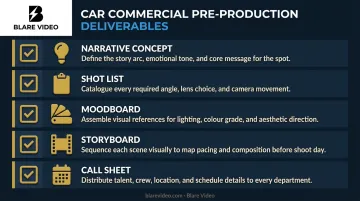
Build a moodboard and storyboard before any crew is booked. Reference specific commercials or films with the visual language you want to achieve. Tools like StudioBinder support storyboards, shot lists, time estimates, and call sheets in one place — all of which the crew will need before arriving on set.
What pre-production should produce:
- A confirmed narrative concept and commercial objective
- A shot list organized by camera setup and estimated time per setup
- A moodboard defining visual tone, color palette, and reference footage
- A storyboard illustrating the shot sequence
- A call sheet with crew assignments, location details, and schedule
Step 2: Location Scouting and Permits
Scout locations for two things simultaneously: visual appeal and practical safety. A winding mountain road may look ideal on Google Maps but have debris, poor surface conditions, or unpredictable traffic at shoot time.
Use sun-tracking apps like PhotoPills to predict where light falls at your planned shoot time. Arriving at a location mid-afternoon when you scouted it at golden hour means flat light on paint and washed-out reflections — both of which are difficult to recover in post.
Permit requirements to confirm before the shoot date:
- Most US cities and counties require a film permit for commercial production on public property
- California Film Commission state permits have a minimum processing time of 4 business days; drone requests require 7 business days; freeway closures require 16 business days
- FilmLA requires proof of liability insurance before coordinating permits in the Los Angeles area
- New York City's Mayor's Office of Media and Entertainment requires permits when productions use equipment beyond handheld cameras, assert exclusive property use, or involve prop vehicles
Road applications typically require vehicle count, crew count, lane usage, and in some cases a Traffic Control Plan stamped by a licensed civil or traffic engineer. Skipping permits doesn't save time — it ends shoots.
Step 3: Production Day Setup and Execution
Get to set early. The time actually available with the hero vehicle is always shorter than the call sheet suggests — crew setup, lighting adjustments, and unexpected delays compress it further.
Use that pre-vehicle window to:
- Rehearse camera moves with a stand-in vehicle
- Confirm the lighting setup and do test exposures
- Walk the shot list with the director and DOP
- Position the drone pilot and confirm airspace clearance
Execute the shot list in a structured sequence rather than improvising on set. Work from wide establishing shots → medium coverage → extreme close-ups of details (badges, brake calipers, exhaust tips, stitched leather, alloy wheel spokes). Capture both static and moving vehicle angles before the light shifts.
Step 4: Post-Production and Delivery
Color grading is where automotive footage either delivers or falls flat. Car paint, metallic surfaces, and reflections respond dramatically to grade adjustments — which is why shooting in log or RAW format is non-negotiable.
Codec choice directly affects what's recoverable in the grade:
- ARRI Log C: Preserves full color information and dynamic range captured by the sensor
- RED REDCODE RAW: Carries sensor characterizations and full RAW controls in post
- Blackmagic RAW: A 2022 Nokian Tyres commercial shot on the URSA Mini Pro 12K used this codec throughout post, graded in DaVinci Resolve Studio — a workflow Blare Video also uses as a standard part of commercial post-production
Build the audio design from location recordings captured on set, layered with licensed music, then mix to final. Deliver in all required formats and aspect ratios before distribution.
What You Need Before You Start Filming
Preparation quality directly predicts shoot-day results. The most common reason car commercial shoots underperform is arriving on set without the right gear, crew, or permissions.
Camera and Equipment
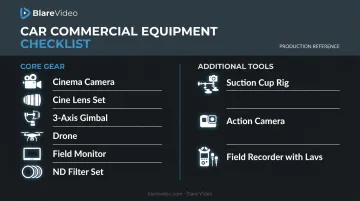
Minimum viable gear for a professional car commercial:
- Cinema or mirrorless camera capable of shooting log or RAW (ARRI Alexa, RED Epic/Weapon, Sony FX6 with 15+ stops of dynamic range, Blackmagic URSA)
- Prime or cine lens set covering wide to short telephoto focal lengths
- 3-axis gimbal (such as a DJI Ronin RS2) for stabilized moving shots
- Drone for aerial coverage — cinematic platforms like the DJI Inspire 3 offer a full-frame 35mm CMOS sensor and 8K video, with noticeably better image quality and stability than consumer-grade options
- Field monitor for on-set client and DOP review
- ND filter set for outdoor shooting to maintain cinema shutter speeds in bright conditions
Additional tools that improve production quality:
- Vehicle-mounted suction cup rig (such as the Matthews Master Mount System, rated to 40 lb) for in-motion exterior close-ups
- GoPro or similar for dashboard and interior angles
- Field recorder with lavalier microphones for engine audio capture
Blare Video uses RED camera systems — the Red Epic Dragon, Red Weapon Helium, and Red Weapon Monstro — paired with Sigma Prime Cinema Lenses and Canon L Series glass across their commercial productions in the US.
Crew and Permits
Minimum crew for a professional car commercial:
- Director
- Director of Photography (DOP)
- Camera Operator
- Gaffer (lighting)
- Production Assistant
- Licensed FAA Part 107 Drone Pilot for aerial coverage
FAA Part 107 certification requires passing the Part 107 Aeronautical Knowledge Test and recertifying every 24 calendar months. Commercial drone operations are capped at 400 ft AGL and cannot be conducted over moving vehicles unless you're operating on a closed or restricted-access site.
These regulatory requirements apply alongside standard location permits — plan for both early in pre-production.
Confirm production liability insurance and all location agreements before the shoot date. Most location owners and municipalities require certificates of insurance before any filming begins.
Camera Techniques and Shot Types for Car Commercials
Shot variety is the difference between a commercial that feels produced and one that feels like a YouTube walkthrough. No single capture method should dominate the edit.
Wide establishing shots place the vehicle in its environment — mountain road, desert highway, urban skyline, studio. They set emotional tone and provide scale. Vary focal lengths between sequences to maintain visual energy.
Rolling shots are among the most technically demanding shots in automotive production. They require a camera vehicle — a chase car, camera truck, or drone — pacing alongside or behind the hero car. Speed, distance, and focal length all interact to control the perceived sense of motion.
A longer focal length at distance compresses the scene and makes the car appear to move faster; a wider angle at close range makes the environment rush past more dramatically. A 180-degree shutter angle (approximately 1/48 sec at 24fps) produces the natural motion blur that separates cinematic rolling footage from video-like results.
Extreme close-up detail shots reward viewers who care about craftsmanship. Walk the car methodically before the shoot and identify every visually compelling element:
- Logos and badging
- Brake calipers and rotor faces
- Alloy wheel spoke patterns
- Exhaust tips
- Stitched leather or suede interior panels
- Engine bay components
- Air intake vents
These macro shots are what separate a commercial from a generic walkaround video.
Aerial and Drone Coverage
Drone shots serve two distinct purposes:
- Low-altitude parallel passes — creates a strong sense of speed and lateral movement alongside the vehicle
- High-altitude wide frames — establishes dramatic landscape context and scale
The DJI Inspire 3's full-frame sensor and 8K output handles broadcast delivery requirements that Mavic-series sensors can't match on larger screens. Mavic-series drones remain practical for social content and lower-distribution projects.
Mixing capture methods matters as much as the individual shots. Ground-level angles, dashboard-mounted clips, and occasional deliberate handheld movement all add texture. When gimbal and drone moments appear within a varied edit, they feel earned rather than repetitive.
Lighting and Audio: The Variables That Shape Your Final Cut
Lighting Setup for Car Commercials
In a controlled studio or garage environment, beauty shots rely on soft, top-down diffused light to make paint surfaces appear clean and reflective. Large overhead diffusion panels handle the fill; a secondary key light from the front or background adds separation and depth — the two-light logic behind the clean manufacturer commercial look.
Outdoors, the most flattering automotive light comes in the hour after sunrise and the hour before sunset. Golden hour produces a low sun angle that creates dramatic shadows along body lines and reveals surface contours that midday shooting flattens entirely. Midday sun also creates harsh, uncontrolled reflections on metallic finishes — a challenge ASC cinematographers address in automotive work.
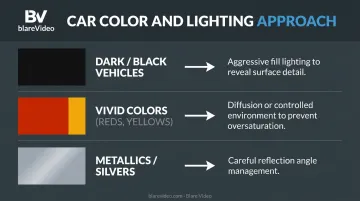
Car color shapes your lighting approach more than most productions anticipate:
- Dark and black vehicles need aggressive fill lighting to reveal surface detail and prevent them from reading as flat silhouettes
- Vivid colors (reds, yellows) can oversaturate in direct sunlight and may require diffusion or a controlled environment
- Metallics and silvers are highly sensitive to reflection angles — even minor light position shifts change the finish character on camera
Capturing Authentic Car Audio
Engine, exhaust, and mechanical sound define the commercial for performance vehicles — stock audio in post never captures exhaust character the way a real pass does.
A practical on-location audio rig:
- Mount a field recorder (such as the Zoom H4n Pro, which records up to 24-bit/96kHz and handles up to 140 dB SPL) in the trunk
- Tape a lavalier microphone to the rear bumper for exterior rolling sound
- Place a second recorder inside the cabin for interior audio
- Tape a lav to a side mirror for front-engine sound — the mirror body reduces wind noise naturally
Run dedicated audio passes separate from your visual shots, with one crew member assigned to audio throughout the day — that single step is what separates usable material from gaps you can't fix in post.
Common Mistakes When Shooting Car Commercials
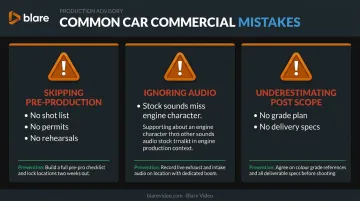
Three mistakes show up consistently across car commercial productions — and all three are preventable in pre-production.
Skipping pre-production. Arriving on set without a shot list, confirmed permits, or rehearsed camera moves is the single most consistent cause of incomplete footage. The hero vehicle window is always compressed. Productions that rehearse setups before the car arrives consistently walk away with more usable material than those that improvise.
Treating audio as an afterthought. Most productions focus entirely on visuals and patch in stock sounds during post. For performance vehicles, that's a costly shortcut — engine character is a selling point, and stock audio doesn't replicate it. Treat location audio capture as a production requirement from day one.
Underestimating post-production scope. Shooting in a flat or log profile without a color grade plan creates problems that even clean footage can't fix. Define the shooting format, post-production workflow, and delivery specs during pre-production — not after the shoot wraps.
Conclusion
A successful car commercial results from careful pre-production, disciplined on-set execution, and professional post-production. Planning what to shoot, how to capture it, and how to finish it isn't overhead — it's the actual work.
The fundamentals in this guide apply across budget levels, whether you're producing an in-house branded video or a broadcast-quality commercial. When a production calls for a full crew, broadcast-grade camera packages, and location scouting and permitting support, it helps to have an experienced team behind it.
Blare Video provides full-service commercial production from concept through final delivery, with crews available across Los Angeles, San Diego, Las Vegas, Phoenix, Dallas, Chicago, New York, and other major US markets.
Frequently Asked Questions
How do you make a car launch video?
A car launch video moves through three phases: pre-production (concept, storyboard, sometimes an animatic), a controlled shoot built around dramatically revealing the vehicle, and a post-production process timed to the embargo date. Final delivery typically spans multiple formats at once — social cuts, broadcast versions, and press assets.
What camera is best for filming a car commercial?
Cinema-grade cameras capable of shooting RAW or log — such as the ARRI Alexa, RED Epic, or Sony FX6 — dominate professional car production. The most important factor is dynamic range: car paint and reflective surfaces respond dramatically to color grading, and compressed formats simply can't hold up under that adjustment.
Do I need a permit to film a car commercial on public roads?
Most US cities and counties require a film permit for commercial production on public property. Driving sequences may additionally require traffic control coordination or a police escort. Confirm requirements with local film offices well in advance — California state permits have a minimum 4 business day processing window, and drone requests require 7 business days.
How long does it take to shoot a car commercial?
A typical single-vehicle shoot runs 8–12 hours on set. The full production timeline from concept to final delivery is generally 2–4 weeks when accounting for pre-production, the shoot day, and post-production including color grade, sound design, and revision rounds.
What is the difference between a car commercial and a car launch video?
A car commercial is an ongoing brand or model advertisement designed for broad, sustained media placement. A launch video is a one-time reveal asset tied to a specific release date, often under embargo. Launch videos prioritize dramatic reveal moments; commercials focus on lifestyle communication and feature messaging.
How much does it cost to produce a car commercial?
Production costs vary widely based on crew size, location versus studio requirements, shoot duration, and post-production complexity. Contact a production company directly for a project-specific quote based on your brief.