Introduction
Most workplace training fails before a single worker steps on the floor. The Bureau of Labor Statistics reported 2.5 million private-industry nonfatal workplace injuries and illnesses in 2024, and manufacturing posted a recordable case rate of 2.7 per 100 full-time workers. Poorly executed training contributes directly to those numbers—along with the $181.4 billion in total work injury costs the National Safety Council recorded that same year.
Industrial training video production is the process of planning, filming, and delivering video content that teaches workers specific processes, safety procedures, and operational tasks. Done right, it's one of the most effective tools for reducing incidents and standardizing performance across a workforce.
This article walks through the complete production process—from defining objectives to measuring results—covering the decisions that determine whether workers actually retain what they watch.
Key Takeaways
- Industrial training video production follows six stages: objective-setting, audience analysis, format selection, scripting, on-site filming, and post-production measurement.
- Videos must account for on-site filming constraints, compliance requirements, and how workers actually consume content on shift.
- One clear learning objective per video prevents scripts from sprawling and keeps production focused.
- Professional production quality signals credibility; workers who operate precision equipment daily can tell when training materials are careless.
What Is Industrial Training Video Production?
Industrial training video production covers the full pipeline from initial brief to final delivery—every decision made along the way to produce video content that trains workers in industrial settings.
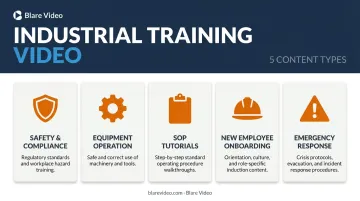
The scope is broader than most people expect. Common video types include:
- Safety and compliance training (PPE use, hazard communication, lockout/tagout)
- Equipment operation walkthroughs for machinery and powered industrial trucks
- Standard operating procedure (SOP) tutorials for production floor tasks
- New employee onboarding specific to facility operations
- Emergency response procedures for high-risk scenarios
How It Differs from General Corporate Training Video
A corporate training video about communication skills can be filmed in a conference room with minimal preparation. Industrial training video production operates under a different set of constraints from the start.
Key distinctions:
- Active facility logistics — noise levels, restricted zones, and shift schedules all shape what's filmable and when
- Crew and on-screen talent must wear required PPE on site
- Technical language must be validated by subject matter experts before it goes on camera
- Many videos must meet OSHA standards—including 29 CFR 1910.147 (lockout/tagout), 1910.132 (PPE), and 1910.1200 (hazard communication)
Those regulatory requirements aren't optional — they're what separates a compliant training asset from a liability.
Why Industrial Companies Need Professional Training Videos
Inconsistent in-person training creates knowledge gaps across shifts, locations, and facility changes. A supervisor explains a procedure one way on Monday; a different supervisor explains it differently on Thursday. Video eliminates that variation—the same standardized instruction plays every time, for every new hire, at every site.
The cost of getting it wrong is concrete:
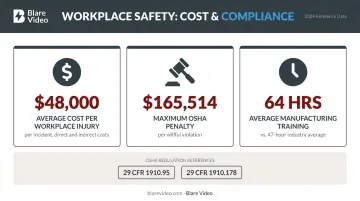
- $48,000 average cost per medically consulted workplace injury
- $165,514 maximum OSHA penalty per willful or repeated violation, effective January 2025
- Compliance failures that create legal liability and documentation gaps
Training volume adds another layer of pressure. According to the 2024 Training Industry Report, manufacturers and distributors averaged 64 training hours per employee—well above the 47-hour all-industry average. With that volume to deliver consistently, reusable, trackable video assets become an operational requirement, not an afterthought.
For many OSHA-covered employers, structured training is a legal mandate. Standards like 29 CFR 1910.95 (hearing conservation) require annual retraining. 29 CFR 1910.178 explicitly allows video as a formal instruction method for powered industrial truck training.
That regulatory paper trail matters. A professionally produced training video doesn't just deliver instruction—it creates timestamped, verifiable documentation that an employer can produce during an audit or in litigation.
Steps for Industrial Training Video Production
The production process has distinct stages, and the most common reason industrial training videos fail to achieve their goals is rushing or skipping pre-production. What looks like a filming problem is almost always a planning problem.
Step 1: Define Your Training Objectives and Core Message
Before any other work begins, establish one specific, measurable learning objective.
Weak objective: "Employees understand safety." Strong objective: "Employees can correctly complete all five steps of the lockout/tagout procedure without reference materials."
That level of specificity shapes everything downstream—script length, format choice, how success gets measured after launch. A narrow focus produces a more effective video. Trying to cover multiple objectives in one video is how you end up with a 20-minute video nobody finishes.
Step 2: Know Your Industrial Audience
Identify who this video serves before writing a single line of script:
- Skill level: Are these experienced operators or first-week hires?
- Language and literacy needs: Does this workforce require bilingual content or simplified vocabulary?
- Viewing conditions: Break room on a shared screen? Mobile device on the plant floor? Group onboarding session?
- Shift patterns: Will workers watch this mid-shift, and does that affect attention span and appropriate length?
Audience profile decisions directly shape tone, pacing, vocabulary, and how long the video should run. A video written for engineers will lose floor workers in the first two minutes.
Step 3: Choose the Right Video Format and Style
| Format | Best suited for |
|---|---|
| Live-action on-site | Physical procedures, equipment operation, PPE demonstrations |
| Animation | Hazardous processes too dangerous to film directly; internal system diagrams |
| Screen recording | Software dashboards, machinery control interfaces |
| Blended (live + animation) | Complex industrial processes needing both demonstration and explanation |
Live-action is the default for most industrial training content—workers respond to seeing actual equipment and real procedures. Animation earns its place when the process can't be safely filmed, or when the internal mechanics of a system need to be shown in a way cameras can't capture.
Blare Video has used exactly this blended approach: their perlite industrial video combined documentary-style facility footage with animated sequences to explain processes that standard camera work couldn't communicate on its own.
Step 4: Write the Script and Create a Storyboard
Write for the ear, not the page. Short sentences. Plain language. One concept per segment.
Research on instructional video engagement consistently favors short, segmented content. A study analyzing 6.9 million video-watching sessions found engagement was highest for videos under 3 minutes, with a recommended maximum of around 6 minutes per segment. For industrial training, 2 to 5 minutes per topic is the practical target. Longer subjects belong in a series, not a single extended video.
Storyboarding matters more in industrial production than in most other video formats. A detailed shot list — close-ups of machinery controls, worker demonstrations, on-screen text callouts, warning label overlays — tells the filming crew exactly what footage is needed on site. That clarity eliminates costly re-shoots when you're working around shift schedules and restricted access zones.
Step 5: Film on Location with Professional Production
On-site filming in industrial environments involves challenges that don't exist on a standard corporate shoot:
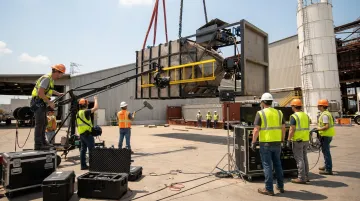
- Background noise from machinery requires directional microphones and careful audio monitoring
- PPE requirements apply to every crew member on the production floor
- Restricted or hazardous zones require site access planning in advance, not on shoot day
- Shift coordination means filming windows may be narrow and non-negotiable
- Warehouse and factory lighting often requires supplemental lighting to produce clear, usable footage
Blare Video's work with MOS Plastics illustrates how these challenges get managed with proper planning. That production combined drone shots for facility scale with close-up process footage, and added motion graphics in post to fill gaps standard camera angles couldn't cover.
Partnering with a production company experienced in industrial environments means PPE compliance on set, proper audio handling in noisy facilities, and footage that holds up in post-production. Blare Video provides full-service industrial production across major US markets — Los Angeles, San Diego, Phoenix, Dallas, Chicago, New York, and beyond.
Step 6: Edit, Distribute, and Measure Results
Post-production priorities for industrial training videos:
- On-screen text callouts highlighting critical steps
- Safety icons and warning label overlays at appropriate moments
- Captions for environments where workers can't use audio
- Consistent brand treatment throughout all modules in a series
Distribution decisions depend on how and where workers will access the content:
- LMS integration for tracked completion and knowledge checks
- In-app or device-based viewing on plant floor tablets
- Embedded in onboarding portals for new hires
- Group screening in break rooms or training facilities
Key metrics to track after launch:
- Completion rates by department or location
- Knowledge check scores before and after viewing
- Incident rate trends in areas covered by the training
- Time-to-competency for new hires completing the onboarding series
Without measurement, you can't prove the video worked—or identify where it needs to be updated as procedures change.
Key Factors That Affect Industrial Training Video Quality
- Validate every procedure with a subject matter expert (SME) — engineers, safety officers, or experienced operators — before a single shot is filmed. A factually wrong safety video is worse than no video at all.
- Assess lighting, acoustics, and environmental hazards during pre-production — not on shoot day when there's no time to adapt.
- Structure the script before worrying about production quality. Clear chunking and logical sequencing are what make information stick — a beautifully shot video with a disorganized script still fails.
- Match video length to how workers actually consume it. A shift-break viewer on a shared tablet needs a 3-minute task-specific clip, not a 25-minute comprehensive overview.
- Build compliance review into the production schedule from the start. In regulated industries, legal or safety sign-off before distribution is standard — treating it as an afterthought creates costly delays.
Common Mistakes to Avoid in Industrial Training Video Production
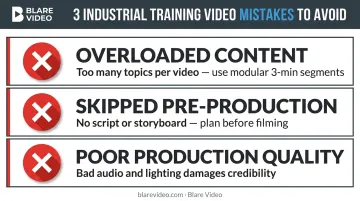
Most production failures trace back to the same three mistakes:
Packing too much into a single video. Teams compress multiple procedures into one video to cut costs, and the result is footage too long to finish and too dense to retain. A modular series of focused 3-minute segments consistently outperforms a 20-minute comprehensive overview.
Skipping pre-production planning. Filming without a finalized script, storyboard, and site access plan produces unusable footage and expensive re-shoots. Crews that arrive knowing exactly what shots they need work faster and make fewer mistakes — the time spent planning is recovered on the day of filming.
Treating production quality as optional. Poor audio, shaky footage, and badly lit machinery demonstrations don't just look unprofessional — they damage credibility. Workers who operate precision equipment daily make a fast judgment: if the training video looks careless, the content probably is too.
Frequently Asked Questions
What are the stages of industrial training video production?
The five core stages are: pre-production (defining objectives, scripting, storyboarding), production (on-site filming), post-production (editing, graphics, captions), distribution (LMS, intranet, device-based delivery), and measurement (tracking completion rates and learning outcomes). Skipping any stage—especially pre-production—creates problems that compound in every stage that follows.
How much does a 2-minute industrial training video cost?
Blare Video's production packages range from around $1,850 for a single-operator shoot day to $5,150+ for multi-person crews with full audio and camera setups, plus post-production. On-site complexity, animation requirements, revision rounds, and distribution format all affect the final budget.
How long should an industrial training video be?
Two to five minutes per topic is the recommended range for most industrial training content. Engagement drops sharply once videos exceed six minutes. Longer subjects should be broken into a series rather than stretched into a single video.
What makes industrial training videos different from standard corporate training videos?
Industrial training videos must address unique on-site filming challenges, comply with safety regulations (OSHA standards in particular), use precise technical language validated by subject matter experts, and remain accessible in environments where workers may be watching on mobile devices or shared screens without headphones.
Should you hire a professional video production company or produce training videos in-house?
In-house production works for simple content updates or screen recordings. Complex industrial training—on-site machinery, compliance requirements, multi-location deployment—benefits from a professional crew with industrial experience, since on-site logistics like PPE compliance, shift coordination, and noise management require a practiced hand.