Written reviews help. But video testimonials do something text simply cannot: they put a real person on screen, with a real voice, real emotions, and a real story. That combination of visual authenticity and narrative structure makes them one of the most persuasive content formats available to marketers today.
This article breaks down 8 concrete benefits of video testimonials — each tied to outcomes businesses actually measure: conversions, engagement, trust, and revenue.
Key Takeaways
- 9 out of 10 people trust what a customer says about a business more than what the business says about itself (Wyzowl)
- 2 in 3 viewers are more likely to purchase after watching a testimonial video showing how a product helped someone like them
- One professionally produced testimonial can be repurposed across your website, LinkedIn, email campaigns, and sales decks — stretching a single shoot across your entire funnel
- Businesses without video testimonials leave a credibility gap that competitors with them will fill
- Video testimonials consistently outperform written reviews on conversion rate, watch time, and buyer confidence
What Are Video Testimonials?
A video testimonial is a short recorded video in which a real customer describes their experience with a product or service. The most effective ones follow a simple three-part structure: the problem they faced, why they chose the solution, and the results they achieved.
Video testimonials work because the medium carries signals that text simply cannot. Body language, tone of voice, and genuine facial expressions all communicate credibility in ways a written quote never could. Skeptical buyers pick up on those cues immediately — which is why video consistently outperforms written reviews at the evaluation stage.
That reach extends across the entire buyer journey:
- Landing pages and product pages
- Sales decks and pitch materials
- Email nurture sequences
- Social media and paid ads
8 Benefits of Video Testimonials That Build Trust and Convert
The benefits below focus on measurable, real-world impact — not just surface-level marketing appeal.
Benefit 1: They Build Authentic, Lasting Brand Trust
Written reviews can be manipulated. The FTC's 2024 final rule on fake consumer reviews acknowledged that roughly 10% of products or businesses have manipulated consumer reviews, causing consumers an estimated $0.12 loss per dollar spent on suboptimal decisions. A video featuring a real person from a real company is inherently harder to fake.
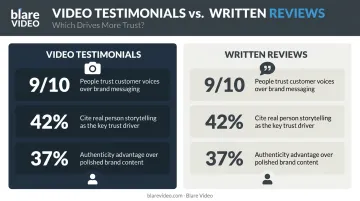
Wyzowl's testimonial research found that 9 out of 10 people trust what a customer says about a business more than what the business says about itself. The same research found:
- 37% say testimonials are effective because they're more authentic than a brand's own messaging
- 42% say they work because they showcase an actual person and help viewers understand that person's story
In high-consideration purchases — enterprise software, professional services, healthcare, financial products — trust isn't a bonus. It's a prerequisite. Video testimonials build it faster than any other owned content format.
Benefit 2: They Create Emotional Connections That Influence Decisions
Even in B2B, buying decisions are emotional. A CEB/Google study of 3,000 B2B purchasers found that B2B buyers perceiving personal value were nearly 50% more likely to buy and 8x more likely to pay a premium for comparable products. Emotion moves money.
Video testimonials surface the emotional arc of a customer's experience in a way that data sheets and case study PDFs never will. The frustration before. The relief after. The visible confidence of someone who found a solution that actually worked.
When a prospect watches someone in a similar role describe a real transformation, they don't just learn about your product — they see themselves in it. Wyzowl's research captures this directly: 2 in 3 viewers are more likely to purchase after watching a testimonial showing how a product helped someone like them.
Benefit 3: They Drive Higher Engagement and Information Retention
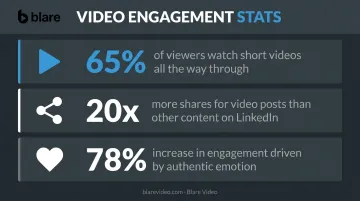
Video holds attention longer than text. Vidyard's 2025 benchmark data shows 65% of viewers watch videos under one minute all the way through, compared to just 20% for videos over 20 minutes. A well-edited 90-second testimonial sits firmly in that high-completion zone.
That engagement advantage matters for two reasons:
- Recall: A prospect who watches a complete testimonial is far more likely to remember your value proposition when they enter a buying decision than someone who skimmed a paragraph.
- Reach: LinkedIn's 2025 analysis of 13,000 B2B videos found that video posts are shared 20x more than other content on the platform. Authentic emotion in brand-awareness video can increase engagement by 78%, extending a testimonial's shelf life well beyond its initial post date.
Benefit 4: They Directly Boost Conversion Rates
Video testimonials work especially well at the decision stage of the funnel — when a prospect already understands the product but needs one final reason to commit. Real customer results lower perceived risk in a way that product descriptions simply cannot.
The numbers are direct: 77% of people who watched a brand's testimonial video said it helped convince them to buy that product or service, according to Wyzowl. Combined with the 2 in 3 purchase-intent figure, this makes testimonial video one of the highest-leverage conversion tools at the bottom of the funnel.
KPIs typically impacted:
- Conversion rate on landing pages and product pages
- Cost per acquisition
- Sales cycle length
- Close rate in sales-assisted deals
Placing a testimonial at the right funnel stage — in a follow-up email, on a pricing page, or in a sales deck — adds third-party validation exactly when a prospect is weighing their options.
Benefit 5: They're Highly Shareable and Easy to Repurpose
A single testimonial shoot produces an entire content library.
One professionally produced testimonial can be cut into:
- Full-length version (2–3 minutes) for the website or sales deck
- 30-second clip for LinkedIn or YouTube pre-roll
- 15-second snippet for Instagram or paid social
- Quote pull for email campaigns or proposal documents
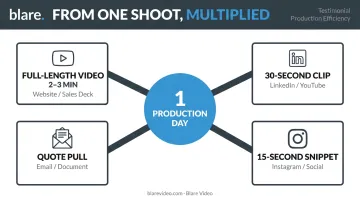
Blare Video's standard testimonial workflow, for example, delivers one main version plus two social media cut-downs — horizontal, square, and vertical formats — from a single production day. That multi-format output multiplies the return on one production investment across every channel in the marketing mix.
Video is also the most shared content format on social media, and testimonials with genuine emotional narrative tend to earn that sharing without paid amplification.
Benefit 6: They Deliver Complex Information Efficiently
A 90-second testimonial communicates a customer's challenge, solution, and measurable results in less time than most people spend reading a product description. For busy buyers, that efficiency matters.
Wyzowl's research reinforces this:
- 47% say testimonial videos are effective because they help visualize how a product or service actually works
- 39% say they work because they illustrate the real-world impact on someone's life
The shorter the time-to-value, the more of your audience will actually consume the content. In B2B markets where decision-makers are time-constrained, that difference in completion rate directly affects how often your message lands.
Benefit 7: They're Mobile-Friendly and Meet Buyers Where They Are
B2B buyers don't just research at their desks. BCG and Google's research found that 80% of B2B buyers use mobile at work, with more than 60% reporting mobile played a significant role in a recent purchase decision.
Video is far easier to consume on a phone than long-form text — a testimonial that auto-plays on LinkedIn during a commute reaches buyers in moments a whitepaper never will. One practical addition worth noting: captions.

Facebook's internal testing found that captioned video ads increased view time by an average of 12% — a meaningful lift in muted autoplay environments where sound is off by default. Captioned testimonials ensure the message lands regardless of context.
Benefit 8: They Provide Measurable, Actionable Analytics
Unlike a printed case study or a written review, video generates data. Key metrics include:
| Metric | What It Tells You |
|---|---|
| Play rate | How compelling your thumbnail and placement are |
| Watch time / completion rate | Whether the story holds attention |
| Drop-off points | Where the narrative loses viewers |
| Click-through rate | Whether the testimonial drives action |
Wistia's 2026 State of Video Report, based on 900+ marketing professionals, found social engagement is now the top success metric for nearly one quarter of marketers tracking video performance. That shift reflects growing sophistication in how businesses evaluate video ROI.
Businesses that track these metrics can refine which testimonials appear at which funnel stages, improving performance over time rather than guessing.
What Happens When Video Testimonials Are Missing
Without video testimonials, a brand relies entirely on its own voice to build credibility. For buyers who need outside proof before committing, that's rarely enough.
G2's 2024 survey of nearly 2,000 B2B decision-makers found that 80% use customer testimonials at the beginning of the buying process and 78% return to them at the end when selecting between finalists. Testimonials aren't just a nice-to-have — they're consulted at every stage.
The competitive risk is concrete. When a prospect visits a competitor's site and sees a library of customer stories on video, then visits yours with only text quotes, the gap in perceived trustworthiness is immediate, even if your product is equal or better.
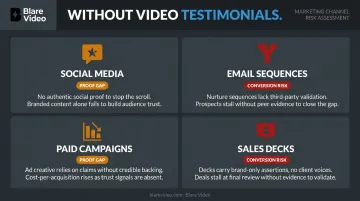
Businesses without a testimonial library also pay a hidden content tax. Without customer stories to repurpose, teams produce more original content to fill social, email, and paid channels, driving up costs across every marketing function:
- Social media posts lack authentic proof points
- Email sequences lose a persuasive mid-funnel asset
- Paid campaigns miss the social proof that lifts conversion rates
- Sales decks rely solely on brand-generated claims
How to Get the Most Value from Video Testimonials
Production quality matters. Poor audio, inadequate lighting, or a stiff on-camera performance pulls attention away from the story — and viewers notice that immediately.
A few principles that separate high-performing testimonials from forgettable ones:
- Choose subjects who achieved real results and can speak naturally on camera — not just satisfied customers, but ones with a story worth telling
- Skip the script; coached conversation almost always outperforms prepared talking points, even with confident executives
- Shoot on location in the customer's actual environment to add visual context and make participation easier
- Decide distribution before the shoot — knowing which clips go to LinkedIn, the homepage, or a sales sequence ensures every production minute has a purpose
These principles inform how Blare Video approaches testimonial production. From pre-production planning and subject coaching through on-location shoots and multi-format delivery, each step is designed to produce content that performs — whether it's anchoring a homepage, running in a sales sequence, or reaching new audiences on LinkedIn. Clients like Google, TikTok, and Moss Adams have trusted that process for exactly that reason.
Frequently Asked Questions
What is a video testimonial?
A video testimonial is a short recorded video in which a real customer shares their experience with a product or service — typically covering the problem they faced, why they chose the solution, and the results they achieved. Seeing a real person speak on camera gives it a credibility that written reviews rarely match.
What are the benefits of using testimonials?
Testimonials build trust, provide third-party social proof, reduce buyer hesitation, and improve conversion rates. Video testimonials amplify all of these effects — the impact of watching a real customer tell their story on camera is something a text quote simply can't replicate.
Why are video testimonials important?
They convey authenticity that text cannot. Facial expressions, tone of voice, and body language let viewers judge sincerity for themselves — which matters most to buyers in evaluation mode. That's why Wyzowl found 9 out of 10 people trust what a customer says over what a brand says.
Do I need permission to use customer testimonials?
Yes. Always obtain explicit written consent from customers before recording, publishing, or distributing testimonial videos. Make sure consent covers how, where, and how long the content will be used.
Do 72% of customers trust a business more after seeing positive reviews?
This figure circulates widely but its original source is unverified. The stronger documented evidence comes from Wyzowl: 9 out of 10 people trust what a customer says about a business more than what the business says about itself — and that trust effect is more pronounced with video, where visual authenticity adds a layer of credibility that text cannot.