Introduction
Remote audiences have never been more demanding — or easier to lose. A single audio dropout, a pixelated feed, or a stream that buffers mid-keynote can erase the credibility your organization spent months building for an event.
The stakes are measurable. According to Bizzabo's 2025 benchmark of 1,558 B2B event organizers and attendees, 73% of attendees now expect modern event technology — up from 63% just two years prior.
That number matters even more when you factor in reach: PCMA reports that 30% of any given event audience prefers to watch on-demand, meaning your stream isn't a supplement to the event. For a significant portion of your audience, it is the event.
Yet most organizations cobble together live streaming from three or four separate vendors: an AV company handles the room, a streaming platform handles distribution, and a freelance editor handles post-production. When something fails, everyone points at someone else — and no single partner owns the outcome. This article breaks down what an end-to-end approach looks like in practice, where fragmented setups fail, and what to demand from a production partner.
Key Takeaways
- 73% of B2B attendees now expect modern event technology, and live streaming quality standards have risen to match
- End-to-end solutions cover every phase under one team: pre-production through post-event delivery
- Fragmented vendor setups create handoff gaps where most live stream failures originate
- Audio quality, redundant connectivity, and multi-camera production are the three biggest levers on viewer experience
- Post-event video content extends your ROI well after the stream ends
What "End-to-End Event Solution" Means for Live Streaming
An end-to-end solution isn't a bundle of services — it's a single, coordinated production strategy that follows your event from initial planning to final content delivery, with one accountable team managing the entire lifecycle.
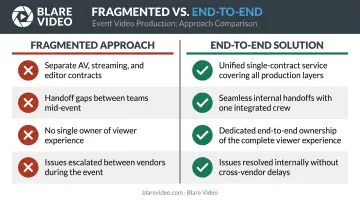
Here's how the two approaches compare:
| Fragmented Approach | End-to-End Solution |
|---|---|
| AV vendor, streaming platform, editor — separate contracts | Single production team owns every layer |
| Handoff gaps between teams | Continuous accountability across phases |
| No one responsible for the viewer experience | One technical director owns the broadcast signal |
| Issues escalated between vendors mid-event | On-site team troubleshoots in real time |
Where Fragmented Setups Break Down
The handoff between vendors is where most live stream failures begin. The AV company rigs the room for the physical audience. The streaming team takes whatever signal they receive and pushes it out. If those two don't communicate beforehand — about audio routing, graphic overlays, or camera framing for remote viewers — the remote audience experiences a degraded version of the event.
Who Benefits Most
End-to-end production approaches make the biggest difference for:
- Corporate conferences and annual meetings with remote stakeholders
- Association events (medical, legal, financial) with distributed memberships
- Product launches where brand perception is tied directly to production quality
- Hybrid events where in-room and remote audiences must be managed simultaneously
- Award ceremonies requiring dynamic coverage and real-time graphics
Blare Video has worked across all of these formats — corporate events for Google and TikTok, association conferences for the American Association of Endodontists — where remote audiences expect the same production standard as the room.
The Core Stages of a Seamless Live Streaming Event Solution
Pre-Production Planning
Everything that goes wrong on event day was usually predictable the week before.
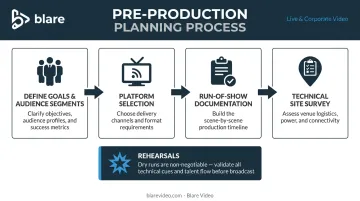
Pre-production for a live stream isn't just scheduling cameras — it requires:
- Defining goals and audience segments: Who is watching live versus on-demand? What do they need to experience?
- Platform selection: YouTube Live, Vimeo, enterprise platforms, or custom embeds each have different encoder requirements and latency profiles
- Run-of-show documentation: A detailed minute-by-minute production schedule that every crew member references during the broadcast
- Technical site surveys: Assessing venue power, network infrastructure, signal paths, and physical camera positions before equipment arrives
Rehearsals are non-negotiable. Testing audio levels, running camera transitions, and briefing presenters on live-format delivery all catch problems before they go on-air. Skipping this step is the single most common cause of avoidable day-of failures.
Blare Video builds this in by default: the team runs full setup and testing the day before to surface connectivity and audio routing issues while there's still time to fix them.
Event Day Production
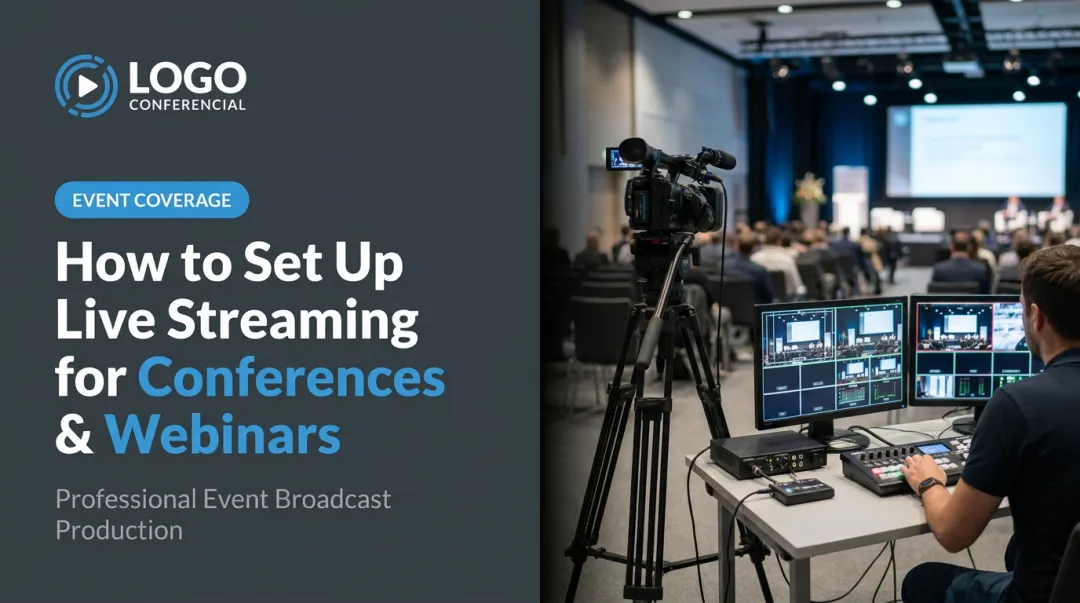
The broadcast layer requires dedicated specialists, not generalists covering multiple roles:
- Multi-camera operators positioned for both the in-room and remote viewer experience
- Live switcher/technical director managing real-time cuts between cameras, slides, and graphics
- Dedicated audio operator running a separate mix for the stream (not just feeding the house PA)
- Lighting adjusted for broadcast — not just for the physical room
Blare Video deploys Tricaster switching systems with HD and Ultra HD cameras for live events, managed by on-site technical directors who handle the complete signal chain from capture to stream output. This integration between camera, switcher, and stream is what makes real-time problem-solving possible.
Real-Time Technical Delivery
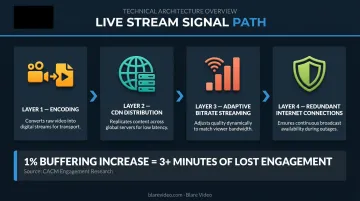
The signal path from camera to viewer involves several technical layers that must work together:
- Encoding — converting the live camera feed into a compressed, streamable format
- CDN distribution — routing the stream through distributed servers to reduce latency for global audiences
- Adaptive bitrate streaming (ABR) — automatically adjusting video quality based on each viewer's network conditions so viewers with slower connections don't experience complete dropouts
- Redundant internet connections — bonded cellular, dedicated wired lines, or satellite as failover
Research from CACM analyzing over 2 million video viewing sessions found that a 1% increase in buffering ratio can reduce viewer engagement by more than 3 minutes during a 90-minute live event. A production team that understands encoder settings and CDN behavior catches buffering issues before they reach viewers.
Post-Event Delivery
Most organizations treat post-event content as an afterthought — which is where ROI often gets left on the table.
82% of event organizers create VOD content from events, per Bizzabo's 2025 benchmark, yet 70% report difficulty demonstrating event ROI. Post-event deliverables are often the most direct way to close that gap.
A full end-to-end solution includes:
- Clean master recording files from the live broadcast
- Edited highlight reels and recap videos
- On-demand uploads to appropriate platforms
- Social media cuts formatted for distribution
- Archival storage of raw footage
Blare Video builds post-production into every event engagement, including highlight and sizzle videos that clients use for sponsorship reporting, future event promotion, and internal communications.
Why Production Quality Is the Heart of Your Live Stream
The streaming platform is just a pipe. What fills that pipe determines whether remote audiences stay engaged or close the tab.
Audio: The Non-Negotiable
Poor audio damages viewer retention more directly than any other production variable. NTIA's 2024 analysis of nearly 2,600 real-world conference audio clips found that unintelligible speech reduces learning, engagement, and comprehension — leading to wasted time and disengagement that's difficult to recover from mid-event.
Professional audio for live streaming requires:
- External microphones (not camera-mounted)
- Dedicated audio mix for the stream, separate from the house PA
- Audio technicians monitoring levels throughout the broadcast
- Pre-event testing of every audio input path
When the AV vendor and streaming vendor are separate, audio routing is often where the handoff breaks. A unified team owns the signal from the microphone through to the final stream output.
Multi-Camera Production and Live Switching
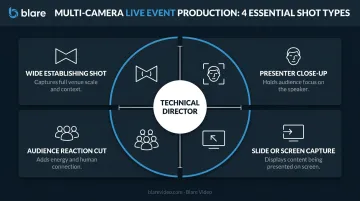
A single static camera cannot sustain remote audience attention across a 2-hour conference session. Dynamic production — cutting between presenter wide shots, slide content, audience reactions, and presenter close-ups — requires an experienced technical director making real-time decisions.
Blare Video's live event setups typically include multiple HD/Ultra HD cameras managed through Tricaster switching equipment, with the TD coordinating camera operators and managing transitions in real time. That real-time direction is what keeps remote viewers watching instead of multitasking.
A well-run multi-camera production typically involves:
- Wide establishing shots for context and room energy
- Tight presenter close-ups during key moments
- Slide or screen capture feeds synced to speaker content
- Audience reaction cuts to reinforce live atmosphere
Production Quality as Brand Signal
For corporate clients — technology companies, healthcare organizations, financial services firms — the quality of a live stream is a direct reflection of organizational credibility. A pixelated feed or dropped audio during a keynote doesn't just frustrate remote viewers; it shapes their perception of the brand behind the event.
PCMA's Forrester Consulting research of 200 North American decision-makers found that 67% struggled to bring brand stories to life in digital or hybrid events, and more than half agreed that poor event delivery results in increased costs, missed opportunities, and poor customer experience.
Common Live Streaming Failures and How End-to-End Solutions Prevent Them
Audio Failure
The most frequently cited live streaming problem. Fragmented vendor setups create audio handoff gaps — the AV team controls the room, the streaming team receives whatever signal is routed to them, and no one owns the end-to-end audio chain. A unified production team eliminates this by managing audio from microphone placement through encoder output.
Bandwidth and Connectivity Failures
Venue Wi-Fi is shared infrastructure. Every attendee device, exhibitor laptop, and building system competes for the same bandwidth. Encore's hybrid event guidance explicitly warns against relying on venue Wi-Fi for live broadcast, recommending dedicated wired connections and VLAN-isolated networks as the baseline.
Blare Video addresses this directly by bringing bonded cellular connections and satellite options to every event. The result: a single point of failure — a cut cable, a saturated network — doesn't take down the entire stream.
On-Site vs. Remote Audience Disconnect
When the in-room production isn't designed with remote viewers in mind, the issues are immediate: presenters facing away from cameras, slides that are illegible at stream resolution, no graphics providing context for remote audiences. PCMA's guidance treats hybrid events as two distinct productions — an in-person event and a digital event — each requiring its own production design.
End-to-end planning builds both audience experiences into the production design simultaneously — camera positioning, graphics overlays, and presenter blocking are decided together, not retrofitted after the in-room setup is locked.
Missing Post-Event Content
Many organizations lose the long-tail value of their live stream by failing to plan for recording quality and content repurposing. If post-production isn't built into the original event plan, the raw footage is often unusable or the deliverables never materialize. Defining deliverables upfront — edited highlight reels, session recordings, repurposed clips for social — means the production team captures with those outputs in mind, not as a cleanup task after the fact.
What to Look for in a Full-Service Live Event Production Partner
Not every video production company that offers "live streaming" delivers end-to-end event solutions. Here's what actually matters:
Core capabilities to verify:
- Pre-production consultation and technical site surveys
- Professional broadcast camera systems with live switching
- Dedicated audio operators (not cameras with built-in mics)
- Experienced technical directors with live broadcast backgrounds
- Post-production deliverables included in the scope
For organizations that hold events in multiple cities, geographic reach directly affects production consistency. A partner with established crews across markets — rather than local vendors hired city by city — ensures the same standards regardless of where the event is held.
Blare Video covers 23 US markets, including New York, Chicago, Los Angeles, Atlanta, Miami, Dallas, Seattle, and San Francisco. Clients managing multi-city event programs work with one production partner rather than coordinating separate vendors in each market.
Portfolio red flags to watch for:
- Only highlight clips, no evidence of full event coverage
- No recognizable corporate or association clients
- No mention of technical crew roles (TD, audio engineer)
- Streaming listed as an add-on rather than integrated capability
The right partner integrates live streaming into the production plan from the first site survey — not as an afterthought once the run-of-show is already locked.
Frequently Asked Questions
What is end-to-end event management?
End-to-end event management means overseeing every phase — planning, logistics, live production, and post-event follow-up — under a single coordinated strategy where one team owns the outcome rather than handing off between separate vendors.
What are the stages of event management?
The three core stages are pre-event planning (objectives, logistics, vendor coordination, technical preparation), event execution (on-site management and live production), and post-event wrap-up (recordings, content delivery, reporting, and stakeholder follow-up). Live streaming events add a fourth layer: real-time technical delivery management during the broadcast itself.
What are the 5 C's of event management?
The 5 C's are Concept (defining the event's purpose and format), Coordination (aligning all vendors, logistics, and timelines), Control (managing execution against the plan), Culmination (the live event itself), and Closeout (post-event reporting, content delivery, and evaluation).
What are the 5 P's of event management?
The 5 P's are Purpose (the event's core objective), People (audience, speakers, crew), Place (venue and platform selection), Process (the production workflow), and Promotion (how the event reaches its intended audience).
What equipment is needed for professional live event streaming?
The essentials: broadcast-quality cameras, professional external microphones with dedicated audio mixing, broadcast lighting adjusted for camera exposure, a hardware or software encoder, redundant internet connections (bonded cellular plus wired), and an experienced technical director managing the live signal. Consumer equipment in any one category will compromise the entire output.
What is the difference between a live streaming platform and a live event production company?
A streaming platform (YouTube Live, Vimeo, LinkedIn Live) distributes your video signal to viewers — it's the delivery infrastructure. A live event production company supplies the crew, cameras, audio systems, and technical expertise to produce a broadcast-quality signal in the first place. A full-service partner coordinates both so neither operates in isolation.