Introduction
Audiences today scroll past hundreds of ads before breakfast. While exact daily ad exposure figures are debated — estimates range widely, and The Drum's 2023 review found weak evidence for the commonly cited 10,000-per-day claim — the attention scarcity is real. Traditional interruption advertising is losing ground.
Branded video has become the default response. According to Wyzowl's 2026 survey, 63% of consumers prefer watching a short video to learn about a product or service, and 91% of businesses now use video as a marketing tool. At this point, video isn't optional — it's the medium audiences expect.
The challenge isn't whether to produce branded video — it's producing it well. This guide breaks down what branded video content production actually involves, which formats earn audience attention, and how the production process works from concept through final delivery.
Key Takeaways
- Branded video content tells a brand's story rather than directly selling a product
- It builds emotional connection, trust, and long-term loyalty with target audiences
- Common formats include brand films, explainer videos, testimonial videos, and social media shorts
- Production spans three core phases: pre-production, production, and post-production
- Repurposing one long-form video across multiple channels multiplies its marketing reach and ROI
What Is Branded Video Content Production?
Branded video content production is the process of creating videos that communicate a brand's values, identity, mission, or story — with emotional resonance as the primary goal, not an immediate sale.
The distinction from traditional advertising matters. A conventional ad interrupts to pitch. Branded video content earns attention by entertaining, educating, or inspiring. The product may barely appear on screen, and that's intentional.
What Does "Branded Content" Actually Look Like?
Consider a few concrete examples:
- A cookware brand publishing weekly recipe tutorials
- An outdoor gear company funding a short adventure documentary
- A productivity app producing a series featuring successful entrepreneurs
None of these formats lead with a sales pitch. All of them carry the brand's identity in every frame.
The Content Marketing Institute defines branded content as a tactic that encourages audiences to engage with a brand through entertainment, information, or educational value — rather than direct promotion. Red Bull's Stratos space jump broadcast is a textbook case: millions of viewers watched a man leap from the stratosphere, and the product was barely mentioned. The brand association — adventure, performance, the extreme — did the work.
The "Customer as Hero" Framework
Effective branded video doesn't position the brand as the protagonist. It places the audience at the center. The brand plays the enabler role, showing viewers how it fits into their lives rather than demanding their attention. That shift in perspective is what makes branded content feel earned rather than forced.
Who Produces It?
Once the strategic frame is clear, execution falls to a branded content producer, who manages the full creative pipeline: defining messaging, scripting, directing shoots, and overseeing post-production. That role typically lives in-house, within an agency, or with a full-service production company. Blare Video, for instance, operates as a concept-to-delivery partner, which keeps brand voice consistent from the first planning call through final cut.
Why Branded Video Production Matters for Your Brand
The business case for branded video is well-documented, and the numbers cover multiple dimensions.
Adoption and Consumer Behavior
- 91% of businesses use video as a marketing tool (Wyzowl, 2025)
- 85% of consumers say a video convinced them to buy a product or service
- 96% have watched an explainer video to learn about a product
- 89% say video quality directly affects their trust in a brand
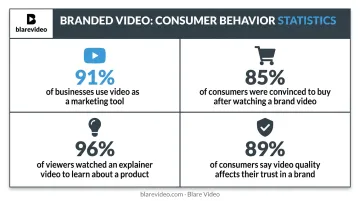
Production quality isn't vanity. To nearly nine in ten viewers, it's a direct signal of whether your brand is worth trusting.
Trust and Brand Lift
Branded video humanizes companies in ways static content cannot. Nielsen's branded content research found that branded content can improve awareness by 10 percentage points and produces 81% aided recall among exposed audiences, compared to 63% among those not exposed.
Edelman's 2025 Trust Barometer found 73% of people say brand trust increases when a brand authentically reflects current culture — exactly what story-driven video does well.
That trust has to be earned repeatedly — and a single well-produced video can keep earning it long after launch.
Evergreen and Multi-Channel Value
A campaign ad has a shelf life. A well-produced branded video does not. It can:
- Live on your website indefinitely and drive organic search traffic
- Appear in email campaigns as a thumbnail link
- Be repurposed into social media clips over months or years
- Support retargeting ad campaigns without additional production spend
82% of video marketers report that video increased web traffic and kept visitors on-site longer, improving both audience engagement and search visibility in a single asset.
Types of Branded Video Content
No single format works for every objective. The right choice depends on where your audience is in the buying journey and what you want them to feel or do next.
Brand Films
Brand films are cinematic, emotionally resonant, and built around a company's mission, values, or origin story. They prioritize feeling over function. Dove's Real Beauty Sketches accumulated 163 million YouTube views and 4 million shares — not because it sold soap, but because it made viewers feel something genuine.
These are the most shareable format and tend to generate lasting brand affinity rather than immediate conversions.
Product Explainer and Demo Videos
Explainer videos are short, problem/solution-focused, and work well at the awareness stage. Given that 96% of people have watched one to learn about a product, they're the most reliably useful format in the branded video toolkit.
Demo videos go deeper — they show exactly how a product works for prospects who are already considering a purchase. Blare Video produced a product explainer for Ricoh across three unique versions, each tailored to a different audience segment within the same launch.
Customer Testimonial and Case Study Videos
Testimonials provide social proof through real customer voices. Case study videos go further — presenting a problem, the solution, and measurable results. Both formats are effective for B2B brands and high-consideration purchases.
Blare Video's work shows how this format scales across markets:
- Moss Adams — 20 filmed interviews across Seattle, Portland, Los Angeles, and San Francisco
- LeanData — candid event soundbites paired with in-depth client interviews in a dedicated quiet space adjacent to the main venue
Company Culture and Behind-the-Scenes Videos
Culture videos show the real people behind a brand. They're essential for:
- B2B relationships where trust drives vendor selection
- Talent acquisition (candidates research culture before applying)
- Industries like healthcare, finance, and nonprofits where values alignment matters
Blare Video's employee video for Williams-Sonoma, filmed at their Las Vegas call center, is a clean example — straightforward, human, and brand-consistent without being promotional.
Branded Social Shorts
Short-form content for TikTok, Instagram Reels, and YouTube Shorts requires a different production mindset. The brand message needs to land in the first two or three seconds. TikTok data shows that ads which pique curiosity keep viewers watching 1.4x longer, and a Meta analysis of 63 brand-lift studies found Reels ads delivered 24% higher median brand lift than standard campaigns.
Platform-native content should feel organic to the feed while still carrying consistent brand identity — not a repurposed 30-second TV spot squeezed into a vertical frame.
The Branded Video Production Process: From Concept to Delivery
Pre-Production
Pre-production is where the creative and logistical foundation gets built. For a branded video, this typically includes:
- Goal setting : awareness, lead generation, brand loyalty, or a specific conversion action
- Audience definition : who the video is for and what emotional response it should trigger
- Creative concept development : the story, tone, and visual approach
- Scriptwriting and storyboarding : turning the concept into a shootable plan
- Location scouting, permitting, and casting : locking the physical and human elements
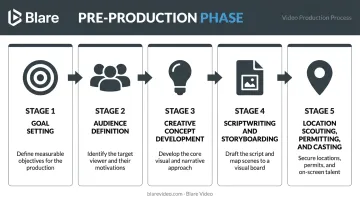
Blare Video's pre-production scope also includes music scoring and licensing — details that most brands underestimate but that directly shape final tone and clearance timelines.
This phase is the single biggest predictor of production success. Problems caught on set can cost five to ten times more to fix than those caught in pre-production. Once pre-production is locked, the shoot moves faster and with far fewer surprises.
Production
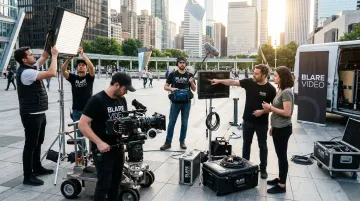
The shoot itself involves professional crew — directors, cinematographers, audio technicians — and equipment calibrated to the brand's visual standards. Blare Video shoots in 4K–8K resolution using Red and Sony cinema cameras, with aerial drone capability for locations that call for it.
Key production elements that affect brand output include:
- Crew composition — director, DP, and audio tech working to the same visual brief
- Camera resolution — 4K–8K capture preserves quality through heavy post-production
- Lighting setup — controlled environments vs. natural light, matched to brand tone
- Audio capture — lavalier and boom coverage, critical for interview and testimonial work
- Drone coverage — aerial establishing shots for industrial, real estate, and event productions
Production quality has a direct credibility effect: 89% of consumers say video quality affects their trust in a brand. A poorly lit interview or muddy audio signals to viewers that the brand cuts corners — regardless of what the script says.
Post-Production and Distribution Prep
Post-production turns raw footage into a finished brand asset through:
- Editing — pacing, story structure, narrative arc
- Color grading — visual consistency and emotional tone
- Sound mixing and music licensing — often underweighted, always noticed
- Motion graphics and titles — brand-consistent text treatment
- Platform formatting — aspect ratio versions (16:9, 9:16, 1:1), caption files, and delivery specs
Blare Video uses Wipster for client review, allowing frame-specific comments directly on the timeline — a practical step that reduces revision cycles and keeps projects on schedule.
How to Integrate Branded Video Into Your Marketing Strategy
Repurpose From the Start
Wistia's research found that one repurposed webinar generated 800,000+ views and 1,500+ hours of watch time — 8.5x the result of the original live event. Over half of companies now repurpose video into social clips by default.
Plan your production for derivative assets before the shoot begins. A 4-minute brand film can yield:
- A 60-second social cut
- Three 15-second quote clips
- A landing page embed
- An email campaign thumbnail
Match Format to Funnel Stage
| Funnel Stage | Best-Fit Formats |
|---|---|
| Awareness | Brand films, social shorts |
| Consideration | Explainer videos, case studies |
| Decision | Testimonials, product demos |
Measure What Matters
Track metrics aligned to your actual objective — not just view counts:
- Awareness: View count, watch time, brand recall lift
- Interest: Engagement rate, click-through rate
- Action: Conversion rate, lead attribution
HubSpot's 2026 data ranks short-form video as the #1 ROI-driving content format reported by marketers, with long-form video ranking second. Tying metrics to funnel stage from the start keeps your team focused on outcomes — not just production deliverables.
What to Look for in a Branded Video Production Partner
Not every production company is built for branded content. Any crew can show up with cameras. What's harder to find is a partner who understands your audience, your objectives, and how the finished video fits into a broader marketing strategy.
Criteria worth evaluating:
- Portfolio spans multiple formats, not a single specialty
- Experience in your sector and with your type of audience
- Full-service capability from concept through post-production
- Geographic coverage if you're running multi-city or regional campaigns
- Discovery process that starts with your goals, not their gear
Industry research consistently shows that poor video quality can damage brand perception — which means choosing the wrong partner carries real brand risk, not just budget risk.
Blare Video operates across 20+ US markets — including Los Angeles, New York, Chicago, Miami, and Dallas — with vetted crews in each location. For brands running multi-city campaigns, that consistency across shoots (same visual standards, same tonal approach) is difficult to maintain without a partner who has local presence everywhere you're filming. Their client roster includes Google, Taco Bell, TikTok, and Williams-Sonoma, reflecting experience across both consumer and B2B branded content.
Frequently Asked Questions
What is a branded content video?
A branded content video is produced or sponsored by a brand to communicate its values, identity, or story — rather than directly advertising a product. The goal is emotional connection and brand loyalty, not an immediate transaction.
What is a branded content producer?
A branded content producer oversees the full creative and production process, from concept development and scripting through directing the shoot and post-production delivery. They can be in-house, agency-side, or part of a full-service production company like Blare Video.
How is branded video different from traditional advertising?
Traditional ads interrupt viewers to push a product. Branded video earns attention through storytelling, education, or entertainment — building trust gradually rather than pushing for an immediate conversion.
How long does branded video production take?
Timelines vary by complexity. A social media short can turn around in a few days; a brand film or mini-documentary typically takes several weeks from concept through final delivery. Pre-production is usually the most time-intensive phase — Blare Video's post-production runs 2–3 weeks for a first client cut on standard projects.
What makes a branded video successful?
Successful branded video hits on a few fronts: it speaks directly to a specific audience's values, it reflects the brand's actual identity rather than just a polished surface, and it has a clear distribution plan so the right viewers actually see it. Production quality matters too — 89% of consumers say it affects their trust in a brand.