Introduction
Every scroll through a social feed is a battle for three seconds of attention. Audiences have seen every trick — the dramatic voiceover, the drone shot, the inspirational swell. Most of it blurs together into forgettable noise.
Creative decisions — not camera equipment — determine whether a video sticks.
According to Wyzowl's 2026 video marketing research, 93% of video marketers say video helped increase brand awareness — and yet most brand videos still fail to leave any lasting impression. The gap between "we made a video" and "we made something people remember" comes down to creative decisions, not camera equipment.
This article covers what a brand video actually is, the five most important types, and eight real-world examples that show what great brand storytelling looks like in practice.
Key Takeaways
- A brand video communicates who a company is and what it values — not what it sells
- 93% of marketers report strong ROI from video, but only authentic storytelling consistently drives brand trust
- Five key formats serve different objectives: brand anthem, explainer, testimonial, culture, and narrative
- The best examples (Nike, Dove, Volvo, Google) share one thing: clarity of message backed by genuine creative conviction
- Identify the one story only your brand can tell, then build your format and execution outward from that core
What Is a Brand Video (and Why It Matters in 2026)
A brand video is a short, high-impact piece that communicates a company's identity — its mission, values, and personality — to an audience that may not yet be ready to buy anything. That makes it fundamentally different from a product demo or feature walkthrough.
A product demo answers "what does this do?" A brand video answers something harder: "why does this company exist, and do I believe them?"
Why the Format Has Real Pull Right Now
HubSpot's 2024 Consumer Trends Report found that 63% of consumers say marketing videos should be authentic rather than polished. That's a significant shift. Audiences aren't asking for bigger budgets — they're asking for honesty.
Meanwhile, 54% of consumers actively want more video content from the brands they follow. Demand exists. The question is whether brands can deliver something worth watching — and where they plan to put it.
Where Brand Videos Live
Brand videos are unusually versatile assets. A single well-produced piece can appear across:
- Website homepages and About pages
- Social media (organic and paid)
- Pitch decks and investor presentations
- Recruitment pages and job listings
- Email campaigns and trade show displays
That cross-channel reach means a single well-executed video can serve a marketing team for months across a dozen different touchpoints.
Types of Brand Videos to Consider
Different video types serve different goals — awareness, trust, conversion, recruitment. Knowing which format you need before production starts saves time, budget, and creative energy.
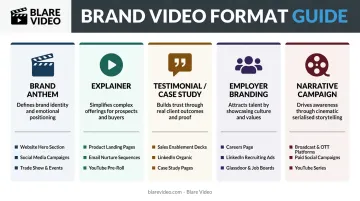
Brand Story / Brand Anthem Video
This is the origin story format: visually rich, emotionally driven storytelling that answers who the brand is and what it believes. Brand anthems work best on homepages, keynote presentations, and major campaign launches. The goal isn't conversion — it's building the kind of emotional connection that makes everything else easier to sell.
Explainer Video
Explainer videos simplify complex products, services, or concepts through animation or talking-head formats. They're built for audiences early in the buyer journey who need to understand what you do before they can consider buying it. Software companies and healthcare organizations lean heavily on this format.
Customer Testimonial / Case Study Video
Real customers talking about real results. The key word is real — scripted testimonials read as scripted. The most effective versions feel like conversations, not performances. Blare Video's approach to testimonial production avoids teleprompters entirely, with a director coaching subjects to speak naturally rather than recite approved language. That distinction shows up in viewer trust and watch time.
Culture & Employer Branding Video
These videos show the people, environment, and values behind a brand — used primarily to attract talent and humanize the organization. Blare Video produced an employer branding video for Williams-Sonoma that featured over 30 employees sharing how joining the company had changed their lives. No script, no corporate talking points — just employees speaking honestly about their work.
Narrative / Emotional Campaign Video
Narrative brand videos follow a story arc — exposition, conflict, resolution — built around a universal theme like ambition, belonging, or perseverance. The product rarely appears front and center. They tend to be the most shareable format precisely because emotional responses drive sharing behavior — people forward what they feel, not what they're sold.
Quick reference — where each format fits best:
- Brand Anthem: Homepage hero, keynote opener, major campaign launch
- Explainer: Product pages, sales decks, early-funnel landing pages
- Testimonial / Case Study: Sales enablement, proposals, review pages
- Employer Branding: Careers page, LinkedIn, job fair materials
- Narrative Campaign: Social media, paid video ads, PR moments
8 Creative Brand Video Examples for 2026
These examples were selected for creative execution, emotional clarity, and the specific lesson each one teaches about brand storytelling — across different industries, budgets, and video types.
| Brand | Year | Video Type | Core Lesson |
|---|---|---|---|
| Nike | 2021 | Brand film | Challenge your own narrative |
| Apple | 2020 | Comedy short | Show product value, don't explain it |
| Dove | 2021 | Social impact | Genuine values outperform positioning |
| 2010 | Product story | The product can be the storytelling device | |
| Lego | 2019 | Brand film | Sell the feeling, not the object |
| Airbnb | 2023 | Animated ad | Concept clarity beats production budget |
| Old Spice | 2010 | Humor/reposition | Self-awareness accelerates brand reappraisal |
| Volvo Trucks | 2013 | Product demo | One specific claim, shown unforgettably |
Nike — "Play New" (2021)
Nike showed professional athletes, including musician Rosalía, attempting sports they'd never tried before, failing comically, and enjoying it anyway. Created with Wieden+Kennedy, the campaign was a deliberate departure from Nike's traditional winning-focused messaging.
What makes it work: Nike's audience isn't mostly elite athletes. It's everyday people who feel intimidated by sports culture. By leaning into vulnerability and humor, Nike spoke directly to that real audience rather than its aspirational persona. Sometimes the strongest move is going against your own established narrative.
Apple — "The Whole Working-from-Home Thing" (2020)
Apple's "Underdogs" characters returned for a pandemic-era sequel, navigating remote work chaos: missed connections, chaotic video calls, impossible deadlines, all while using Apple products throughout. The film runs like a short comedy, not an ad.
What makes it work: Product features are shown, not explained. Viewers discover the value of Apple tools through what the characters actually do with them. There's no feature list, no voiceover selling anything. The product is woven into the story so naturally that the selling happens without you noticing.
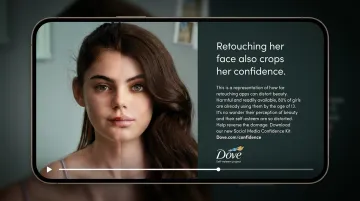
Dove — "Reverse Selfie" (2021)
Part of Dove's Self-Esteem Project, this video rewinds a teenage girl's social media photo transformation back to her natural face, reversing the filters, the editing, and the careful staging in reverse chronological order. Launched in April 2021, it addressed digital distortion and its effect on young people's self-image.
Why it landed: According to One Show award records, the campaign generated 6 billion earned media impressions and reached 66 million TikTok users. Those numbers reflect something real: Dove's commitment to its values isn't just marketing positioning.
It's the actual product of a brand that consistently acts on what it says it believes. Values-driven storytelling only works when the values are genuine.
Google — "Parisian Love" (2010)
A complete love story told through nothing but Google Search queries. No characters on screen. No dialogue. Just a series of search terms, results, and map directions that trace a relationship from studying abroad in Paris to raising a child together. It aired during the 2010 Super Bowl and ranked among the top-performing spots by multiple online buzz measures that year.
What makes it work: The product is the storytelling device. Google didn't hire actors or build sets. They used their actual product to tell a human story, showing what it does and making you feel something at the same time. Production complexity doesn't determine impact.
Lego — "Rebuild The World" (2019)
Lego's first major brand campaign in 30 years, developed with BETC Paris and launched in September 2019, combined animation and live-action to celebrate creativity and imagination. The campaign involved musician Mark Ronson and carried a single central message: anything is possible when you approach the world with a builder's mindset.
The lesson: Lego almost entirely de-emphasizes the product itself. What they're actually selling is a feeling: creative freedom and the confidence to imagine something new. The strongest brand videos sell an emotion, not a SKU.
Airbnb — "Get an Airbnb" (2023)
Airbnb's global animated campaign used simple, playful animation to contrast the constraints of hotel stays with the spacious, authentic experiences of Airbnb properties. It communicates the core value proposition clearly and memorably in under 60 seconds.
What makes it work: The minimalist animation style keeps all focus on the message. This is particularly instructive for brands with tighter budgets: high production value doesn't require live-action shoots. The right creative concept, executed with visual clarity, does the same job.
Old Spice — "The Man Your Man Could Smell Like" (2010)
Rapid-fire absurdist humor. A single take. A shirtless spokesperson moving through increasingly impossible scenes. Old Spice used the campaign to reposition an aging brand as bold, self-aware, and modern, targeting both men and their partners simultaneously.
The Effie case study records Old Spice Red Zone body wash sales rising 60% by May 2010 and 125% by July 2010, with the campaign earning a 2011 Gold Effie.
What makes it work: The video mocks its own legacy. Old Spice understood that its existing consumer persona was holding the brand back, so they made fun of it first. Humor, when it genuinely reflects brand identity, is one of the most effective tools for driving shares and brand reappraisal.
Volvo Trucks — "The Epic Split" (2013)
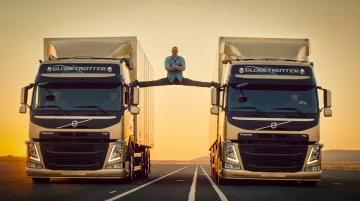
Jean-Claude Van Damme performs a slow split between two reversing Volvo trucks at dawn. That's the entire video. No voiceover. No feature list. No talking heads explaining why the steering is precise.
Volvo reported more than 73 million YouTube views, and the campaign won at Cannes Lions in 2014.
The takeaway: Volvo identified one specific product differentiator, steering precision, and built a visually unforgettable demonstration around it. The stunt is the proof point. Find the one thing your product does better than anyone else, then show it in the most dramatic way possible.
What Makes a Great Brand Video
The examples above are separated by decades, industries, and budgets. What they share is more interesting than their differences.
Start With a Single Objective
Before any creative conversation happens, a brand video needs a clear, singular purpose. Brand awareness, recruitment, customer trust, and lead generation all demand different creative approaches. A video that tries to accomplish everything typically accomplishes nothing.
Know Exactly Who You're Talking To
Generic messaging connects with no one. Nike's "Play New" worked because the team made a decision: this is for everyday people, not elite athletes. Dove's "Reverse Selfie" worked because it spoke directly to parents and young women dealing with specific pressures. Audience specificity is what makes the creative land. The narrower the target, the stronger the resonance.
Authenticity Over Polish
HubSpot's consumer data is clear: 63% of consumers prefer authentic over polished. Real people, genuine testimonials, and behind-the-scenes content consistently outperform glossy productions that feel manufactured. This doesn't mean low-quality — it means the storytelling has to feel honest.
Production Fundamentals That Separate Forgettable From Memorable
Even authentic stories need execution. The production choices that matter most:
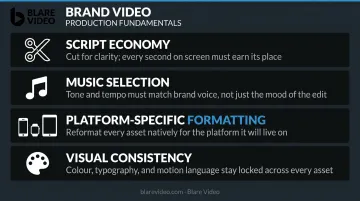
- Script economy — every second should earn its place. If a scene doesn't advance the story or reinforce the brand, cut it
- Music selection — music carries emotional weight that visuals alone can't
- Platform-specific formatting — square for Instagram, captioned for silent autoplay, vertical for Reels and TikTok, short-form cuts alongside the full hero version
- Visual consistency — color grading, typography, and motion style should feel intentional, not assembled from separate ideas
Blare Video builds these considerations into each production phase — from concept and script through shoot and post — so creative decisions made early don't get lost by the time the final cut is delivered.
Conclusion
Every brand video worth remembering starts with a truth — something the brand actually believes, expressed through a story worth watching. Budget and production value matter far less than emotional honesty. The brands that get it right — whether it's Google telling a love story through search queries or Volvo proving steering precision with a Van Damme split — start with what only their brand can honestly say, then build the creative around it.
If you're planning a brand video, start with your most important business objective and the one story only your company can tell. Everything else — format, platform, length, style — follows from that.
Blare Video works with brands across corporate, healthcare, retail, technology, and industrial sectors to develop brand videos from concept through final delivery. Production teams are based in Los Angeles, San Diego, Las Vegas, Phoenix, Tucson, and cities across the country — covering creative development, production, and platform-specific post-production under one roof.
Reach out to discuss what your brand's story could look like on screen.
Frequently Asked Questions
What is a branding video?
A branding video communicates a company's identity, mission, and values rather than promoting a specific product or service. Its primary goal is to build emotional connection and brand recognition — not to close a sale.
What is an employer branding video?
An employer branding video showcases a company's culture, people, and workplace experience to attract and retain talent. These are typically used on career pages, LinkedIn, and job listings to differentiate the organization as a place people actually want to work.
What is a narrative video?
A narrative video tells a story with a beginning, middle, and end — using characters, conflict, and resolution to engage viewers emotionally, often without explicitly selling a product or service.
What is a brand narrative?
A brand narrative is the overarching story a company tells about who it is, what it stands for, and why it exists. Brand videos are one of the most effective formats for bringing that narrative to life visually and emotionally.
How long should a brand video be?
It depends on platform and objective. Social media brand videos typically perform best under 60–90 seconds, while homepage hero videos or campaign anthems can run 2–3 minutes. Vidyard's research shows 65% of viewers watch business videos under 60 seconds to completion.
How much does a brand video cost?
Production costs vary significantly based on scope, crew size, shoot days, locations, talent, animation, and post-production complexity. According to Clutch's May 2026 pricing guide, most professional video production projects fall in the $10,000–$49,999 range, though budgets above and below that are both common.