Introduction: When Filmmaking Meets the Boardroom
Most corporate videos do their job. They inform, they brand, they check a box. Corporate documentaries do something harder — they make audiences feel something real about a company, its people, and its purpose.
The difference is measurable. According to Nielsen's 2021 branded content research, 72% of audiences felt featured talent fit the brand well — yet only about one-third found the content genuinely authentic. Companies are investing in the look of authenticity without earning it. Corporate documentary filmmaking, done well, is how you close that gap.
This article covers both sides of the discipline: the specific craft techniques that separate a compelling documentary from a polished but hollow brand film, and the ethical obligations that filmmakers and brands cannot afford to ignore.
Key Takeaways
- Corporate documentaries build emotional connection through real human narrative, not just promotion.
- Nielsen found branded content generates 86% average brand recall versus 65% for pre-roll ads, supporting story-led formats.
- Authentic unscripted interviews, observational B-roll, and honest story selection are the pillars of documentary credibility.
- Ethical obligations include meaningful informed consent, narrative fairness, and avoiding manufactured authenticity.
- Corporate documentaries are evergreen assets repurposed across full films, social cuts, internal use, and investor presentations.
Corporate Documentary vs. Standard Corporate Video
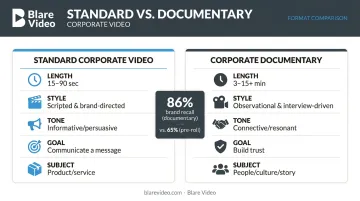
Standard corporate videos are built around a message. They're typically scripted, tightly timed (15–90 seconds), and optimized to communicate a specific point quickly. They're effective for that purpose — but they rarely move an audience emotionally, and they're not designed to.
Corporate documentaries work differently. They build narrative arcs around real human experiences: an employee's unlikely career path, a company's origin under pressure, a community changed by a product. The story carries the brand rather than the other way around.
Key Structural Differences
| Feature | Standard Corporate Video | Corporate Documentary |
|---|---|---|
| Length | 15–90 seconds | 3–15+ minutes |
| Approach | Scripted, brand-directed | Observational, interview-driven |
| Emotional register | Informative, persuasive | Connective, resonant |
| Primary goal | Communicate a message | Build trust and emotional investment |
| Subject | Product, service, brand | People, culture, story |
That difference in purpose shows up in results. Nielsen's 2016 research found branded content averaged 86% brand recall compared to 65% for pre-roll advertising — a gap that reflects what story-led formats do when emotional connection is the goal. The most effective brand programs use both formats: short-form for reach and message delivery, long-form documentary for depth and trust-building.
The Art: Craft Techniques That Elevate Corporate Stories
Dialogue and Interview Techniques
The interview is the core building block of any corporate documentary — and most interviews are edited poorly.
The "warm-up" problem: Most people begin answers with verbal throat-clearing — "That's a great question," "Well, I think what you'd say is..." — and end them trailing off. Cutting the first and last few seconds of each answer produces confident, authoritative statements. The speaker sounds decisive rather than hesitant.
Before: "Yeah, so — I mean, I think what makes this place different is probably the culture. Like, everyone really does look out for each other, I've noticed that."
After: "What makes this place different is the culture. Everyone looks out for each other."
Narrative juxtaposition takes this further. Placing contrasting or complementary statements from different interview subjects back-to-back creates tension and emotional texture that no script could manufacture. A founder describing the founding challenge, immediately followed by a frontline employee describing why they stayed: that sequence builds a story without a single line of narration.
Visual Storytelling Principles
Pacing is where corporate documentaries most often fall apart. Long, static interview shots lose audiences fast. Research on shot length across film history shows average cuts have shortened dramatically — from around 10 seconds in early Hollywood to under 4 seconds in contemporary production — reflecting how audiences' visual expectations have shifted.
In corporate video, where attention is already contested, long static shots cause audiences to check out faster.
Strong corporate documentary visual storytelling includes:
- Environmental B-roll — real work happening, tools being used, people in motion. This is the visual layer that makes a film feel credible rather than staged.
- Room tone and ambient sound — the background noise of an actual workplace signals authenticity in a way that a silent, perfectly clean audio bed never can.
- Candid moments between interviews — someone laughing before the camera rolls, a brief exchange between colleagues — these are gold.
Beyond pacing, a strong narrative arc holds the whole thing together:
- Beginning: Set the origin, challenge, or context that grounds the story
- Middle: Show the people, effort, and decisions that define the experience
- End: Land on the impact, resolution, or honest current reality
Without this structure, even beautifully shot documentary footage becomes a collection of interview clips rather than a film.
The Responsibility: Ethical Obligations in Corporate Documentary Filmmaking
Corporate documentary filmmaking is where creative ambition and ethical obligation collide.
Documentary filmmaking carries an implicit contract with its audience: what you're watching is real. Corporate documentary borrows that credibility. When filmmakers violate it — through selective editing, coached responses, or manufactured emotional moments — they don't just produce a weaker film. They damage the brand's credibility, often irreversibly.
Informed Consent Beyond the Release Form
Real employees, customers, and community members who appear on camera must genuinely understand how their stories will be used, edited, and distributed. A signed release form handles legal exposure. It doesn't guarantee ethical consent.
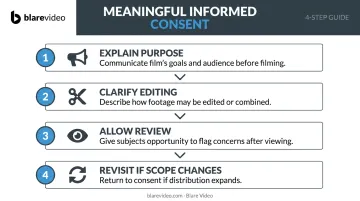
Meaningful consent involves:
- Explaining the film's purpose and intended audience before filming begins
- Sharing how the interview might be edited or combined with other footage
- Giving subjects a reasonable opportunity to flag concerns after viewing
- Revisiting consent if distribution scope changes significantly after production
The IDA's ethical framework for documentary filmmaking is clear that a filmmaker's duty of care extends to both subjects and viewers — not just the client who commissioned the work.
The Manufactured Authenticity Trap
Handheld cameras, candid-looking interviews, natural lighting — these are aesthetic signals that audiences have learned to associate with authenticity. Sophisticated viewers are increasingly good at detecting when those signals are deployed around scripted or heavily coached content.
Nielsen's data makes the gap concrete: 72% of audiences felt branded content talent was a good fit, but only about one-third found the content authentic. Casting and production polish are not authenticity. Real unscripted moments are — and viewers feel the difference even when they can't name it.
Narrative Fairness and Story Selection
Two obligations that filmmakers often underweight:
Narrative fairness — If an employee says "I love working here, though the growth process has been difficult," cutting to only the first clause isn't editing. It's misrepresentation. Even when a selective cut serves the brand story better, it violates the implicit trust documentary format creates.
Story selection — Choosing whose experience gets documented shapes the portrait of an organization viewers will trust. A film featuring only uniformly positive experiences isn't a document — it's a brochure with production value. Audiences recognize that absence, even if they can't always explain why they don't believe it.
The Production Process: From Story Discovery to Final Cut
Pre-Production: Finding the Real Story
The most important work in a corporate documentary happens before a camera is switched on.
Effective pre-production means extended conversations with leadership, employees, and stakeholders to surface which authentic stories also align with the brand's strategic goals. Those stories aren't always the ones leadership expects to find.
Blare Video's pre-production process reflects this: before any production begins, the team conducts consultations with clients to uncover the real narrative threads, followed by comprehensive planning that includes location scouting, scheduling, and creative development. A mandatory pre-shoot call with the client, producer, and crew ensures alignment before a single frame is captured.
Location scouting does more than solve logistical problems — it creates the conditions where genuine storytelling can happen. The right environment puts interview subjects at ease and contributes visual context that a conference room with a branded backdrop never can.
Production: Capturing Genuine Moments
On set, there's a core tension to manage: the footage needs to meet professional cinematic standards (clean audio, proper exposure, controlled framing) while the subjects need to feel relaxed enough to speak honestly.
Blare Video's approach centers on making interviews feel like genuine conversations rather than recorded performances. The company actively avoids scripted responses and teleprompter use, both of which create the exact robotic quality that undermines documentary credibility. The director's role is specifically to calm nerves and create the conversational atmosphere that generates footage worth using.
Equipment matters here too. Blare Video's crews deploy professional cinema cameras (including Red Epic Dragon and Red Weapon systems) alongside comprehensive lighting and audio setups that capture broadcast-quality footage without the visual weight of a studio environment.
Post-Production: Where the Story Takes Shape
Editing is where the documentary's true form emerges. An editor working with 8 hours of raw interview footage must make thousands of decisions — what to include, exclude, reorder, and emphasize — and each decision carries both creative and ethical weight.
Blare Video's post-production workflow includes:
- Transcribing all interviews to identify story threads efficiently
- Multiple rounds of client review at key stages before final output
- Color grading (including DaVinci for advanced projects), sound design, and music licensing
Music and color grading deserve particular attention. Both carry enormous power to shape emotional tone, and that power should serve the story — not compensate for footage that hasn't earned the emotion being layered onto it.
The difference is meaningful in practice. A quiet, restrained score under a genuine moment of employee vulnerability is craft. A swelling orchestral build under staged b-roll is something else entirely.
Maximizing Impact: Where Corporate Documentaries Live and Work
A well-produced corporate documentary is not a single-use asset.
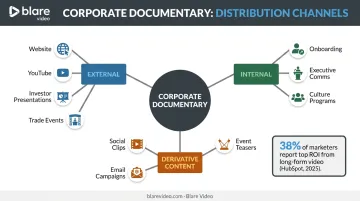
External distribution channels:
- Website cornerstone content (About, Culture, or Impact pages)
- YouTube channel long-form anchor
- Investor and board presentations
- Trade event and conference screens
Internal applications:
- Onboarding content that communicates culture more effectively than any employee handbook
- Executive communications and milestone documentation
- Recognition and culture-building programs
Derivative content: The full documentary can be cut into social media segments, email campaign content, and event teaser clips — extending reach without additional production cost.
That distribution flexibility compounds the ROI. According to HubSpot's marketing data, long-form video ranked among the top ROI-driving content formats, used by 38% of marketers in 2025. Unlike campaign-driven promotional videos that age with their campaign, corporate documentaries built around genuine human stories hold their relevance.
The Mattress Firm employee story Blare Video produced for area manager Christina is a clear example. The film followed her journey from customer dealing with severe back problems to regional manager — the kind of human arc that doesn't lose its resonance six months after publication, or six years.
That longevity is what makes the investment worthwhile. A corporate documentary built around real stories earns its cost repeatedly, across years of deployment.
Frequently Asked Questions
How is a corporate documentary different from a standard corporate video?
Corporate videos are scripted and optimized for quick, clear messaging — they inform and promote. Corporate documentaries build narrative arcs around real human experiences, targeting emotional connection rather than message delivery. The result is a format that takes longer to produce but builds deeper, more durable audience trust.
What makes a corporate documentary feel authentic rather than promotional?
Authentic documentaries rely on unscripted interviews, genuine observational footage, and honest story selection. Over-coaching subjects or scripting responses produces the stilted, manufactured quality audiences detect quickly. The goal is to capture what people actually think and say — then shape it through editing, not before filming.
What ethical responsibilities come with corporate documentary filmmaking?
Filmmakers owe subjects meaningful informed consent, not just a signed release form. They're also obligated to narrative fairness — not editing interviews to misrepresent actual views — and to honest story selection that reflects the organization's real culture, not only its best face.
How long does it typically take to produce a corporate documentary?
Most projects span several weeks to a few months across pre-production, principal photography, and post-production. Multi-city shoots or high interview counts extend that range. Strong pre-production planning is the single biggest factor in keeping timelines tight.
Can corporate documentaries serve both internal and external audiences?
Yes, and the strongest ones are designed for both from the start. A documentary about company culture works externally as a brand trust signal and internally as onboarding material, recognition programming, or executive communication.
What types of organizations benefit most from corporate documentary filmmaking?
Any organization with a genuine story to tell — strong founding narratives, community impact, notable milestones, or workplace cultures worth preserving. Technology firms, healthcare organizations, manufacturers, nonprofits, and financial services companies all fit that description.