Introduction
Video has become the dominant communication format for businesses across every sector. 91% of businesses now use video as a marketing tool, and 96% of B2B buyers prefer video content when researching products and services. From corporate training modules to brand campaigns, professional video content is now a baseline expectation.
Yet most businesses searching for video help encounter a confusing landscape. Freelancers, boutique studios, and agencies all call themselves "video production companies," making it difficult to know what you're actually getting.
The distinction matters. Scope and accountability differ sharply between a solo videographer who captures footage and a full-service production company that manages every stage of the process.
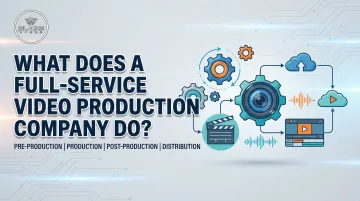
This guide breaks down exactly what a full-service video production company does in practice, stage by stage, from concept development through final delivery — so you know what to look for before signing a contract.
Key Takeaways
- A full-service company manages strategy, scripting, filming, editing, and delivery—not just one piece
- The process unfolds in three structured stages: pre-production, production, and post-production
- You get a dedicated team (directors, cinematographers, editors, project managers), not just a camera operator
- Full-service companies produce corporate videos, commercials, events, testimonials, and social content
- The core advantage: one accountable partner — no handoff gaps, no misaligned direction between stages
What Is a Full-Service Video Production Company?
"Full-service" means the company handles every stage of video production under one roof—from initial concept development through final platform-ready delivery—rather than specializing in just filming or just editing.
This differs fundamentally from a standard videographer or partial-service provider. A full-service company brings a structured team of specialists:
- Directors who shape creative vision
- Producers who manage logistics and budgets
- Cinematographers who control visual quality
- Editors who craft the final story
- Motion graphics artists who add polish
They work within a defined production framework—not just technical execution. That distinction matters, because it shapes everything from client experience to final output quality.
A full-service company is not a crew that shoots and hands you raw footage. It's not a marketing agency quietly outsourcing video to freelancers. And it's not a solo operator stretched thin across disciplines. Each of those gaps tends to show up in the finished product.
Who Uses Full-Service Production Companies?
Typical clients include corporate businesses, technology companies, healthcare organizations, retail brands, and event organizers. Blare Video, for instance, produces work for clients ranging from startups to established names like Google, Taco Bell, and Williams-Sonoma, with production teams operating across Los Angeles, San Diego, Las Vegas, Phoenix, and Tucson.
The Full Production Process: From Concept to Final Cut
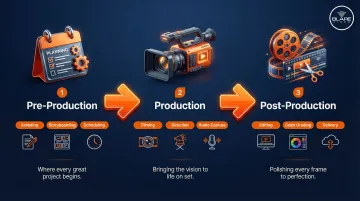
A full-service video production company operates through three defined stages—pre-production, production, and post-production. Each contributes essential work to the finished product, and skipping or rushing any stage compromises the final result.
Pre-Production: Where Great Videos Are Actually Made
Pre-production is the planning phase and the most underestimated stage of video production. This is where creative direction, scripts, shot lists, storyboards, talent casting, location scouting, and production schedules are all developed before a camera is ever turned on.
Inadequate pre-production is the primary driver of costly reshoots and budget overruns. Any weakness in a film can be addressed during pre-production, but failing to plan leads to on-set issues that cannot be fixed later.
Key pre-production deliverables include:
- Script or interview plan that establishes the narrative and messaging framework
- Storyboard or visual reference document showing shot-by-shot scene visualization
- Shooting schedule that aligns crew, talent, and location availability
- Logistics checklist covering permits, location access, and equipment needs
Full-service companies treat pre-production as a strategic exercise, not just a checklist. They align the video's messaging, tone, and visual style with your brand guidelines and campaign goals before production begins. This upfront investment prevents expensive mistakes and ensures the shoot day runs efficiently.
Production: Filming Day Execution
Production day is when the crew executes the shot list to capture all necessary footage in a controlled, efficient manner. A professional crew includes:
- Director — controls creative vision and directs talent
- Director of Photography (DP) — shapes the visual look through lighting and camera positioning
- Camera operators — execute camera movements and framing
- Audio technicians — plan microphone placement and monitor sound quality
- Lighting grips — implement the lighting plan
- Production assistants — manage logistics and support crew needs
Professional equipment matters. Full-service companies use broadcast-grade or cinema cameras—such as ARRI ALEXA, RED V-RAPTOR, or Sony FX6—and professional audio/lighting setups. Experienced on-set direction keeps the shoot on schedule and ensures every take is usable.
Production day is one component, not the whole job — it's supported by weeks of pre-production and followed by a thorough post-production process.
Post-Production: Where the Story Comes Together
Post-production transforms raw footage into a finished, deliverable-ready video. This stage includes:
- Editing and pacing to assemble footage into a coherent narrative
- Color correction and grading for visual consistency and mood
- Sound design and audio mixing to balance dialogue, music, and effects
- Music licensing to secure legal rights for background tracks
- Motion graphics and title cards for branded visual elements
- Voiceover recording and sync when narration is required
The revision cycle is built into this stage. Clients review cuts, provide feedback, and the editing team refines until the video meets the agreed-upon brief.
Platform Delivery: The Final Critical Step
92% of users watch videos with the sound off on social media, making captions and platform-native formats essential. A full-service company delivers platform-ready versions tailored to where your audience actually watches:
- Horizontal cuts for YouTube and websites (16:9 aspect ratio)
- Vertical formats for TikTok, Instagram Reels, and Stories (9:16 aspect ratio)
- Shorter edits for paid ads and quick social posts
- Captioned versions optimized for silent viewing
What Types of Videos Does a Full-Service Production Company Make?
Full-service companies produce a wide range of video types, each with its own crew requirements and production approach:
Primary video categories include:
- Corporate overview videos that capture brand story, company culture, and mission
- Brand commercials produced for TV, streaming, and digital platforms
- Customer testimonial videos featuring authentic client stories
- Product demos and explainer videos showcasing features and benefits
- Event highlight reels from conferences, trade shows, and galas
- Training and internal communications videos for onboarding and education
- Social media content series built for platform-native, short-form delivery
The production approach and crew size differ by video type. A large-scale commercial shoot involves more crew, multiple locations, and extensive post-production complexity. A testimonial interview requires a smaller crew but careful lighting and audio setup to capture authentic, usable footage. Full-service companies scale resources accordingly.
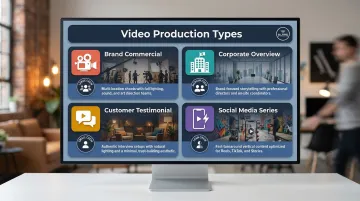
Social media video has become its own discipline within that mix. Short-form video now delivers the highest ROI of any content format, with 49% of marketers reporting top performance. These projects require vertical aspect ratios, runtimes under 60 seconds, and content designed for sound-off viewing — a meaningfully different production brief than a corporate overview or broadcast commercial.
Full-Service vs. Hiring a Freelancer: What's the Difference?
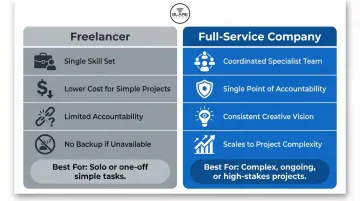
The core distinction is simple: a freelancer typically specializes in one skill (filming or editing), while a full-service company provides a coordinated team with defined roles covering every stage.
Practical Advantages of Full-Service
- One project manager handles communication — no juggling multiple vendors with competing priorities
- The same team that develops the concept executes the shoot and completes the edit, keeping the creative vision consistent
- If something goes wrong, one company is responsible for making it right
- Documented schedules with milestone-based approvals keep the project on track from day one
The Freelancer Trade-Off
Freelancers are often highly skilled and cost-effective for smaller projects. That said, assembling a piecemeal production team introduces real challenges:
- If your freelancer gets sick or overbooked, the project stalls with no backup
- When the editor blames the footage and the videographer blames the edit, you end up mediating
- Managing files, feedback, and revisions across multiple contractors falls entirely on you
- One person cannot simultaneously operate camera, manage lighting, and capture clean audio
When to Choose Which Model
A freelancer may be sufficient when:
- The project is simple (a single-angle interview with minimal editing)
- Post-production needs are basic (trim, export, deliver)
- Budget is tight
- Turnaround is flexible
Full-service is the right investment when:
- The video ties to a campaign goal, brand launch, or event
- Multi-platform distribution is required
- You need multiple deliverables from one shoot
- Professional polish and consistency matter to your brand
- You want one accountable partner managing the entire process
Conclusion
A full-service video production company is not just a filming crew—it's a structured production partner that manages strategy, planning, execution, and delivery to ensure the final video serves your business objective.
Understanding what pre-production, production, and post-production each involve equips you to evaluate proposals accurately, set realistic timelines, and choose a partner whose scope matches your needs. When you know the full process, you can spot the difference between a vendor who captures footage and a partner who delivers results.
Blare Video provides full-service video production for businesses across Los Angeles, San Diego, Las Vegas, Phoenix, and Tucson. Project types include:
- Corporate videos and brand storytelling
- TV commercials and product launch campaigns
- Testimonial and interview series
- Event coverage and highlight reels
- Industrial and healthcare documentation
Whatever the format, working with a team that owns the process from concept through final delivery means fewer gaps, clearer communication, and a finished product that actually performs.
Frequently Asked Questions
What is full service video production?
Full-service video production means a company handles every phase of the process—from concept development and scripting through filming to editing and final delivery—rather than just one component like filming or editing.
What are the 5 stages of video production?
While the core framework is three stages (pre-production, production, post-production), some frameworks break it into five: development, pre-production, production, post-production, and distribution/delivery.
How much does video production services cost?
Costs depend on video type, length, crew size, location, and edit complexity. A simple corporate interview runs less than a multi-day commercial shoot. A full-service company should provide a detailed proposal tailored to your project rather than a generic rate card.
What is the difference between a full-service video production company and a freelancer?
Freelancers typically cover one skill set (filming or editing), while a full-service company provides a coordinated team across all production stages with a single point of accountability and consistent creative vision.
How long does the video production process take?
Timelines vary by project scope, but a typical corporate video project spans several weeks from kickoff to final delivery. Pre-production often takes as long as or longer than the shoot day itself.
What types of videos does a full-service production company make?
Common video types include corporate overviews, brand commercials, customer testimonials, event highlights, training videos, product demos, and social media content for platforms like Instagram, TikTok, and YouTube. Full-service companies also handle more specialized formats—industrial and manufacturing documentation, medical and healthcare videos, and agricultural content—depending on their production expertise.