Introduction
Decision-makers searching for an explainer video production company face a crowded market: hundreds of studios promise results, yet outcomes vary wildly based on who you choose. The stakes are real. The wrong partner doesn't just waste budget—it produces a video that misrepresents your brand, fails to convert, and costs time to redo. The right partner creates a reusable asset that works across every stage of the buyer journey.
The numbers back up that investment: 91% of businesses now use video as a marketing tool, with explainer videos ranking as the second most popular format. 96% of people have watched an explainer video to learn about a product or service, and 85% report being convinced to buy after watching.
Video is a proven channel — the question is whether the company you hire can actually deliver those conversion outcomes for your specific audience. This guide gives you a framework to find out.
Key Takeaways
- Explainer video companies create short-form videos (60-120 seconds) that simplify concepts for target audiences
- The right partner combines strategic scripting, brand alignment, and production expertise across the full process
- Evaluate portfolios for message clarity in the first 10 seconds, not just visual polish
- Key selection factors: in-house team composition, script development process, revision policy transparency, and pricing breakdowns
- Before signing, verify revision terms, request a creative brief walkthrough, and ask for references from similar industries
What Is an Explainer Video Production Company?
An explainer video production company is a specialized studio that produces short, focused videos — typically 60 to 120 seconds — built to communicate a product, service, or concept in a clear, watchable format. Unlike general video production agencies that handle commercials and documentaries, explainer video companies specialize in breaking down complex ideas quickly and memorably.
Types of Explainer Videos They Produce
The format you encounter depends on your message complexity, audience, and brand personality:
- 2D Animation — Character-driven motion graphics ideal for SaaS platforms and abstract concepts; the most cost-efficient option with flexible timelines
- 3D Animation — Best for product visualization and manufacturing demos; expect higher budgets and longer production windows
- Live-Action — Features real people to humanize a brand; strongest fit for testimonials and human-centric messaging
- Hybrid/Mixed-Media — Pairs animation with live footage for creative flexibility across complex narratives
Key Use Cases Across Industries
Explainer videos serve diverse objectives across sectors:
- Tech/SaaS: Dropbox used a simple animated explainer on its homepage to explain cloud storage, increasing conversion rates by over 10% and growing from 5,000 to 75,000 users overnight
- Healthcare: Bethanien Hospital implemented a customized explainer video to guide patients through admissions, reducing uncertainties and shortening interview times
- Financial Services: Plaid uses a 60-second animated explainer to visually demonstrate how its infrastructure securely connects apps to bank data
- Nonprofits: Charity: Water utilized immersive video storytelling to raise $2.4 million at a single gala and saw a 90% increase in year-end donations
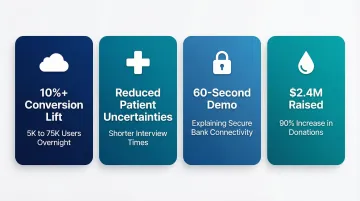
These results reflect what a well-matched production company can deliver — which is why choosing the right one matters more than most buyers initially expect.
What to Look for in an Explainer Video Production Company
Choosing an explainer video partner is different from hiring a general production crew. The craft of simplifying complex ideas requires a specialized blend of strategic scripting, animation expertise, voice direction, and brand alignment—factors that vary significantly across companies.
The following six factors help you move from gut feel to a structured, outcome-driven evaluation.
Portfolio Depth and Style Versatility
Review portfolios with a critical eye: look not just for visual polish but for whether each video clearly communicates its core message within the first 10–15 seconds. Research shows the steepest drop in viewer engagement occurs in the first 10-15 seconds, and videos that front-load value retain viewers longer.
What to assess:
- States the problem and solution in the first 10 seconds — not after a lengthy intro
- Demonstrates range beyond a single style (flat animation only, for instance, may not fit every brand)
- Shows work across multiple industries, adapting tone and pacing for different audiences
In one case study, re-editing an onboarding video to cut a long setup and deliver core information within 10 seconds increased overall engagement by 5 percentage points and cut initial viewership loss in half.
In-House Team vs. Freelancer Model
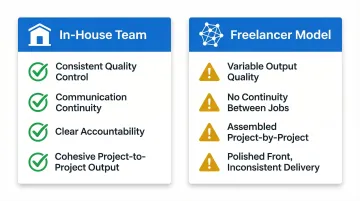
Team composition directly affects output consistency. Companies that rely heavily on freelancers often produce variable results, while an in-house team of writers, animators, voice directors, and editors ensures cohesive quality from project to project.
Questions to ask:
- Who will actually work on your video?
- Is the team that presents to you the same team that produces?
- Are key roles—scriptwriting, animation, voiceover direction—handled internally or outsourced?
These questions reveal a lot. Studios with in-house teams maintain quality control, communication continuity, and accountability throughout the project lifecycle. Freelancer-heavy models may present a polished front but assemble project-by-project crews with no continuity between jobs.
Script Quality and Creative Strategy
The script is the single most important element of any explainer video. Poor scripting produces confusion even when animation quality is high. Evaluate a company's scriptwriting capability by reviewing how clearly their existing videos state the problem, solution, and call to action.
Cognitive research principles that drive comprehension:
- Coherence principle — Removing irrelevant content improves retention, not just clarity
- Signaling principle — Explicitly highlighting key points accelerates learning
- Personalization principle — Conversational language produces better comprehension than formal prose
Ask how the company gathers information before writing. The right production company runs a structured discovery or creative brief process—asking substantive questions about your business, audience, and goals—before writing a single word. Companies that skip strategy and jump straight to visuals typically produce generic content that doesn't convert.
Production Process Transparency
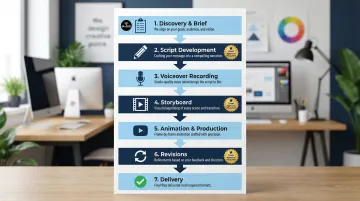
A professional production workflow should include these defined stages:
- Discovery/Brief — Gathering client objectives, target audience, and brand guidelines
- Script Development — Writing and client approval before moving forward
- Voiceover Recording — Professional talent selection and direction
- Storyboard — Visual blueprint showing scene composition and pacing
- Animation/Production — Actual video creation
- Revisions — Structured feedback loops with clear approval gates
- Delivery — Final files optimized for intended platforms
Critical questions about revisions:
- How many rounds are included at each stage?
- At which stages can changes be requested?
- What happens if feedback substantially changes the creative direction?
- What triggers additional cost?
Vague revision terms are a common source of scope creep. A company that can walk you through their workflow clearly—with defined timelines and client touchpoints at each stage—is a company that respects your budget and deadline.
Budget Transparency and ROI Orientation
Distinguish between companies that give opaque quotes and those that provide production breakdowns. A reliable vendor will explain what drives cost: animation complexity, video length, voiceover talent, and rounds of revision.
Industry cost benchmarks:
A 2024 survey of 242 explainer video production companies found the average price for a 1-minute animated explainer is $8,457, with a median of $5,400. Prices ranged from $600 to $250,000 depending on complexity.
| Tier | Price Range | What You Get |
|---|---|---|
| Budget/Freelance | $1,000 - $3,500 | Stock assets, client acts as project manager, variable quality |
| Mid-Range/Professional | $8,000 - $25,000 | Fully managed, custom art, scriptwriting, voiceover, animation |
| Premium/Cinematic | $30,000 - $100,000+ | High-end 3D, frame-by-frame animation, or premium live-action |
Look for evidence the company thinks in terms of results, not just deliverables. Ask whether they can share case studies where explainer videos improved conversion rates, reduced support inquiries, or shortened sales cycles. Crazy Egg used an explainer video to increase conversion rates by 64%, generating an extra $21,000 in monthly revenue.
Communication, Collaboration, and Revision Culture
Evaluate communication style early: in your first interaction, does the company ask substantive questions about your business, audience, and goals—or do they immediately pitch their own capabilities? Companies that lead with listening tend to produce videos that reflect the client's vision rather than their own aesthetic preferences.
What to assess:
- Uses project management tools or collaboration platforms for transparency
- Checks in consistently during active production, not just at delivery
- Has a clear process for handling mid-production feedback without scope chaos
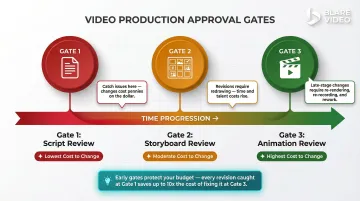
- Builds review gates at script, storyboard, and animation phases—not just at the end
Structured approval gates at multiple stages prevent costly rework. Changes become expensive and time-consuming once animation begins, so a company that builds in script and storyboard review phases protects both your budget and timeline.
Questions to Ask Before You Sign
Bring this ready-to-use set of discovery questions to any vendor conversation:
Process & Team:
- Can you walk me through your script development process?
- Who specifically will be working on my project—names and roles?
- How many full-time employees work on production versus freelancers?
Revisions & Approvals:
- What does your revision policy include, and what triggers additional cost?
- At which stages can I request changes—script, storyboard, animation?
- How do you handle feedback that substantially changes creative direction?
Experience & Results:
- Can you share a case study from a company in my industry?
- What measurable outcomes have your explainer videos achieved—conversion lifts, reduced support tickets, shortened sales cycles?
Distribution & Optimization:
- How do you recommend distributing the final video for maximum impact?
- Will you deliver multiple formats optimized for homepage, sales decks, social platforms, and email campaigns?
How a company answers these questions tells you as much as the answers themselves. A vendor that answers directly—without deflecting or overselling—shows how seriously they take client collaboration.
Distribution guidance is also worth probing. A company that delivers a file and walks away leaves the hardest part to you. The best vendors factor in where the video will live—homepage, sales deck, social, email—before they write the first line of the script, because format, length, and call-to-action design all depend on it.
Red Flags to Watch Out For
Most vendor evaluation mistakes happen before a contract is signed. These are the signals worth catching early:
Portfolio red flags:
- Only one visual style or one industry vertical represented
- High volumes of similar-looking videos with stock characters or template backgrounds
- Cannot speak to the strategic goal each portfolio video was designed to achieve
- No evidence of message clarity in the first 10-15 seconds
Process red flags:
- Inability to articulate a defined production process
- No structured script review phase before moving to animation
- Vague or absent revision policy
- Jumping straight to visuals without a discovery or brief process
Pricing red flags:
- Unusually low pricing with no explanation of how they deliver at that cost
- Completely opaque pricing with no breakdown available
- Unwillingness to explain what drives cost
Team composition red flags:
- Freelancer-heavy model disguised as a full-service studio
- Cannot tell you how many full-time employees work on production
- The team that presents is not the team that produces
If a vendor can't answer basic questions about their team or process during the sales conversation, that gap only widens once production starts.
How Blare Video Can Help
Blare Video is a full-service video production company with deep expertise in corporate storytelling and brand narrative, operating across Los Angeles, San Diego, Las Vegas, Phoenix, and Tucson, with production reach extending to San Francisco, Dallas, Seattle, and Portland. Their client roster includes Google, TikTok, Taco Bell, Williams-Sonoma, and the American Association of Endodontists.
Key differentiators for explainer video projects:
- Deploys production crews across multiple cities for on-location shoots when live-action is part of your explainer
- Handles everything from creative concept through post-production under one roof, maintaining quality control at each stage
- Brings hands-on experience in interview production, testimonial video, and social content — formats that feed directly into polished explainer work
Blare Video's portfolio spans corporate businesses, technology companies, healthcare organizations, nonprofits, and financial services firms—giving them the cross-industry fluency needed to tailor explainer video messaging to diverse audiences. Their multi-location presence allows them to support clients with regional production needs while maintaining consistent quality standards.
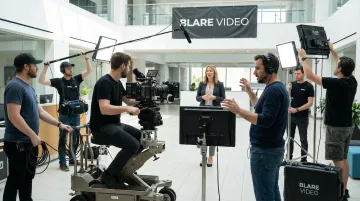
For live-action components, the team works with RED Epic and Canon 5Dmk3 cameras, with additional capabilities in HDR time-lapse and advanced post-production workflows.
On timelines: most projects move from initial brief to final delivery in 1-2 months, with explainer videos typically receiving 20-30 hours of editing depending on the level of polish required.
Browse their portfolio or contact the team to discuss your explainer video goals.
Conclusion
Choosing an explainer video production company is not a creative decision—it is a strategic business decision that affects how your brand is perceived, how clearly your value proposition is communicated, and how efficiently you convert prospects.
The goal is not to find the most impressive reel—it's to find the partner whose process, communication style, and creative approach align with your business objectives. When evaluating candidates, look closely at:
- Portfolio clarity within the first 10 seconds of each video
- In-house team composition versus contractor-heavy models
- Script development rigor and how they handle messaging strategy
- Production process transparency and milestone structure
- Budget clarity (itemized vs. lump-sum quotes)
- Revision culture and how disputes are handled
An explainer video is a long-term asset, not a one-time deliverable. Revisit its performance periodically—tracking conversion rates, engagement duration, support ticket volume, and bounce rate on landing pages—and ask whether your production partner can scale alongside your content needs as the business grows.
Frequently Asked Questions
How much does it typically cost to hire an explainer video production company?
Professional explainer videos range from $8,000 to $25,000 for mid-range 2D animation, with budget options starting around $1,000 and premium 3D or live-action reaching $30,000 to $100,000+. Key cost drivers include animation style, video length, voiceover talent, and revision rounds. Request an itemized production breakdown rather than a flat quote to understand where your investment goes.
What is the typical turnaround time for an explainer video?
A professionally produced 60-90 second explainer typically takes 6-12 weeks from kickoff to final delivery, depending on complexity. Scripting and animation phases consume the most time, with post-production editing requiring 2-3 weeks for the first rough cut. Build in buffer time and plan for responsive feedback cycles at each stage.
What is the difference between an animated and a live-action explainer video?
Animated explainers excel at visualizing abstract concepts, software demos, and scalable content that doesn't require re-shooting. Live-action builds trust, humanizes brands, and features real people—ideal for testimonials and customer stories. Some projects benefit from a hybrid approach that combines both formats to reach audiences through multiple visual registers.
How long should a corporate explainer video be?
The optimal range is 60-90 seconds for explainer videos intended for landing pages or sales use. 65% of viewers watch a business-related video to the end if it's under 60 seconds. Social media formats may require shorter cuts (15-30 seconds). Script length—not animation—typically determines final runtime, so prioritize concise messaging.
What should I include in a creative brief for an explainer video production company?
A strong brief covers:
- Target audience and the core problem the video solves
- Desired tone and visual style references
- Distribution platforms and any brand or compliance guidelines
- Business objectives and measurable success criteria
The more specific you are upfront, the more accurately the production company can align creative execution with your goals.
How do I evaluate an explainer video company's portfolio effectively?
Watch each video critically for message clarity in the first 15 seconds, stylistic range across different clients, and evidence of a defined call to action. Ask the company to walk through the strategic goal behind each sample shown—not just the visual execution. Look for companies that can adapt tone, pacing, and aesthetic to diverse industries rather than repeating one formula.