Introduction
Video has become the dominant format for business communication—91% of businesses now use video as a marketing tool, and the medium drives more engagement than any other content format. But with that demand comes a real divide: polished, high-performing video versus content that erodes audience trust before a viewer finishes the first 10 seconds.
Smartphones have made recording accessible, but producing video that moves audiences, builds trust, and drives conversions requires expertise, professional equipment, and strategic thinking. The gap between consumer gear and professional production shows up in every frame—in lighting, audio, editing, and storytelling.
This article breaks down the tangible, operational benefits of hiring a professional video production company. Each benefit maps directly to outcomes businesses across corporate, healthcare, industrial, and retail sectors actually see on screen and in performance data.
Key Takeaways
- Professional production companies provide specialized technical expertise and broadcast-grade equipment that DIY approaches cannot replicate
- High production quality directly impacts brand credibility and audience trust, translating to measurable engagement and conversion outcomes
- Full-service partners handle pre-production through post-production, saving businesses time and resources
- The right production partner delivers creative strategy, scripting, editing, and multi-format output tied to your business goals
What Is a Professional Video Production Company?
A professional video production company is a full-service team that manages the entire lifecycle of video content—from concept development and scripting through shooting, editing, and final delivery. These companies coordinate specialized crews, equipment, and post-production craft to transform raw footage into polished, on-brand content that holds an audience's attention.
That scope covers a wide range of business needs, including:
- Corporate communications and brand commercials
- Event coverage and highlight reels
- Product launches and demonstrations
- Customer testimonials and case studies
- Social media content and training videos
The real difference between a professional production company and a DIY approach isn't camera quality — it's the coordinated crew, strategic creative direction, and post-production expertise that turn footage into content built to convert.
Key Benefits of Hiring a Professional Video Production Company
The benefits below are tied to measurable outcomes—brand performance, audience response, operational efficiency—not abstract notions of "higher quality."
Professional Equipment and Technical Expertise
Professional production companies bring specialized gear that consumer equipment cannot replicate: broadcast-grade cameras such as RED Epic systems, professional audio rigs, lighting packages, stabilizers, and editing suites. Blare Video, for example, uses RED Epic Ultra HD cameras as the standard for high-stakes commercial and corporate shoots.
This advantage shows up in every frame. Professional shoots deliver properly lit subjects, clear isolated audio, stabilized cinematography, and color-corrected footage that reflects brand identity. Smartphone recordings rarely check more than one of those boxes.
Why this matters:
Poor production quality creates an immediate trust signal problem. 89% of consumers say video quality impacts their trust in a brand, and audiences register amateurish visuals as a proxy for amateurish service. Better production value means content is more likely to be shared, embedded, or used across multiple channels—maximizing the return on a single production investment.
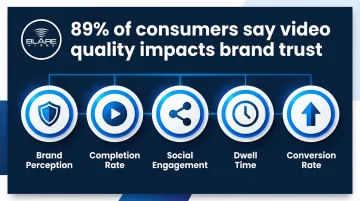
KPIs impacted:
- Brand perception scores
- Video completion rates
- Social engagement rates
- Website dwell time
- Conversion rates on landing pages with embedded video
When this advantage matters most:
High-stakes brand moments—product launches, investor presentations, trade show materials, TV commercials, and any content reaching a cold audience for the first time.
Enhanced Brand Credibility and Audience Engagement
Professional video production delivers more than sharp visuals—it delivers brand storytelling. The ability to construct a narrative arc, integrate music and sound design, and edit for emotional resonance requires trained editors and directors who understand pacing, music, and emotional arc.
Professional editors and directors shape raw footage into content that connects emotionally. They use B-roll, pacing, voiceover, and music to guide viewer response. Unedited or roughly cut content simply cannot do that—and audiences leave fast when it tries.
Why this matters:
Authentic storytelling showcasing genuine emotions saw up to a 59% lift in video completion rates compared to standard corporate messaging. Video content that emotionally engages viewers increases both retention and brand recall. A brand that consistently produces polished video signals competence and trustworthiness, which directly influences purchase intent and customer confidence.
KPIs impacted:
- Brand recall
- Audience retention rate
- Social shares
- Click-through rates on video ads
- Customer testimonial effectiveness
- Email open rates when video is included
When this advantage matters most:
Testimonial and case study videos, corporate culture videos, brand commercials, and any content competing in a crowded digital feed where the first few seconds determine whether a viewer stays or clicks away.
End-to-End Efficiency and Strategic Execution
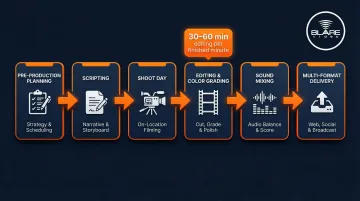
Professional production companies manage the entire process: pre-production planning, scripting, location scouting, permitting, shoot day coordination, editing, sound mixing, and final delivery in required formats. The client does not have to manage any of it internally.
This removes the hidden cost of DIY video: the internal hours spent learning software, coordinating logistics, reshooting poor footage, or correcting audio issues post-shoot. A professional company brings a predictable timeline and budget from day one.
Why this matters:
Editors typically spend 30-60 minutes of editing per finished minute of video, meaning an average long-form video can require 5-20 hours of editing alone. Time spent managing a DIY production is time diverted from core business operations. A professional team delivers faster turnaround, reduces costly reshoots, and produces content that is ready to publish across channels the moment it's delivered.
KPIs impacted:
- Project turnaround time
- Internal resource hours saved
- Cost per video asset
- Content reuse across platforms
- Time-to-publish
When this advantage matters most:
Time-sensitive campaigns, multi-location productions, event coverage with tight deadlines, and organizations producing video across multiple markets simultaneously.
What Happens When You Skip Professional Video Production
Relying on amateur video for business purposes creates immediate, visible consequences:
- Poor audio quality that makes dialogue difficult to follow
- Shaky footage that signals low production value
- Inconsistent color grading across scenes
- Weak editing that loses viewers within the first few seconds
Each piece of low-quality video that reaches an audience chips away at perceived professionalism—making it harder to establish credibility with new prospects who have no prior relationship with the brand. Over time, that erosion compounds.
Without a structured production process, video projects drag on. Costs accumulate unpredictably through multiple revision rounds, and the final output often can't be repurposed across the formats needed—social, web, broadcast, email.
Those production costs connect directly to viewer behavior. Just one buffering event decreases the amount of video watched by 39%, and technical failures like poor encoding or improper audio sync cause abandonment at every stage of the funnel.
Every video that underperforms due to production quality is a missed conversion. Prospects who encounter low-quality content don't reach out — they move on to a competitor whose video felt more credible and authoritative.
How to Get the Most Value from Your Video Production Partner
Professional video production delivers its best results when you come to the engagement with clear goals—knowing your target audience, your distribution platform, and what the video needs to drive: awareness, trust, conversions, or training.
A productive client-production company relationship looks like:
- Active collaboration in pre-production (approving scripts and storyboards)
- Clear feedback during review rounds
- Commitment to using finished content consistently across appropriate channels
When your team shows up prepared and collaborative, the production process moves faster—and the finished content works harder.
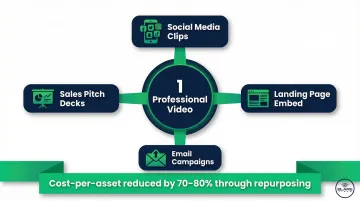
Video ROI compounds when content is treated as a strategic asset. A single professionally produced video can be distributed across multiple channels:
- Short clips cut for social media feeds
- Embedded video on product or service landing pages
- Video assets included in email campaigns
- Sales outreach and pitch deck support
Repurposing a single professional event video into multiple assets can drop the cost-per-asset by 70–80%, turning one production investment into a library of content that keeps working.
Conclusion
Professional video production combines technical quality, strategic storytelling, and operational efficiency into content that actually performs. These aren't separate benefits — they reinforce each other.
A library of high-quality video assets builds brand authority over time, and businesses that invest in professional production consistently outperform those relying on in-house DIY production.
For businesses ready to produce video that works—across corporate communications, brand campaigns, events, and social content—Blare Video offers full-service production from concept to post-production across Los Angeles, San Diego, Las Vegas, Phoenix, and Tucson.
Frequently Asked Questions
What are the benefits of hiring a professional for video production?
Professional video production companies provide access to broadcast-grade equipment, technical expertise in shooting and editing, and strategic storytelling capabilities. They produce polished content that builds brand credibility and drives measurable audience engagement, driving higher completion rates and conversions.
How much does it cost to hire a video production company?
According to Clutch's 2026 Video Production Pricing Guide, the average cost ranges between $100-$149 per hour, with most video production projects typically costing less than $10,000. Costs vary based on scope, length, location, and crew size.
What is the hourly rate of a videographer?
Freelance videographers typically charge around $600-$1,200 per day for filming and $60-$90 per hour for editing, depending on experience level, market, and whether editing is included in the package.
When should I hire a video production agency?
Hire a video production agency for high-stakes brand content, campaigns reaching new audiences, multi-location productions, tight deadlines, or any project where production quality will directly influence customer trust or purchasing decisions.
Why should we hire a professional video editor?
Editing is where raw footage becomes a narrative. Professional editors apply pacing, color grading, sound design, and storytelling structure that shape how audiences respond to and remember content — directly impacting completion rates and brand recall.
What are the key elements of an effective video?
Effective videos combine a clear message and script, high-quality visuals and stable cinematography, professional audio, intentional pacing and editing, and distribution optimized for the target platform and audience.