Introduction
B2B marketing has earned a reputation for being dry—yet the brands that consistently break through the noise do so with video. The difference isn't budget or industry. It's understanding what makes buyers pay attention.
The strongest B2B videos don't lead with product features — they lead with story, emotion, or a sharply defined problem. Connection comes before conversion. According to Brightcove's research, 95% of B2B buyers say video plays an important role in moving a purchase forward.
But only if the video earns their attention first.
This post curates 20 examples across video types and industries. Each one illustrates a specific technique B2B marketers can study and apply — from enterprise brands with full production teams to lean in-house crews working with limited resources.
Key Takeaways
- Story and problem-first framing outperforms feature-led video every time
- The 20 examples break into four formats — brand films, explainers, humor-driven ads, and testimonials — each suited to a different funnel stage
- Every standout video follows one rule: one message, one audience, one CTA
- Production quality matters, but creative concept matters more
- Use these examples to match video type to funnel stage
What Makes a B2B Video Stand Out
The best B2B videos don't just inform — they stick. Four qualities separate memorable from forgettable:
- Clarity: The message lands in seconds, without explanation
- Creativity: The format surprises; it doesn't follow a template
- Emotional resonance: It connects to a real pain point or aspiration
- Deliberate CTA: There's one clear next step, not three vague ones
Most forgettable B2B videos fail on at least two of these.
Match Video Type to Buyer Stage
Video type must align with buyer stage:
- Awareness-stage videos build intrigue and trust — think brand anthems and explainers
- Consideration-stage videos resolve objections and prove ROI — demos, case studies, testimonials
Conflating these two goals in one video is one of the most common B2B mistakes.
Story First, Product Second
Decision-makers respond to narratives about their challenges and outcomes — not feature lists. The best examples in this post sell a transformation, not a tool.
The data backs this up. Research from the LinkedIn B2B Institute shows emotional B2B ads are 7 times more effective at driving long-term business outcomes than rational messaging alone. Yet 81% of B2B video ads fail to gain adequate attention or drive brand recall — largely because the creative lacks distinctiveness and emotional pull.
Video Influences Buying Decisions
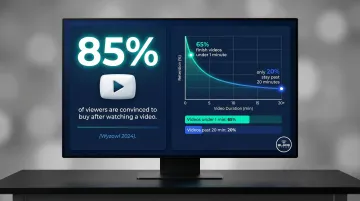
Wyzowl's 2024 report found that 85% of people are convinced to buy a product or service after watching a video. Vidyard's benchmarks reinforce why format matters: 65% of viewers finish videos under one minute, while only 20% stay past 20 minutes. Length and intent must align — or you lose the audience before the point lands.
20 B2B Video Examples That Stand Out
These 20 examples are grouped into four strategic categories based on format and intent. Each demonstrates a replicable technique—not just big-brand budgets.
Brand Storytelling and Anthem Videos
Brand anthem videos anchor the company's "why" in the buyer's mind before any product conversation begins. They're top-of-funnel and emotionally driven.
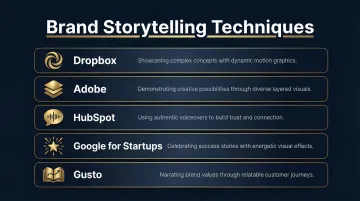
Dropbox — My Shot + Your Illustration
This 16-second brand promo for Dropbox Paper uses bold motion graphics and kinetic energy, with no explanatory copy. Key takeaway: Brevity and visual dynamism can communicate brand personality more powerfully than a script.
Adobe — Pure Imagination Anthem
Adobe's Oscars spot set a montage of user-created visuals to Gene Wilder's "Pure Imagination," positioning Adobe as a creative partner rather than software. Key takeaway: When your product enables creativity, show the output—not the interface.
HubSpot — Grow Better
HubSpot's collage-style video uses simple voiceover to issue a values-driven invitation to "grow better," planting a flag rather than pitching a product. Key takeaway: Taking a brand stance builds long-term affinity with buyers who share those values.
Google for Startups — Two Desperados
This animated motion graphic traces the journey of a Serbian game developer through the Google for Startups accelerator program. Key takeaway: Founder stories create emotional identification and make B2B programs feel human and accessible.
Gusto — Sleepy Planet
Gusto's 3D animated video foregrounds the company's people-first values, showing how payroll professionals quietly support workers who change the world. The lesson: Brand values land harder when illustrated through story rather than stated in copy.
Animated Explainers and Product Demos
Animated explainers and demos simplify complex products, compress sales conversations, and perform across multiple funnel stages. The risk is generic execution—these examples avoid it.
Monday.com — Marketing Motion Graphics
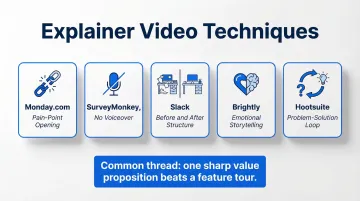
Monday.com uses clean, colorful animation to break down workflow complexity into a visual sequence a busy manager can follow in 60 seconds. Key takeaway: When your product's value is organizational clarity, your video's design should model that same clarity.
SurveyMonkey — Introducing the New SurveyMonkey
This no-voiceover product reveal uses 3D animations, kinetic motion, and energetic music to convey ease of use without a single word of copy. Why it works: Removing narration forces visual design to carry the message—and it reads as more confident when the execution is strong.
Slack — What Is Slack
Slack's demo-style video opens on the universal pain of scattered team communication and transitions directly into screen-based proof of how Slack resolves it. Anchoring a demo in a recognizable pain point—before showing the interface—keeps far more viewers watching through to the end.
Brightly — 2D SaaS Value Showcase
Brightly's concise 2D explainer communicates the value of its SaaS platform in under 60 seconds using clean illustration and tight scripting. Key takeaway: Top-of-funnel B2B videos don't need to cover every feature—a single sharp value proposition outperforms a comprehensive feature tour.
Hootsuite — Social Media Animated Explainer
Hootsuite's animated video pairs conversational voiceover with vivid graphics to walk small business viewers through the cost of ignoring social media, then positions its platform as the fix. Key takeaway: The "before and after" structure (problem world vs. solution world) is one of the most reliable frameworks for an explainer video.
Humor and Personality-Led Videos
Humor is underused in B2B despite its effectiveness. It lowers psychological defenses, increases shareability, and gives brands that might otherwise feel corporate a distinct personality. These examples use humor strategically—to amplify a specific product message, not just to entertain.
Dialpad — Failed Voice Auditions
This comedic skit shows rejected AI voice candidates auditioning for Dialpad, each failing in a distinct and funny way. Key takeaway: Using humor to dramatize what your product is NOT makes the value of the real product more memorable than a straightforward feature demo.
Mailchimp — Now What, That's What
Mailchimp's campaign uses empathy and offbeat humor to mirror the frustrations of new business owners, with the product positioned as the obvious (but lightly handled) solution. Key takeaway: Leading with empathy before introducing a solution is especially powerful in B2B, where buyers are often overwhelmed and under-resourced.
SAP — A Kid's Perspective
This employer brand video features children of SAP employees trying to explain what their parents do—a late-night talk show segment masquerading as B2B content. The lesson: Employer brand and culture videos can drive pipeline indirectly by building trust and familiarity with the company's identity.
LaunchDarkly — Live, Laugh, Launch
This comedic series follows developer Jess navigating conversations with her parents, who perpetually fail to understand what she actually does. Key takeaway: Serialized B2B content that leans into a relatable character creates ongoing engagement and brand affinity, not just a single touchpoint.
Uberflip — What the Heck Is Uberflip
Uberflip's video explains the same product to wildly different audience personas—including five-year-olds and grandmothers—without losing the core message. Why it works: If your product serves multiple buyer types, switching personas mid-video keeps pacing fresh and demonstrates breadth of use case at the same time.
Testimonials, Case Studies, and Behind-the-Scenes Videos
This category converts because third-party validation removes doubt, and transparency builds the kind of trust that closes deals. These videos are most effective at the bottom of the funnel, where buyers are comparing options and need proof.
Bosch — Meet Our Robotics Researchers
This behind-the-scenes video tours Bosch's robotics lab, featuring real engineers alongside their AI counterparts, delivered with surprising warmth and humor. Key takeaway: BTS content makes technical brands feel approachable and signals the kind of organizational culture that enterprise buyers want to partner with.
Salesforce — Intro for Small Business
Salesforce's animated video follows a small business owner named Carl through a narrative arc where Salesforce's tools enable visible business growth. Key takeaway: Using a named, relatable protagonist turns a product demo into a success story—a format that mirrors how buyers imagine their own outcomes.
Squarespace — Make the Next Series
This highly stylized live-action series showcases real Squarespace users building businesses in industries like food, fashion, and design. A video series gives you recurring content rather than a one-off campaign—and that compounding presence is what drives long-term brand building.
Slack — The Office-Style Mockumentary
This mockumentary-format case study follows office workers trapped in email hell before discovering Slack, using visual metaphors (inboxes morphing into threads) to make abstract benefits concrete. Key takeaway: Borrowing a recognizable entertainment format like the mockumentary gives B2B video a familiar structure that lowers the barrier to engagement.
ServiceNow — Turn Ordinary Workdays into Extraordinary Experiences
This energetic montage embeds the word "now" into a variety of workplace scenes, using seamless editing and visual creativity to convey urgency and platform agility. The lesson: A simple conceptual hook—one word, one theme—can carry an entire video when the editing and design execution is strong.
Best Practices We Can Learn From These Examples
Story First, Product Second
Every example in this list leads with a human situation—a problem, a frustration, an aspiration, or a character—before introducing the brand. This sequencing isn't just a creative preference. It's a conversion strategy.
Buyers don't start caring about a product. They start caring about their own problem. Research shows that storytelling increases conversion rates by approximately 30% compared to traditional marketing messages, and consumers retain information 22 times better when it's presented as a story rather than raw facts.
Match Format to Funnel Stage
Animation and humor work best for awareness and consideration—they earn attention. Testimonials and demos work best for evaluation—they earn trust and reduce risk.
Mismatching format to funnel stage is the most structurally common error in B2B video strategy.
Practical Framework:
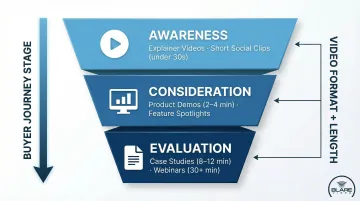
- Awareness (top of funnel): Explainer videos, short social clips under 30 seconds
- Consideration (mid-funnel): Product demos running 2-4 minutes, feature spotlights
- Evaluation (bottom of funnel): Case studies at 8-12 minutes, webinars 30+ minutes
One Message, Executed With Craft
The single biggest differentiator across these 20 examples: each video commits to one core idea.
The temptation in B2B is to use video as a feature dump. Resist it. Tighter scripting, even at the cost of "completeness," consistently produces better results. One focused message is easier to remember, easier to share, and easier to act on.
Production Consistency Signals Brand Trust
That same discipline extends beyond messaging to visual execution. Color, typography, motion style, and sound design should be consistent across every video a brand produces. Brands like Mailchimp and Gusto extend their full brand identity into video—not just their logo.
Inconsistency across assets signals disorganization to discerning B2B buyers. When every video looks like it came from a different company, trust erodes.
How to Brief Your B2B Video Production Partner
A strong video brief must define three elements before production begins:
- The specific audience and where they are in the buyer journey — Are you speaking to a CFO evaluating ROI or a product manager exploring tools?
- The single measurable outcome the video must drive — Awareness? Demo requests? Trial sign-ups?
- The one message the viewer must walk away with — Not three messages. One.
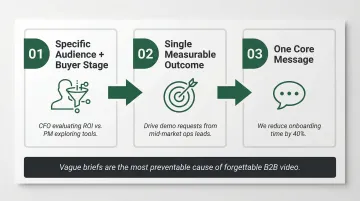
Vague briefs are the most common reason B2B videos are forgettable—and the most preventable.
Evaluating a Video Production Partner
Look for:
- Proven work in the specific format you need — corporate storytelling, event coverage, testimonials, or industrial documentation
- A portfolio spanning multiple industries, showing they can translate your sector's nuance into clear narrative
- In-house concept-to-delivery capability, which cuts miscommunication and compresses timelines
Blare Video has handled this full production scope for clients including Google, LeanData, and TikTok — across corporate, technology, and event formats.
Distribution Plan as a Production Input
The platforms where the video will live—LinkedIn, a product landing page, email nurture, trade show screens—should determine the video's format, length, aspect ratio, and pacing before a single frame is shot.
Locking down your distribution channels early shapes every creative decision that follows.
Conclusion
What makes B2B video work isn't a production budget or a famous brand. It's a clear strategic brief, creative conviction, and a willingness to treat buyers as human beings who respond to story, humor, and authentic proof.
The 20 examples in this post span software, hardware, professional services, and consumer platforms—and they all follow the same underlying principles. Whether your goal is a polished brand anthem, a sharp product demo, or a testimonial series that closes enterprise deals, the execution depends on a production partner who understands B2B storytelling at every stage—from concept and scripting through to final delivery.
If any of these examples sparked an idea for your own brand, Blare Video's corporate video portfolio is a good place to see what's possible—or reach out directly to talk through your next project.
Frequently Asked Questions
What is B2B video content?
B2B video content is any video produced by a company to communicate with other businesses—including explainers, demos, testimonials, brand films, and event highlights. The goal is to build awareness, generate leads, or support sales conversations.
What kind of videos attract viewers?
Videos that hook viewers in the first 5-10 seconds consistently outperform those that lead with product features or company credentials. A single focused message paired with a relatable problem or an unexpected creative format makes the biggest difference.
How to make a good product demo video?
The strongest product demo videos open with the pain point the product solves, show the product in a real workflow (not a staged ideal scenario), and close with a specific CTA. Keep total length between 60 and 90 seconds for initial exposure.
How do I introduce a new product in a video?
Product launch videos perform best when they frame the product as the answer to a recognizable market problem, using either a narrative arc or a high-energy visual reveal. Pair the video with a distribution plan that matches where your target buyers are already spending time.
What is a brand awareness video?
A brand awareness video is a top-of-funnel asset designed to establish who a company is, what it stands for, and why it exists—rather than to explain a specific product. The goal is emotional recognition and brand recall, not immediate conversion.
How to build B2B brand awareness?
B2B brand awareness is built through consistent video content distributed across LinkedIn, YouTube, and owned channels. Storytelling that centers on a buyer's problem or aspiration outperforms content built around the company's own credentials or history.