Introduction
Most buyers check reviews before they commit — but a written quote only goes so far. 79% of people have been convinced to buy a product or service after watching a video testimonial. Despite that, most companies approach testimonial video production without a clear picture of what they'll actually spend.
The cost of a testimonial video can range from a few hundred dollars for a basic smartphone shoot to over $100,000 for multi-location campaigns with full production crews. Understanding what drives that gap is the difference between a budget that works and one that wastes money — or leaves results on the table.
This guide breaks down real pricing tiers, the specific cost components behind each, the variables that affect price, and how to figure out what your business actually needs to spend.
Key Takeaways
- Professionally produced testimonial videos typically range from $1,500 to $20,000+, with full-service agency production going higher
- The biggest cost drivers are crew size, shoot location, video length, and post-production complexity
- Smaller businesses and frequent publishers can operate at the lower end; enterprise-level or high-distribution videos justify mid-to-high budgets
- Match your budget to how hard the video will work — high-distribution content justifies more spend
How Much Does a Testimonial Video Cost?
There's no fixed price for a testimonial video — budgets range from $1,500 to $50,000+ depending on scope, crew size, and post-production needs.
Companies tend to make two budget mistakes: underestimating scope (leading to underperforming videos) or overspecifying (paying for production value audiences won't notice). The tiers below clarify where your project actually falls.
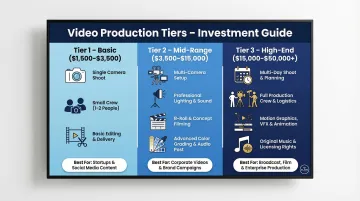
Tier 1: Basic Testimonial Video ($1,500–$3,500)
This tier includes:
- Single-camera setup
- One shoot location
- Minimal crew (1–2 people)
- Basic editing with standard color correction and cuts
- No motion graphics or B-roll
- Final deliverable typically 1–2 minutes
Best for: Small businesses, startups, or brands needing a quick, authentic customer story for a website landing page or email campaign without broadcast-quality production.
Tier 2: Mid-Range Professional Production ($3,500–$15,000)
This tier covers:
- Multi-camera setup
- Professional lighting
- Dedicated director and cinematographer
- One or two shoot locations
- B-roll footage
- Branded lower-thirds
- Professional color grade and sound design
- 2–4 weeks of post-production turnaround
Blare Video's full-service testimonial productions operate within this range, covering markets including Los Angeles, San Diego, Las Vegas, Phoenix, and Tucson. Their crews bring experience in corporate and brand storytelling for clients like Google, Williams-Sonoma, and TikTok.
Best for: Mid-size and enterprise businesses producing testimonials for sales decks, paid media campaigns, trade show materials, or high-traffic website placements where production quality directly reflects brand credibility.
Tier 3: High-End / Full-Service Production ($15,000–$50,000+)
This top tier includes:
- Concept development
- Full pre-production logistics
- Multi-day shoots
- Multiple locations
- Larger crew (director, DP, sound mixer, gaffer, PA)
- Professional talent coordination
- Advanced post-production with motion graphics
- Music licensing
- Multiple revision rounds
Ideal if: The video will run as a paid ad at scale, anchor a major campaign, or serve as flagship sales collateral where maximum polish is non-negotiable.
Key Factors That Affect the Cost of a Testimonial Video
Five variables drive most of the cost difference between a $2,000 testimonial video and a $20,000 one. Knowing where each dollar goes lets you trade off intelligently rather than just accepting a quote.
Video Length and Number of Subjects
Longer videos require more filming, more interview time, and far more editing hours. Featuring multiple customer subjects—filmed in different locations or on different days—multiplies crew and post-production costs.
Videos under 1 minute see an average engagement rate of 50%, with 65% of viewers staying engaged all the way to the end. Extending run-time beyond 2 minutes typically requires additional B-roll, more interview angles, and extra editing time to maintain viewer attention.
Location and Travel Requirements
Where you film has a direct effect on your budget. Studio shoots offer controlled environments, predictable lighting, and no permit fees. On-site shoots at customer offices cut location fees but add crew prep time. External locations bring permits, travel costs, and site-specific logistics.
City-specific permit costs:
- Los Angeles: Standard film permit: $931; Fire Safety Officer: $127/hour (4-hour minimum)
- San Francisco: $300/day for corporate media; SFPD Officer: $154.57–$211.47/hour (4-hour minimum)
- Smaller markets: Lower day rates and fewer permit requirements
Crew Size and Equipment Level
Crew configuration is often the single largest line item in a production budget. A solo operator with a mirrorless camera keeps costs low and produces an authentic, documentary-style feel. A full union crew delivers broadcast-grade quality — at broadcast-grade rates.
Solo operator setup:
- One person handling camera and audio
- Portable lighting kit; natural light when available
- Lower cost, faster scheduling, less intrusive on-site
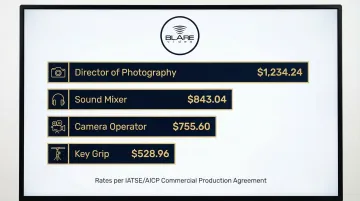
Full professional crew (union day rates):
- Director of Photography: $1,234.24 / 8-hour day
- Camera Operator: $755.60 / 8-hour day
- Sound Mixer: $843.04 / 8-hour day
- Key Grip: $528.96 / 8-hour day
Equipment rental:
The full-crew setup makes sense for videos appearing in paid media or high-stakes sales contexts. For internal use or early-stage social content, a solo operator often delivers enough.
Post-Production Complexity
Those crew and equipment costs cover one shoot day. Post-production is where hours accumulate quietly — and where the quality gap between tiers becomes most visible.
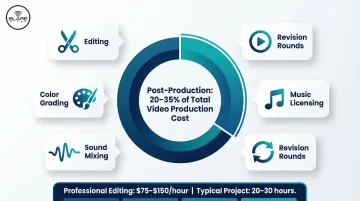
Post-production can account for 20–35% of total video production costs. Key line items include:
- Editing (rough cut through final approved cut)
- Color grading
- Sound mixing
- Motion graphics and animated lower-thirds
- Music licensing
- Revision rounds
Professional video editing runs $75–$150 per hour, and most testimonial projects require 20–30 editing hours depending on complexity.
Urgency and Timeline
Rush projects—where the client needs delivery in days rather than weeks—typically carry a premium. Standard testimonial timelines run 3–6 weeks from shoot to delivery. Compressed timelines require editors and crew to shuffle schedules, often adding 20–30% to the base cost.
The Real Cost Breakdown: What You're Actually Paying For
The quoted price for a testimonial video is almost never a single line item. It represents the sum of distinct production phases, each with its own costs. Breaking these down helps you evaluate quotes accurately and avoid surprise invoices.
Pre-Production (One-Time)
- Project kick-off and creative brief
- Scripted question development
- Location scouting
- Scheduling coordination with the customer subject
- Shot list and call sheet preparation
Skipping or underfunding pre-production is one of the most common causes of expensive shoot-day problems — poor scheduling alone leads to delays, incomplete interview coverage, and rushed setup time. Everything that goes wrong on shoot day usually traces back to something that wasn't resolved in pre-production.
Production / Shoot Day (One-Time)
- Crew day rates
- Equipment rental (cameras, lenses, lighting, audio)
- Location or studio fees
- Talent fees if a professional on-camera interviewer is used
Most testimonial videos wrap in a half-day to full-day window. Add multiple subjects or locations and you're looking at multi-day shoots — which multiplies every line item above.
Post-Production (One-Time, Variable Scope)
- Editing (rough cut through final cut)
- Color grading
- Audio cleanup and mixing
- Motion graphics (lower-thirds, intro/outro cards)
- Music licensing
- Export in required formats and aspect ratios (16:9 web, vertical for social, etc.)
Revision rounds beyond the standard allocation add hourly editing fees, typically in the $75–$150/hour range.
Distribution Format Add-Ons (Periodic/Optional)
Many clients underestimate the cost of repurposing. Cutting a 2-minute testimonial into 30-second and 15-second social edits, adding subtitles, or creating a vertical-format version for Instagram/TikTok each adds incremental editing cost. Build these into your initial budget — retrofitting them later costs more than planning for them upfront.
Music licensing is another variable worth pricing before you commit to a platform:
- Artlist Pro/Business plans cover commercial use, but companies with over 50 employees require custom Enterprise licenses
- Epidemic Sound Business plan costs $29.99/month, but companies over $10M yearly turnover require custom Enterprise pricing
- PremiumBeat single-track licenses range from $59 (Standard) to $999 (Business)
How to Estimate the Right Budget for Your Testimonial Video
The right budget is determined by how the video will be used, not just what it will look like. A video that drives pipeline needs different investment than one used occasionally in proposals.
Ask yourself these four questions before setting a budget:
1. Where will this video live and how much traffic will it receive?
- Homepage hero or product landing page = higher budget justified
- Internal sales enablement or email follow-up = lower budget acceptable
2. How many subjects and locations are required?
- Single subject, single location = Tier 1 or low Tier 2
- Multiple subjects across multiple cities = high Tier 2 or Tier 3
3. Does this video need to match the visual quality of paid media or TV?
- Running as a pre-roll ad or broadcast spot = high Tier 2 or Tier 3
- Embedded on a case study page = Tier 1 or mid Tier 2
4. How many final deliverable formats do you need?
- Just 16:9 web format = standard scope
- Web + vertical social + 30-second cuts + subtitles = add 15–25% to budget
Working with an experienced production company early—even just for a scoping call—helps you avoid scope creep and surprise costs. Blare Video covers multi-city production across Los Angeles, San Diego, Las Vegas, Phoenix, and other markets, so clients don't absorb long-distance travel costs for shoots in those regions. A direct scope conversation upfront gets you to an accurate number faster than any rough estimate.
What Most Buyers Get Wrong About Testimonial Video Costs
Focusing Only on the Per-Video Shoot Cost While Ignoring Post-Production
Many businesses receive a competitive shoot quote and then experience sticker shock when editing, color, and sound are itemized separately. Clarify what "all-in" vs. "shoot-only" quotes actually mean before signing.
What to ask:
- Does this quote include all post-production?
- How many revision rounds are included?
- Are music licensing and motion graphics extra?
That quote confusion often leads to a second, more expensive mistake.
Assuming Cheaper Always Means Comparable
The difference between a $1,500 one-person shoot and a $6,000 professional production isn't just cosmetic. It's lighting, audio quality, direction, and the ability to get a real performance out of a customer who isn't a professional speaker.
Poor audio or flat lighting signals low brand investment to viewers before they've heard a single word. Research shows that low audio quality leads listeners to evaluate speakers as less credible, reliable, and trustworthy. Production quality shapes trust — and trust is the entire point of a testimonial.
Once you've accounted for quality, the next trap is going too far in the other direction.
Over-Specifying for the Use Case
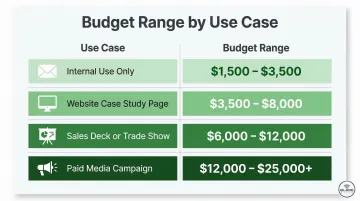
A testimonial video used in sales email follow-ups doesn't need the same production budget as one running as a pre-roll ad on YouTube. Matching production investment to distribution context is how smart marketers avoid overspending without sacrificing results.
| Use Case | Appropriate Budget Range |
|---|---|
| Internal use only | $1,500–$3,500 |
| Website case study page | $3,500–$8,000 |
| Sales deck or trade show | $6,000–$12,000 |
| Paid media campaign | $12,000–$25,000+ |
Frequently Asked Questions
How long should a client testimonial video be?
Most effective testimonial videos run between 60 and 90 seconds for digital and social use. Longer 2–3 minute versions work well for website case study pages or sales presentations. Length directly affects production and editing cost, with each additional minute adding 30–50% to post-production time.
How much does a 1-minute testimonial video cost?
A professionally produced 1-minute testimonial typically costs between $2,000 and $8,000 depending on crew size, location, and post-production scope. Simple single-camera shoots fall at the lower end, while multi-camera, B-roll-inclusive productions sit at the higher end.
What is included in testimonial video post-production costs?
Post-production covers editing, color grading, audio mixing, motion graphics such as lower-thirds identifying the subject's name and title, music licensing, and export in multiple formats. Post-production typically accounts for 20–35% of total video cost.
How long does it take to produce a testimonial video?
A professionally produced testimonial takes 3–6 weeks from kick-off to final delivery, covering pre-production, the shoot day, and review rounds. Rush timelines add 20–30% to the base cost.
Can I get a high-quality testimonial video on a limited budget?
Yes. Shooting at the client's office, limiting to one subject, and keeping the cut to 60–90 seconds are the most effective ways to control costs without sacrificing quality. These adjustments can reduce total project cost by 30–40%.
How do I evaluate quotes from different video production companies?
When comparing quotes, check for:
- Whether the price is all-in (pre-production, shoot, and post) or shoot-only
- How many revision rounds are included
- What delivery formats are provided
- Verifiable experience with corporate testimonial content — ask for portfolio examples and references