Introduction
Post-production costs regularly blindside filmmakers. Raw footage is only half the job, and the editing room is where budgets spiral fast — catching even experienced producers off guard. A 90-minute feature can wrap principal photography on time and under budget, then run 30% over when editorial labor drags into extra weeks, VFX shots need multiple revision rounds, or QC failures trigger expensive fixes.
While post-production budgeting follows general principles, actual allocations vary widely based on project scale, genre, VFX complexity, and sound requirements. No single formula works across every project. A dialogue-driven indie drama and a VFX-heavy sci-fi short require fundamentally different resource distributions, even at similar total budgets.
This guide walks through how to build a post-production fund allocation strategy step by step, covering what to prepare, what drives costs, and what mistakes to avoid.
Key Takeaways
- Post-production typically runs 20–25% of a film's total budget—and splitting that across editorial, sound, VFX, and color takes deliberate planning
- Start allocation planning before production begins—decisions made during prep directly affect editing room expenses
- The four major cost categories are editorial/finishing, sound design/mixing, visual effects, and color grading
- Build in a 10–15% contingency within your post-production allocation to absorb surprise costs
- Lock in vendor rates early, bundle services where possible, and track spending in real time
How to Allocate Funds for Film Post-Production
Determine Post-Production's Percentage of Your Total Budget
The starting point isn't a dollar amount—it's a percentage. Research shows that post-production typically consumes 20–25% of a film's total budget, but this benchmark shifts based on your film's specific needs.
Budget tier heavily influences the percentage:
- Micro-budget/indie ($500K–$1M): 10–12.5% of total budget
- Mid-budget indie ($3M–$8M): 12–15% of total budget
- Studio feature ($50M+): 15–25% of total budget
Genre dramatically affects this split. A dialogue-driven indie drama shot in a single location might stay at the lower end, while a VFX-heavy sci-fi project can push post-production to 35–40% of the total budget. Tentpole franchise features allocate 30–60% of their entire budget to VFX alone.
To adjust your baseline percentage, ask:
- How many VFX shots does the script require?
- Does the story demand complex sound design or ADR work?
- Will you need extensive color correction or creative grading?
- Are there multi-format deliverables (theatrical DCP, broadcast master, streaming specs)?
Break Down the Allocation by Department
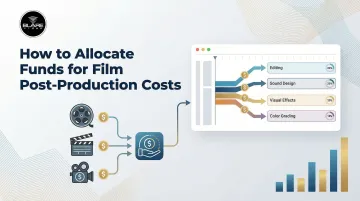
Once your overall post-production budget is set, subdivide it by department using percentage-of-post-budget benchmarks:
| Department | Percentage of Post Budget | Key Cost Drivers |
|---|---|---|
| Editorial | 30–35% | Editing software/hardware, editorial staff, storage systems |
| Sound Design & Mix | 25–30% | Studio rental, sound designer/mixer fees, ADR sessions, Foley |
| Visual Effects | 20–25% (up to 40%) | Software licenses, render farms, specialized artists |
| Color Grading | 15–20% | Specialized equipment, professional colorist rates |
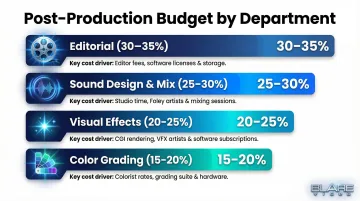
Projects with minimal VFX can reallocate that percentage toward editorial or sound. If your film has no CGI but requires extensive location sound cleanup and ADR, shift 10–15% from VFX to sound. For animated features, VFX and animation absorb 65–80% of the total budget.
Rebalancing example:
- Documentary with no VFX: Shift VFX allocation (20%) → 10% to editorial, 10% to sound
- Horror film with heavy sound design: Increase sound to 35–40%, reduce VFX to 10%
Estimate Timeline-Based Labor and Facility Costs
Post-production labor is typically billed by hour, day, or week. Estimate hours by projecting your runtime and complexity, then multiply by the applicable rate range below.
Current union labor rates (2025–2026):
- Feature editor: $79.01/hour or $3,428–$3,545/week
- Assistant editor: $57.54/hour or $2,302/week
- Colorist (journeyperson): $81.61–$103.56/hour
- Re-recording mixer: $89.92–$103.56/hour
Facility rental costs:
- Color suite/edit bay: $500/day
- VFX facility rental: $1,000–$4,000/day
- Audio mix stage: $1,500/day
Fixed costs — software licenses, facility rentals, storage systems — run regardless of how long post takes. Variable costs like overtime and additional revision rounds scale with duration. A 90-minute feature typically requires 8–12 weeks of editorial work; a 10-minute short might need 1–2 weeks.
Add Delivery and Distribution Line Items
Once labor and facility costs are locked in, delivery costs are what most budgets miss. These line items belong in every post-production budget:
- Mastering and output fees for final file exports and format conversions
- DCP creation at $5–$18 per minute (2K DCPs under 10 minutes can be $99 flat; features up to 100 minutes average $385–$595)
- Closed captioning at $1–$7 per minute (English broadcast captions start at $1/min; non-English average $7/min)
- Quality Control (QC) passes at $150 per hour for file-based QC
- Music licensing — sync rights for any third-party music or footage used
Delivery requirements vary by distributor or platform. Netflix, for example, mandates Interoperable Master Format (IMF) compliance and specific technical specs. Confirm platform requirements before finalizing this portion of the budget. Discovering a spec mismatch after picture lock can mean re-encoding, re-QC, and additional facility time — easily adding thousands to your final cost.
What You Need Before Allocating Post-Production Funds
A Locked or Near-Final Script
Attempting to budget post-production without a locked script is one of the most common causes of underestimation. Scene complexity, VFX requirements, and dialogue-heavy sequences all emerge from the script and directly determine post costs.
What to extract from your script:
- Total page count and estimated runtime
- Number of locations (affects continuity editing complexity)
- VFX shot count and type (invisible cleanup vs. hero CGI)
- Dialogue-heavy scenes requiring ADR
- Music cues and licensing needs
Equipment/Workflow Requirements
The camera format, resolution, and codec used during principal photography determine storage needs and editing workflow complexity. Higher-resolution formats (4K, RAW) require more powerful workstations, larger storage systems, and often proxy workflows.
Storage cost examples:
- Uncompressed 4.5K ARRIRAW: ~$31 per hour of footage
- 8K REDCODE RAW (5:1 compression): ~$16 per hour
- For a 2-hour feature with 10:1 shooting ratio, basic storage for three copies of 4.5K ARRIRAW costs $1,860—but housing it in RAID enclosures pushes total storage costs above $5,000
Proxy editing workflows reduce hardware and time costs by allowing editors to work in low-resolution copies before conforming to full-resolution media for finishing.
Skills and Personnel Readiness
Your storage and workflow requirements directly shape the personnel decisions that follow. Whether you hire freelance specialists, a full-service post house, or an in-house team changes your cost structure entirely.
Cost structure comparison:
- Freelance specialists: Day rates with maximum flexibility, but expect coordination overhead across multiple vendors
- Full-service post house: Bundled rates and a single point of contact — Blare Video, for example, covers the full arc from concept through post, which can sharpen upfront cost estimates for corporate and commercial projects
- In-house team: Fixed salary costs work best when you're running consistent production volume
Key Variables That Drive Post-Production Costs Up or Down
Even well-planned post budgets overrun when certain project variables don't get enough weight during allocation. Understanding which factors have the most pricing impact helps you build a more accurate budget from the start.
Project Length and Complexity
A longer runtime means more editorial hours, more sound elements to mix, and more footage to color grade. A 90-minute feature and a 10-minute short differ dramatically in post costs even at similar per-minute production budgets.
Complexity multipliers:
- Complex non-linear storylines or flashback sequences require additional editorial time
- Multi-format content (mixing archival footage, animation, live action) adds conforming work
- Intercutting timelines demand precise continuity management
VFX Volume and Type
VFX is the most variable and risk-prone post-production expense. Even a small number of CGI-heavy shots can consume an outsized portion of your total post budget.
Cost differences by VFX type:
| Effect Type | Tier-1 Studio (US/UK) | Mid-Tier/Outsourced |
|---|---|---|
| Wire removal/cleanup (invisible) | $3,000–$8,000 | $800–$3,500 |
| Sky replacement/environment | $5,000–$20,000 | $2,000–$9,000 |
| Digital double (hero) | $40,000–$120,000 | $18,000–$60,000 |
| CG creature (hero, per shot) | $60,000–$250,000 | $25,000–$110,000 |
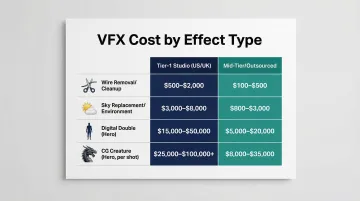
A 100-shot sequence of invisible effects can be budgeted under $500K, whereas a 40-shot sequence with hero CG creatures can exceed $6M.
Number of Revisions and Decision-Makers
Revision rounds are one of the most overlooked cost drivers in post. Every additional stakeholder in the approval chain increases the likelihood of change requests, and each round adds editor, colorist, and sound hours that weren't in the original estimate.
A few contract-level decisions can keep revision scope from spiraling:
- Set revision limits in vendor contracts (e.g., "up to 2 rounds of client notes included")
- Define approval hierarchy clearly before post begins (who has final sign-off?)
- Bill for revision rounds beyond the contracted limit at a pre-agreed hourly rate
Sound Complexity and Music Licensing
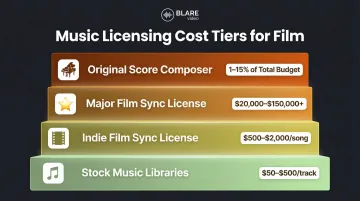
Music licensing costs range from $50 for a stock track to well over $150,000 for a commercially released song — the gap between options is enormous and directly affects how much budget you need to reserve.
Music licensing cost ranges:
- Stock music libraries: $50–$500 per track
- Indie film sync license: $500–$2,000 per song
- Major film sync license: $20,000–$150,000+ for prominent placement
- Original score composer: 1–5% of total budget (large films) to 5–15% (smaller projects)
ADR (Automated Dialogue Replacement) sessions add unplanned studio time if production audio is unusable. ADR recording runs $300–$350 per hour, plus SAG-AFTRA actor session rates of $241–$248 per role.
Common Post-Production Budget Allocation Mistakes
Treating Post-Production as an Afterthought
Many producers finalize the production budget first and assign post-production whatever is left over, rather than planning it as an equal priority from the start. This consistently results in quality compromises or budget overruns. Post-production is where the film is actually assembled — cut it short and the finished product shows it.
Underestimating Delivery and QC Costs
Producers often budget for the creative work (editing, color, sound) but overlook distribution prep entirely. DCP creation, captioning, IMF packaging, and QC passes all carry real costs — and most distribution channels require all of them.
Not Building a Post-Production Contingency
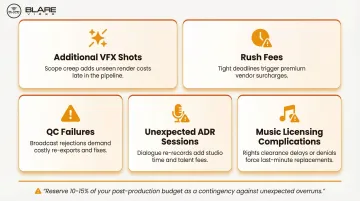
A general production contingency may already be committed when post surprises emerge. Post-production should have its own dedicated 10–15% contingency buffer separate from the broader production reserve.
Common post-production surprises:
- Additional VFX shots requested after picture lock
- Rush fees for accelerated turnaround
- QC failures requiring re-exports and fixes
- Unexpected ADR sessions
- Music licensing complications
Locking Vendor Agreements Without Specifying Deliverables
Vague contracts lead to scope creep and unexpected invoices late in the process.
What to specify in vendor contracts:
- Exact deliverable formats and resolutions
- Number of revision rounds included
- Timeline and milestones
- Ownership of project files and raw assets
- Rush fee policies
Nailing these details upfront keeps vendor relationships clean and protects the budget at the stage when surprises are most expensive.
How to Optimize Post-Production Spending Without Compromising Quality
Pre-Production Workflow Planning
The biggest post-production savings often start before cameras roll. Decisions made before a single frame is shot directly reduce revision time in post. Using previsualization (previs) can cut location-related costs by 25–40% and significantly reduce costly post-production fixes and reshoots.
Pre-production cost savers:
- Clear shot lists reduce editorial guesswork
- Defined VFX pre-visualization establishes scope before shooting
- Organizational systems for footage (naming conventions, metadata) streamline editorial
Proxy Editing Workflows
Once your footage is organized, editing speed becomes the next cost lever. Proxy workflows let editors cut in low-resolution files before conforming to full-resolution media — reducing hardware demands and facility costs.
This approach is especially valuable for 4K and 8K projects where real-time playback otherwise requires expensive workstations. Common tools that support proxy workflows include:
- DaVinci Resolve — built-in proxy generation and media management
- Adobe Premiere Pro — ingest proxies automatically during import
- Avid Media Composer — industry standard for high-volume offline editing
Bundling Services with a Single Vendor
Efficient proxy editing reduces labor time — but vendor strategy shapes where that saved time translates into dollars. Combining color grading and finishing at one facility, or hiring one sound house for both design and final mix, creates negotiating leverage and often yields package discounts compared to hiring specialists separately.
Additional bundling benefits:
- Reduced coordination overhead
- Faster turnaround (no handoff delays)
- Consistent quality control
- Off-peak scheduling discounts (committing to minimum hours)
Budget Monitoring Throughout Post
Vendor strategy controls costs at the contract stage. Ongoing budget monitoring keeps them in check once work begins. Reviewing spend weekly — rather than only at project close — lets supervisors catch overruns before they compound.
Tools for cost tracking:
- Spreadsheet-based cost tracking (Excel, Google Sheets)
- Dedicated production budgeting software (Movie Magic Budgeting, Celtx)
- Weekly variance reports comparing actual spend to estimates
Conclusion
Effective post-production budgeting starts at the script stage, runs through every department, and accounts for timeline, labor, delivery, and contingency costs. The most common failures come from treating post-production as an afterthought. Planning it as a defined budget line from the outset protects both the creative vision and the overall investment.
For corporate and commercial productions, partnering with a full-service video production team that offers integrated post-production services gives you consolidated cost visibility, fewer handoff gaps between production phases, and a clearer picture of total spend before the project begins.
Frequently Asked Questions
How much does post-production cost for a film?
Post-production typically represents 20–25% of the total film budget, though costs vary widely by complexity. Indie shorts often land in the $25K–$100K range, corporate videos run $10K–$50K, and studio features can exceed $10M–$50M+.
What percentage of a film budget goes to post-production?
The industry-standard range is 20–25% of the total film budget. VFX-heavy productions or films with complex sound requirements can push this to 35–40%, while micro-budget indies sometimes compress to 10–12.5% due to resource constraints.
How much do video production services cost?
Video production pricing depends primarily on how the crew is structured. Freelance day rates run $500–$2,500, production companies charge $5,000–$50,000 for full projects, and in-house teams work on fixed salaries. Post-production is billed separately — typically by the hour or week.
What is the average budget for a feature film?
Studio features average around $65 million, reflecting mid-range commercial films with union crews and global post-production workflows. Independent features typically cap around $2 million, with many festival-bound films made for $250K–$1 million.
What are the biggest post-production budget mistakes filmmakers make?
The most costly errors are treating post as an afterthought rather than a planned priority, forgetting delivery costs (DCP, QC, captioning), and failing to set a dedicated 10–15% post-production contingency separate from the general production reserve.
How do you create a post-production budget breakdown?
Allocate 20–25% of your total budget to post-production, then divide it across departments — editorial typically takes the largest share, followed by sound, VFX, and color. Always add a 10–15% contingency line and validate estimates against current labor and facility rates in your market.