Introduction
Most B2B video ads underperform — not because companies aren't investing, but because they're following consumer playbooks. 91% of businesses now use video in their marketing, 93% report positive ROI, and 96% of B2B buyers prefer video when evaluating products and services. Yet the vast majority of video ad guidance is written for consumer brands, not professional buyers.
Business buyers are a different audience entirely. The average B2B purchase involves 13 stakeholders, with 89% of deals crossing multiple departments. These professionals are skeptical, juggle competing priorities, and need proof — not entertainment.
This guide walks through the exact step-by-step process for creating video ads that resonate with professional buyers, the critical variables that impact conversion, and the costly mistakes B2B brands make most often.
Key Takeaways
- Business audiences respond to credibility-first hooks, not entertainment-based surprises
- Frame pain points precisely and introduce solutions within the first 20-30 seconds
- Proof matters: specific client names, statistics, and case study results outperform generic claims
- Match your CTA to the buying stage: cold audiences need educational offers; warm audiences convert on demos
- Production quality signals trustworthiness — poor visuals lose credibility before your message lands
Step-by-Step: How to Create a High-Converting Video Ad for Business Audiences
Step 1: Define Your Target Audience and Their Core Pain Points
Identify exactly who you're trying to reach:
- Industry sector and company size
- Job title and department
- Daily business challenges they face
B2B buying decisions typically involve 6 to 10 decision-makers for standard software purchases, expanding to up to 19 members for complex enterprise deals exceeding $250,000. Your video should speak to the primary viewer while acknowledging shared concerns across the committee.
Articulate one specific, deeply felt pain point your product or service resolves. Avoid vague problems like "inefficient processes" or "lack of visibility." The more precisely you describe their situation—"Your finance team spends 12 hours monthly reconciling data across three disconnected systems"—the more they'll feel the ad was made for them.
Step 2: Write a Hook That Earns Attention Through Credibility
The first 3-5 seconds determine success. On LinkedIn, the median watch time for a video ad is just 5.86 seconds, with 60.5% of viewers dropping off before completion. Your opening must stop a professional mid-scroll—but through credibility, not entertainment.
Effective B2B hook formats:
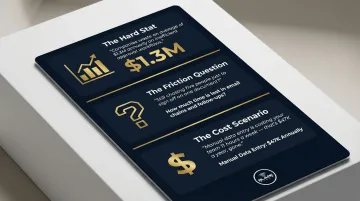
- A hard stat that stings: "Most manufacturing companies waste $47,000 annually on preventable equipment failures..."
- A question that exposes friction: "Is your sales team still manually updating CRM records after every call?"
- A scenario that names the cost: "If your procurement process requires seven approval signatures, here's what it's costing you."
Visual hooks matter equally. Professional settings, screen recordings of software interfaces, or confident on-camera spokespeople signal credibility immediately. LinkedIn best practices emphasize avoiding slow logo fade-ins or "welcome to" intros—lead with the result instead.
Step 3: Frame the Problem and Introduce Your Solution Early
Acknowledge the viewer's struggle before presenting your product as the answer. Research from the LinkedIn B2B Institute reveals that inspiring emotion in B2B ads is 7x more effective at driving long-term business outcomes than relying solely on rational messaging.
Introduce your solution within the first 20-30 seconds of a 60-90 second ad. Delayed payoffs lose professionals mid-scroll. Vidyard's benchmark data confirms that the highest viewer engagement occurs within the first quarter of a video's runtime.
Critical framing difference: While B2C leans on desire and emotion, B2B should emphasize outcomes:
- Time saved
- Revenue gained
- Risk reduced
- Efficiency improved
Step 4: Build Credibility with Proof That Speaks to Professionals
Social proof carries exceptional weight in B2B contexts. 90% of buyers report that social proof heavily influences their shortlist. Customer reviews are also cited as the number one information source when researching and comparing products.
Effective B2B proof types:
- Named client testimonials (with permission)
- Specific case study results ("Reduced processing time by 62% in 90 days")
- Industry awards and certifications
- Recognizable client logos
Avoid empty superlatives — "our proven platform" or "trusted by thousands" signals nothing to a skeptical buyer. Specific numbers and named clients do more work. For example, Blare Video demonstrates credibility by showcasing clients like Google, Taco Bell, and TikTok—enterprise-level partnerships that signal trustworthiness to other business buyers.
Real spokesperson interviews and on-camera testimonials consistently outperform animated or AI-generated proof—B2B buyers are quick to recognize and discount anything that feels staged.
Step 5: Close with a CTA Matched to the Buying Stage
B2B purchases rarely happen in one click. The average B2B buying cycle lasts 11.3 months, and buyers have typically been through eight to nine prior purchase journeys for the same solution type before making a decision.
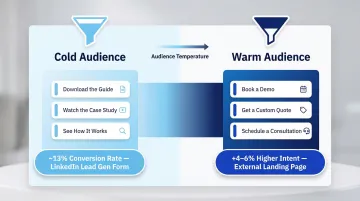
Match your CTA to audience warmth:
| Funnel Stage | Recommended CTA | Conversion Rate |
|---|---|---|
| Cold Audience | "Download the Guide," "Watch the Case Study," "See How It Works" | LinkedIn Lead Gen Forms: ~13% |
| Warm Audience | "Book a Demo," "Get a Custom Quote," "Schedule a Consultation" | External landing pages: 4-6% (higher intent) |
For longer ads (90+ seconds), include a mid-video CTA since many viewers won't watch to the end but may still be interested enough to click early.
Reinforce your CTA visually and verbally—80% of LinkedIn users watch videos with the sound off, and across social media, 85% of videos are consumed without sound. On-screen text or graphics ensure the message lands regardless of audio.
What You Need Before You Start Production
Rushing into production without the right foundations wastes budget and generates creative that fails to convert. Get these elements locked in before any camera rolls.
Messaging and Script Foundation
Before any camera rolls, finalize a script or detailed brief that reflects your audience research. Include:
- Core pain point articulation
- Solution framing and key benefits
- Desired CTA and conversion goal
- Proof points and statistics to reference
A tight script prevents costly reshoots and ensures every second of footage serves a conversion goal.
Platform and Format Clarity
Identify where the ad will run before production begins. Aspect ratio, maximum length, and sound assumptions differ significantly:
- LinkedIn: Square (1:1) or vertical (9:16) for mobile feeds; 15-30 seconds recommended
- YouTube pre-roll: Horizontal (16:9); under 3 minutes for skippable ads, 15-20 seconds for non-skippable
- Meta placements: Various ratios by placement; 5-15 seconds for in-stream desktop, 5 seconds to 10 minutes for mobile
Shooting in the wrong format wastes footage and requires awkward cropping that undermines visual quality.
Production-Quality Standards for B2B
B2B buyers evaluate vendors before they respond to messages — and production quality is part of that evaluation. Grainy footage or muffled audio signals a lack of professionalism before a single word registers. Minimum benchmarks include:
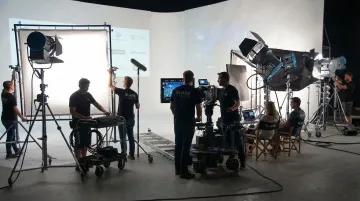
- Lighting: Even, professional lighting that eliminates harsh shadows and ensures subject clarity
- Audio clarity: Broadcast-quality audio capture with minimal background noise (lavalier mics or boom microphones)
- Camera resolution: Minimum 1080p HD, ideally 4K for future-proofing
If in-house resources fall short of these benchmarks, partnering with a full-service production company — one that manages concept through post-production — is often more cost-effective than renting equipment and hiring crew piecemeal. Blare Video, for instance, covers major US markets including Los Angeles, San Diego, Las Vegas, Phoenix, and Tucson with end-to-end production capabilities built for corporate clients.
Key Variables That Determine Whether Your Business Video Ad Converts
Two brands can follow the same production process and get completely different conversion outcomes. The difference usually comes down to four variables that most advertisers configure without enough attention.
Variable 1: Video Length
Business professionals will invest time in a video if it earns that attention quickly. Too short and you can't establish credibility; too long and you lose them before the CTA lands.
Platform-specific recommendations:
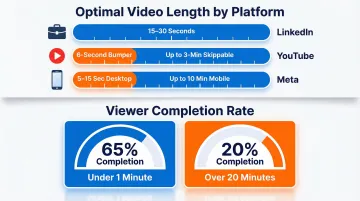
- LinkedIn: 15-30 seconds for most ads; under 15 seconds for brand awareness
- YouTube: Under 3 minutes for skippable in-stream; 15-20 seconds for non-skippable; 6 seconds maximum for bumper ads
- Meta: 5-15 seconds for desktop in-stream; 5 seconds to 10 minutes for mobile in-stream
Completion rate benchmarks:
- Videos under 1 minute: 65% of viewers stay engaged to the end
- Videos over 20 minutes: Only 20% of viewers remain engaged
Variable 2: Tone and Message Framing
B2B buyers respond to rational messaging backed by emotional resonance — not pure logic, and not pure lifestyle. Getting this balance wrong makes ads feel either sterile or off-brand.
The jargon problem: Research from Nielsen Norman Group found that websites using clear, simple language had conversion rates up to 124% higher than those filled with jargon. Conversely, 68% of B2B software buyers abandoned a purchase journey because they couldn't understand what the product actually did.
Effective vs. ineffective tone examples:
Effective (Clear, outcome-focused): "Our platform reduces your compliance reporting time from 40 hours to 4 hours per quarter."
Ineffective (Jargon-heavy, vague): "Leverage our cutting-edge solution to streamline mission-critical workflows and unlock synergies across your organization."
Variable 3: Platform and Audience Targeting
The same video that converts on LinkedIn may underperform on YouTube. LinkedIn users are in active professional mode — evaluating vendors, scanning industry content. YouTube audiences are more passive, which changes how and when your message needs to land.
Platform targeting capabilities:
LinkedIn Campaign Manager allows precise B2B targeting by:
- Job title, job function, and seniority
- Company name, industry, and size
- Matched audiences for retargeting and account-based marketing (ABM)
YouTube Custom Segments enable intent-based targeting:
- Keyword-based targeting around products being researched
- URL targeting based on competitor sites or industry resources
- App targeting for mobile behavior patterns
Variable 4: Thumbnail and First-Frame Visual
On platforms that don't guarantee autoplay, the first frame or thumbnail image determines whether anyone clicks. A weak visual kills the ad before it starts.
Effective first frames for B2B video ads:
- Confident on-camera speakers looking directly at the camera (25-35% higher view rates)
- Bold text overlays with clear value statements
- High-quality branded environments (office settings, product demonstrations)
- Screen recordings showing software functionality
Common failures:
- Blurry stills or auto-generated thumbnails
- Generic stock scenes with no brand identity
- Low-contrast images that don't stand out in feeds
Common Mistakes Businesses Make With Video Ads (and How to Avoid Them)
Trying to Say Too Much
B2B advertisers often pack multiple messages into one ad — several products, multiple use cases, competing CTAs. This dilutes the message for everyone watching. One ad should pursue one objective. Address each buyer persona with separate creative rather than attempting to please everyone in a single spot.
Skipping Audience Validation Before Production
Many businesses script and shoot videos based on internal assumptions about buyer pain points rather than actual customer research or sales team input. Mis-framed problem statements cause viewers to mentally opt out within seconds. Validate your messaging with real buyers before committing to production.
Neglecting Sound-Off Viewing
80% of LinkedIn users and 85% of all social media users watch videos without audio. Ads that rely entirely on voiceover lose half their audience before the hook lands. Make sure your video works on mute:
- Upload SRT caption files to every platform
- Use bold text overlays (5-7 words per screen)
- Build visual storytelling that communicates without sound
Treating Video as a One-Time Asset
High-performing B2B brands treat each video as a testing asset — varying hooks, CTAs, and lengths to find what converts. Not iterating based on performance data means paying full production costs for permanently underperforming creative. Test multiple versions and track completion rates and CTR to know what's actually working.
When to Work With a Professional Video Production Company
DIY video tools can serve early-stage testing, but for B2B brands where production quality directly signals credibility, there is a clear threshold where professional production pays for itself.
Scenarios where professional production becomes essential:
- Enterprise sales cycles where deals exceed $50,000
- High-stakes campaigns representing the brand to C-suite decision-makers
- Events requiring multi-location shoot capabilities
- Brand-defining ad launches with significant paid media budgets
Once those situations apply, the question shifts from whether to go professional to what a production partner actually delivers beyond better cameras.
What professional production brings beyond equipment:
- Concept development and strategic messaging
- Scriptwriting expertise tailored to B2B audiences
- Brand storytelling that builds trust and credibility
- Broadcast-quality post-production polish
Companies like Blare Video offer end-to-end corporate video production across major US markets. Their work with enterprise clients like Google, Williams-Sonoma, and Moss Adams reflects the production caliber that enterprise decision-makers expect.
Signals it's time to go professional:
- Budget is allocated for paid distribution across LinkedIn, YouTube, or Meta
- The ad will represent your brand to senior decision-makers
- In-house attempts have consistently underperformed
- The campaign requires testimonial or event footage at scale
- You're targeting enterprise accounts where credibility is paramount
Frequently Asked Questions
What makes a video ad effective for B2B audiences specifically?
B2B video ads require credibility signals, pain-point precision, and proof-based messaging that consumer ads don't. Professional audiences respond to specific statistics, named clients, and rational outcomes rather than lifestyle imagery or emotional appeals alone. Production quality matters more because it signals trustworthiness.
How long should a business video ad be?
Optimal length depends on platform and audience warmth. For cold audiences on LinkedIn or YouTube, aim for 60-90 seconds—introduce the solution within the first 20-30 seconds, since videos under 1 minute retain 65% of viewers to completion. For retargeting warm audiences, 15-30 seconds works well.
How can I expand the reach of my business video ad?
Cross-promote across platforms, use paid amplification on LinkedIn or YouTube with precise targeting, and repurpose long-form videos into 15-30 second clips for different placements. Always include captions for sound-off viewing and test multiple creative variations.
Is $10 a day enough for Google ads?
While $10/day meets minimum platform requirements, B2B video ad campaigns need higher daily budgets to generate enough data to optimize effectively. LinkedIn recommends a minimum of $100/day per campaign to exit the learning phase given longer sales cycles and higher CPCs in competitive industries. Scale budget once you identify a winning creative.
How do I measure whether my business video ad is converting?
Track hook rate (3-second views), view-through rate, click-through rate (LinkedIn median: 0.24%), cost per lead or demo booked, and downstream pipeline influenced. On YouTube, also monitor engaged-view conversions—users who watch 10+ seconds and convert later. CTR alone won't tell the full story for B2B; measure full-funnel impact.
Should I hire a professional production company or produce video ads in-house?
In-house tools work for early experimentation and low-budget testing. Professional production becomes essential when the ad needs to build credibility with senior business buyers, represent your brand in high-visibility placements, or support enterprise sales cycles. Budget, audience sophistication, and campaign stakes determine the right choice.