Introduction
B2B buyers today demand proof before they commit. 95% of B2B buyers say video plays an important role in deciding to move forward with a purchase, and 41% actively seek out customer reviews to refine their vendor shortlist. Written case studies still matter, but corporate case study videos deliver peer proof in a format that matches how modern buyers actually evaluate vendors. They combine emotional storytelling with hard evidence—and they do it faster than any written asset can.
This guide covers what makes these videos work: key elements, common formats, real-world examples worth studying, and production best practices from pre-production through final cut.
Key Takeaways
- Corporate case study videos turn real client success stories into persuasive video content that builds trust faster than written case studies alone
- The strongest videos follow a clear structure: problem, solution, and measurable outcome — told through an authentic customer voice
- Ideal length is 90 seconds to 2.5 minutes; longer videos risk losing viewer attention before the payoff
- Production quality matters: clean audio, sharp lighting, and tight editing are what separate forgettable videos from ones that actually convert
- Four main formats serve different goals: testimonial-driven, results-led, narrative storytelling, and animation
What Is a Corporate Case Study Video (and Why It Matters)
A corporate case study video is a short-form video in which a real client describes a business challenge they faced, the solution your company provided, and the measurable impact it created. Unlike a general testimonial, this format follows a defined problem-solution-result structure, incorporates supporting visuals or data, and is built to hold up under the scrutiny of a B2B buying committee. Your brand plays the role of trusted partner — the client's results do the convincing.
Why this format matters:
- 70% of B2B buyers say video is the best content format for creating awareness of business-related problems
- 63% of B2B tech buyers say short-form social video content from industry experts helps inform buying decisions
- Video delivers proof faster than text alone, making it ideal for decision-makers evaluating multiple vendors under time pressure
That last point is what drives corporate marketing teams toward this format. A well-produced case study video answers the one question that moves deals forward: "Has this worked for a company like mine?"
Key Elements of a High-Performing Corporate Case Study Video
Compelling Story Arc
The most effective corporate case study videos follow a three-act structure:
- Act 1: Introduce the client's pain point or business challenge with enough specificity that your target audience recognizes themselves
- Act 2: Show how your product or service intervened, including implementation details that build credibility
- Act 3: Deliver measurable outcomes that prove business impact
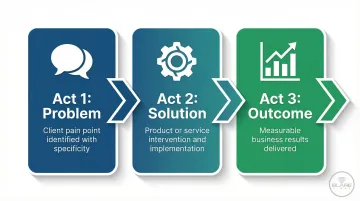
Skipping or rushing Act 1 costs you emotional engagement — and viewers who don't feel the problem won't care about the solution.
Authentic Interview Subject (the "Champion")
The spokesperson matters. A real client speaking on camera with genuine enthusiasm is far more persuasive than a scripted actor. Select someone who can:
- Speak specifically to business outcomes, not just general satisfaction
- Represent the target buyer persona (job title, industry, company size)
- Communicate clearly and confidently on camera
Data and Measurable Proof
Concrete numbers are what make B2B audiences trust the story. Include:
- Cost savings or revenue growth percentages
- Time reclaimed (hours, days, weeks)
- Conversion lifts or efficiency gains
- Scale indicators (headcount doubled, customer base tripled)
Even directional figures like "cut onboarding time roughly in half" carry more weight than vague praise.
Visual Proof and Supporting Footage
Cutaways serve two purposes: they break up the interview and validate claims visually. Include:
- Product walkthroughs or interface demos
- On-location office footage showing real work environments
- Workflow demonstrations
- Team interactions
Strong B-roll gives skeptical viewers something concrete to anchor the claims they're hearing — without it, even a compelling interview can feel unsubstantiated.
Optimal Length and Pacing
Industry data suggests testimonial videos perform best between 60 and 90 seconds, though corporate case studies often extend to 2.5 minutes when complexity requires it. If a video is under 1 minute, 65% of viewers stay engaged all the way to the end. Beyond three minutes, engagement drops steadily.
Every cut should have a purpose. If a clip doesn't advance the story, build credibility, or move the viewer toward the CTA, it belongs on the cutting room floor.
Best Formats for Corporate Case Study Videos
Not all corporate case study videos look the same. The right format depends on your marketing goal, solution complexity, and what story your client can best tell. Choosing the format before scripting begins saves significant time in production.
Challenge-Solution-Impact (Structured)
The most widely used format in B2B video, it mirrors how buyers naturally evaluate decisions. The structure:
- Open with the client's problem
- Transition to the solution and implementation
- Close with measurable results
This format suits enterprise audiences who want clarity and proof without narrative ambiguity.
Testimonial-Led
The entire video anchors around a single client voice — usually a senior stakeholder whose credibility carries the message. A VP at a Fortune 500 company vouching for a B2B vendor is a natural fit here, where the speaker's title is itself a form of social proof.
Results and Data-Driven
This format leads with outcomes first — a headline result like "29% increase in qualified leads" — before unpacking how it happened. Performance-driven audiences in sales, finance, or operations tend to respond to hard numbers before they'll engage with the story behind them.
Narrative / Brand Storytelling
A cinematic approach that treats the client's journey as a short story — slower pacing, emotional music, rich visuals — designed to build brand affinity rather than just prove ROI. The production investment is higher, but the output tends to be the most shareable and memorable of any format.
Animation and Mixed Media
When live interviews aren't feasible, or when the product or process is too abstract to film, animation or motion graphics can tell the story just as effectively. It's also the practical choice when a client prefers to stay off camera entirely.
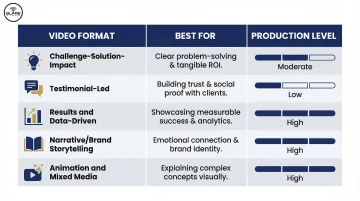
Here's a quick reference for matching format to context:
| Format | Best For | Production Level |
|---|---|---|
| Challenge-Solution-Impact | Enterprise B2B, complex sales cycles | Moderate |
| Testimonial-Led | High-credibility spokespeople, brand trust | Moderate |
| Results & Data-Driven | Sales, finance, ROI-focused audiences | Moderate |
| Narrative / Brand Storytelling | Brand campaigns, top-of-funnel awareness | High |
| Animation & Mixed Media | Abstract products, camera-shy clients | Varies |
Corporate Case Study Video Examples Worth Studying
These five case study videos each do something distinct well. Studying them — and the specific choices behind them — gives you a practical blueprint for your own production.
Slack (Built in Slack / Fazz Financial Group)
Slack's case study featuring Fazz Financial Group succeeds by letting the customer carry the story authentically. The client specifically quantifies impact: "Slack integrations have automated so many of our tasks and reduced emails by 90%."
The lesson: Specificity in client quotes is what creates conviction.
HubSpot (EZ Texting)
The HubSpot / EZ Texting case study works by making the workplace feel real — office footage, live call environments, team interactions — which gives the story a credible, lived-in quality. The client notes they "tripled headcount" as a direct result.
The lesson: B-roll that shows the client's actual environment makes the story feel more credible on screen.
Salesforce (Valpak)
The Salesforce/Valpak case study gets right to the problem without preamble: "We have been a paper-based organization for 20 plus years... writing contracts on carbon copy pieces of paper." The video uses visuals to explain a complex workflow and ties the solution directly to business relief: "Our quote time is now 70% quicker."
The lesson: Opening with the problem — not the company's credentials — hooks the audience immediately.
Dropbox (Missouri Star Quilt Company)
The Dropbox Missouri Star Quilt Company case study uses a cinematic short-film approach to turn a small business success story into an emotionally resonant case study that ends with community impact: "Missouri Star has brought life back to Hamilton... it's changing people's lives."
The lesson: High production value and emotional storytelling are justified when the goal is brand differentiation, not just lead generation.
Xero (The Business of Dog Massage)
The Xero SMB testimonial works because it immediately identifies its target audience (small business owners), uses plain language to explain pain points, and closes with a concrete efficiency win. Audience-specific language and relatable pain points make even simple productions highly effective — proof that budget doesn't determine impact.
What these examples share: Each video leads with a real problem, uses the customer's own words to quantify the result, and keeps the production choices in service of the story — not the other way around. Those are the same principles worth applying before your camera rolls.
Best Practices: From Pre-Production to Final Cut
Pre-Production (Finding Your Champion and Mapping Your Story)
A case study video is only as strong as its subject. The first step is coaching clients to identify the right spokesperson — ideally a senior stakeholder with a specific success story and willingness to speak on camera.
Writing targeted interview questions before filming is critical. Questions should draw out:
- The problem in the client's own words
- The turning point or decision moment
- The measurable result with specific numbers
That interview prep work pays off on shoot day. Blare Video's pre-production process includes story development and client coaching specifically so spokespeople arrive confident and on-message — not figuring it out in front of the camera.
Production Quality Considerations
Corporate audiences notice quality. Non-negotiables include:
- Clean audio: Lapel or boom mic (never rely on on-camera audio alone)
- Professional lighting: Three-point lighting or natural light setups that flatter the subject
- Steady camera work: Tripod or gimbal stabilization
- Purposeful B-roll: Office environments, product demos, team interactions
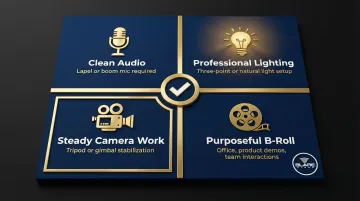
Even strong interview footage can lose credibility in post if production fundamentals were skipped. Watch for these common mistakes:
Common mistakes that undercut credibility:
- On-screen text that disappears before it can be read
- Inconsistent color grading between shots
- Background distractions in interview settings
- Poor audio quality (echo, background noise, low volume)
Post-Production: Editing, Branding, and CTA
Raw footage doesn't tell a story — editing does. These post-production decisions shape whether the final video lands or falls flat:
- Tight editing: Remove anything that doesn't serve the arc
- Consistent branding: Brand colors, fonts, and logo placement throughout
- Clear CTA: URL, tagline, or spoken invitation to learn more
Video length discipline is a post-production decision. If the story can be told in 90 seconds, don't stretch it to three minutes.
Conclusion
Corporate case study videos work when they prioritize the client's story over the brand's credentials. Authentic voices, real data, and professional production determine whether a video builds trust or gets skipped.
Producing a case study video that performs requires more than good equipment. It requires a production partner with experience in corporate storytelling, interview direction, and brand-accurate post-production. Blare Video works with corporate clients across Los Angeles, San Diego, Las Vegas, Phoenix, and Tucson to produce case study videos that do exactly that.
Frequently Asked Questions
What is a corporate case study?
A corporate case study documents how a real client used a company's product or service to solve a specific business problem. In video form, it combines the client's authentic voice with supporting visuals and data to build credibility with prospective buyers.
What are the 5 components of a case study?
Every case study video covers five core elements:
- Client background and context
- The challenge or problem faced
- The solution implemented
- Measurable outcomes or results
- The client's reflection or recommendation
In video format, these elements are woven into a narrative arc rather than presented as a checklist.
How long should a corporate case study video be?
The industry-recommended range is approximately 90 seconds to 2.5 minutes for most corporate use cases. Shorter cuts work well for social media; slightly longer formats are appropriate for sales enablement pages or conference presentations.
What makes a good corporate case study video?
The strongest case study videos feature a credible spokesperson and a clear problem-solution-result structure. Specific measurable outcomes are non-negotiable — and audio, lighting, and editing quality must reflect the professionalism of the brand.
How much does it cost to produce a corporate case study video?
Costs vary widely based on production scope, location, number of shoot days, and post-production complexity. 42% of companies spend under $1,000 annually on video production, while 12% spend over $20,000. A production company covering your market can give you an accurate quote once they understand your scope and goals.
What types of companies benefit most from case study videos?
B2B companies with longer sales cycles benefit most — particularly in technology, professional services, healthcare, financial services, and enterprise software. According to Forrester, the typical B2B buying decision now involves 13 internal stakeholders and nine external influencers. Credible peer proof is essential for reducing buyer hesitation at every stage of that process.