Introduction
Audiences will skip a 30-second ad without hesitation, then spend 10 minutes watching a brand story they actually care about. With ad-skipping rates on streaming platforms above 60% and ad blocker usage climbing past 40%, corporate documentaries have shifted from "nice-to-have" extras to essential storytelling tools that drive measurable business outcomes.
The best corporate documentaries don't feel like ads at all — they feel like films. That distinction is what builds genuine viewer trust, strengthens brand loyalty, and earns the kind of attention paid media rarely can.
This guide covers what corporate documentaries are, five outstanding real-world examples from major brands, and actionable lessons marketers can apply to their own storytelling strategies.
Key Takeaways
- Corporate documentaries work because they use real people and candid interviews — not scripted ad copy
- The best examples serve clear business goals—CSR awareness, brand origin, community connection—without feeling like sales pitches
- The five examples here span industries and formats, with takeaways for companies of any size
- Recurring techniques: handheld camera work, on-camera interviews, story-driven structure, and b-roll shot in real environments
What Is a Corporate Documentary Video?
A corporate documentary is a business video that uses documentary filmmaking conventions—subject interviews, improvised activity footage, handheld camera movement, and narrative arc—to communicate a brand's values, purpose, or story. Unlike standard corporate videos that directly showcase services or credentials, documentaries place real people at the center and let their experiences carry the message.
Where a standard corporate video tells viewers what a company does, a documentary shows them why it matters — through the voices of real employees, customers, or community members.
That distinction makes the format surprisingly versatile. Corporate documentaries serve across:
- PR campaigns, social media content, and investor communications
- Employee recruitment and internal culture storytelling
- Event screenings and brand milestone documentation
- Long-form content that extends the ROI of a single production day
The format's power comes from its authenticity. Audiences are quicker to trust a story told through real people and unscripted moments than one delivered through polished narration alone.
5 Great Examples of Corporate Documentary Videos
These five examples were selected for their storytelling technique, clarity of business purpose, and the practical lessons they offer to brands considering the documentary format. They span different approaches—CSR campaigns, community storytelling, heritage branding, founder stories, and environmental advocacy—so you can identify which model fits your goals.
Example 1: Coca-Cola's 5by20 Campaign
The Initiative: Coca-Cola's 5by20 program set a global goal to economically empower 5 million women entrepreneurs across its value chain by 2020. Launched in 2010 with pilot markets in South Africa, Brazil, India, and the Philippines, the initiative ultimately reached over 6 million women across 100 countries.
Documentary Approach: The 5by20 documentary series features real women in real communities, shot on location across multiple countries. Films highlight entrepreneurs like Maya from Indonesia and Lea, who makes bags from recycled bottles. There's no product placement, no sales pitch—just authentic stories of transformation.
Why It Works: This is a textbook example of using documentary film to humanize a global corporation. Coca-Cola doesn't sell a product; it sells a value system. The authenticity of subjects' stories does the heavy lifting that no ad copy could accomplish. An impact study by Ipsos in South Africa revealed that participants' average business sales increased by 46%, giving the documentary series concrete proof points.
| Documentary Type | Storytelling Technique | Business Goal |
|---|---|---|
| CSR / Social Impact | On-location interviews with beneficiaries, real community footage, no scripted narration | Strengthen brand reputation and global goodwill through corporate social responsibility |
Example 2: Starbucks – A Community Story
The Production: In 2014, Starbucks launched "Meet Me at Starbucks," its first global brand campaign. The centerpiece was a 6-minute interactive mini-documentary plus eight short films, culled from 220 hours of footage shot by 39 filmmakers across 59 locations in 28 countries. All of it was captured within a single 24-hour period.
One standout short, Rebuilding Memories, follows Jean'ette and Rosaria, who meet weekly at Starbucks for a scrapbooking club. After experiencing loss, Rosaria found community and healing through this simple gathering. Starbucks is the setting, not the subject.
Why It Works: By keeping the brand in the background and letting a deeply human story unfold organically, the film communicates Starbucks' positioning as a "third place"—a home away from home—far more effectively than any tagline. Nielsen research shows that advertisements with strong emotional response increase sales by 23% overall.
| Documentary Type | Storytelling Technique | Business Goal |
|---|---|---|
| Customer / Community Story | Personal testimonial as voice-over, emotional narrative arc centered on a non-brand subject | Reinforce brand positioning as a community gathering place and drive emotional affinity |
Example 3: Stella Artois – The Painted Sign
The Film: Released in 2010 and directed by Malcolm Murray, Up There is a 12-minute documentary about the dying art of hand-painted wall advertising. The film follows painters from Sky High Murals and Colossal Media as they spend 21 days painting Stella Artois' nine-step pouring ritual on a 20-by-50-foot SoHo wall.
The story focuses on the art and the artists. The product appears prominently—it's literally being painted on the wall—but the narrative never shifts to sell the beer. Audiences watch because the subject is genuinely interesting; brand exposure follows naturally.
Why It Works: This is one of the best examples of product placement done through documentary film. The brand never interrupts the story; it's woven into it. The technique works especially well for heritage or lifestyle brands that want to align with craftsmanship and culture. Up There was shortlisted at the 2010 Cannes Lions for Directing Craft and earned a One Show Documentary Merit.
| Documentary Type | Storytelling Technique | Business Goal |
|---|---|---|
| Brand Values / Cultural Heritage | Subject-driven narrative focused on artisans, with product embedded organically in visual content | Associate brand with craft, artistry, and cultural preservation to elevate brand prestige |
Example 4: Adobe Photoshop – The Founders' Story
The Documentary: To celebrate Photoshop's 20th anniversary in 2010, Adobe released Startup Memories — The Beginning of Photoshop, an 18-minute documentary featuring a roundtable interview with founders Thomas Knoll, John Knoll, Russell Brown, and Steve Guttman. The film blends archival news footage, old photographic stills, and candid group conversation.
Why It Works: Founder-driven documentaries are highly effective for technology companies because they transform software products into human stories. Audiences connect with creators' curiosity, struggle, and vision rather than a list of features. This format builds credibility and legacy—particularly valuable for established brands that need to reinforce industry authority without launching a new product. For any brand with a compelling origin, this format converts internal history into external trust.
| Documentary Type | Storytelling Technique | Business Goal |
|---|---|---|
| Origin / Founder Story | Multi-subject group interview combined with archival stills and news footage | Build brand legacy, celebrate company history, and reinforce creative authority |
Example 5: Patagonia – Environmental Brand Documentary
The Approach: Patagonia has produced multiple corporate documentaries—most notably around environmental activism and outdoor conservation. DamNation (2014), an 87-minute film directed by Ben Knight and Travis Rummel, explores the U.S. dam system and advocates for dam removal and river restoration. Patagonia funded the $500,000 production.
DamNation won the Documentary Spotlight Audience Award at SXSW 2014 and the Documentary Award for Environmental Advocacy at the Environmental Film Festival. Distributed via theatrical tours, Vimeo on Demand, and Netflix, the film generated over 42,000 petition signatures asking President Obama to crack down on "deadbeat dams."
Why It Works: Patagonia's documentary work builds brand identity around a belief system rather than a product line. Products rarely appear, but values are front and center. Customers who align with those values become advocates, not just buyers.
That model is now being replicated across retail, food, and tech sectors—driven by its measurable impact on customer loyalty and earned media reach.
Patagonia Films continues producing impactful work, including Artifishal (2019) and shorter films like Cochamó Por Siempre and The Last Observers.
| Documentary Type | Storytelling Technique | Business Goal |
|---|---|---|
| Brand Mission / Environmental Advocacy | Issue-driven narrative, real environmental subjects, cinematic outdoor footage | Attract values-aligned customers, generate earned media, differentiate through purpose-led storytelling |
What Makes These Examples Great: Key Techniques to Note
Lead with People, Not Products
The common thread across all five examples: none lead with the product or the brand. They lead with a human being, a community, a craft, or a cause. The brand's role is always to enable the story, never to interrupt it. That restraint is what earns viewer trust.
That philosophy shows up in three concrete production choices worth borrowing.
Three Essential Production Techniques
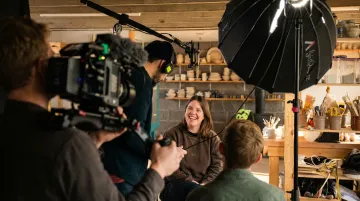
Candid Subject Interviews: Shot in natural environments — workshops, kitchens, job sites — not staged boardrooms. The difference is immediately visible: subjects talk, they don't perform.
Real Activity B-Roll: Painters painting, entrepreneurs working, scrapbookers creating. No stock footage. Authentic activity captured in the moment gives the story visual evidence.
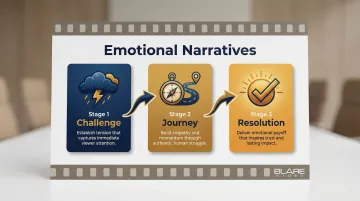
Emotional Narrative Arc: Every documentary follows a structure: challenge → journey → resolution. That arc gives viewers a reason to keep watching — and a reason to care.
Length and Distribution
The most effective corporate documentaries in this list run 3-8 minutes for social and web use, but their storytelling depth makes them feel longer. Research shows:
| Platform | Optimal Length | Engagement Benchmark |
|---|---|---|
| LinkedIn (B2B) | 30-90 seconds | Videos under 30 seconds show 200% higher completion rates |
| YouTube | 5-10 minutes | 51% of B2B buyers research here; ideal for discoverability |
| Brand Websites | 2-5 minutes | Best for converting viewers, especially with lead-gen forms (up to 65% conversion) |
Don't fear long-form content. A 35% retention on a 30-minute video represents 10.5 minutes of watch time — a strong signal to platform algorithms and a meaningful amount of time a viewer spent with your brand.
How to Plan Your Own Corporate Documentary
Start with Audience Values, Not Brand Messaging
Planning begins by identifying the intersection of what your audience cares about and what your company genuinely does. The story lives in that overlap, not in a list of services or achievements.
Ask:
- What challenges do our customers face?
- What values do we share with them?
- What human stories can illustrate those shared values?
Define the Format Before the Script
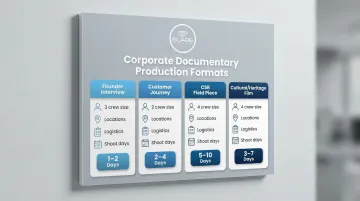
Once the story angle is identified, the production format should follow. Each format requires different resources:
Founder Interview:
- Small crew (director, cinematographer, sound)
- Single location or controlled environment
- Archival material sourcing
- 1-2 shoot days
Customer Journey:
- Multiple locations (customer's environment)
- Documentary crew with mobility
- Release forms and scheduling coordination
- 2-4 shoot days
CSR Field Piece:
- International or multi-location travel
- Larger crew with local fixers
- Cultural sensitivity and translation
- 5-10 shoot days
Cultural/Heritage Film:
- Subject matter experts and access
- Cinematic production values
- Specialized equipment (drones, stabilizers)
- 3-7 shoot days
Work with Professional Production Teams
Once you know your format, the right production team makes the difference between a polished documentary and a missed opportunity. Blare Video has produced documentary-style brand content for clients including Google, TikTok, and Taco Bell across Los Angeles, San Diego, Las Vegas, and beyond. Their full-service approach covers:
- Pre-production planning and story development
- Professional camera crews with broadcast-grade equipment
- Post-production editing and color grading
That end-to-end support shortens production timelines and keeps the final cut aligned with your brand story from day one.
Conclusion
Corporate documentaries work because they respect the audience's intelligence. Rather than selling, they show — and let viewers draw their own conclusions. That's why their emotional impact tends to outlast traditional ad campaigns.
When done well, documentary-style content builds a level of trust that most marketing formats can't match — and creates brand advocates who connect around shared values, not just transactions.
If you're considering a corporate documentary, connect with Blare Video to discuss the story your brand has to tell and how a professional production team can produce it across Los Angeles, San Diego, Las Vegas, Phoenix, Tucson, and beyond.
Frequently Asked Questions
What is a corporate documentary?
A corporate documentary is a business video produced in documentary style—using real people, candid interviews, and authentic storytelling—to communicate a brand's values, history, or social impact without relying on a scripted promotional format.
How much does a 30 minute documentary cost?
Production costs vary based on crew size, shoot days, locations, and post-production complexity. Professional corporate documentaries typically range from $20,000 to $300,000+, with broadcast-quality projects at the higher end of that range.
What is the difference between a corporate video and a corporate documentary?
A corporate video is typically scripted, brand-led, and focused on showcasing products or services, while a corporate documentary is story-led, featuring real subjects and unscripted moments that build emotional connection with the audience rather than delivering a direct message.
How long should a corporate documentary be?
Most effective corporate documentaries for digital and social distribution run between 3 and 8 minutes. Longer cuts (15–30 minutes) are reserved for investor presentations, event screenings, or dedicated YouTube channels where engaged audiences seek in-depth content.
What types of companies benefit most from corporate documentaries?
Corporate documentaries work especially well for brands with strong community ties, notable founding stories, active CSR programs, or mission-driven positioning. Technology, healthcare, consumer goods, nonprofits, and financial services companies use the format most often—though any brand with a genuine story to tell can benefit.