Introduction
SaaS companies face a brutal reality at launch: buyers are skeptical, and even genuinely good products get ignored when their launch videos feel mediocre. A detailed feature walkthrough no longer cuts it. Buyers have sat through thousands of SaaS demos and been promised transformation before.
The real challenge in 2026 isn't making a launch video — it's making one that changes how your buyer thinks about their own problem before you ever mention your product.
That's exactly what the best launch videos of 2026 do. This post breaks down standout examples, identifies what each one does differently, and pulls out the repeatable patterns any SaaS team can apply — whether you're targeting enterprise buyers, building waitlist buzz, or fighting for space in a crowded category.
Key Takeaways
- SaaS launch videos that convert lead with a problem reframe, not a feature list
- Standout examples: Slack, Airtable, Figma, Pendo, Ceipal, and Bolt by Superside — each using a distinct storytelling approach
- Effective videos address 2–3 specific pain points and engineer a single mental shift
- Match video type to funnel stage: explainer for awareness, demo for consideration, launch highlight for PR
- Choose a production team with SaaS storytelling experience — narrative strategy matters as much as camera work
What Makes a Great SaaS Product Launch Video in 2026
The defining quality of 2026's best launch videos is not production budget. It's whether the video changes how the viewer thinks about their own problem. Buyers have seen thousands of SaaS demos. They're immune to feature walkthroughs. The videos that break through don't demonstrate capabilities—they reframe the buying decision.
Three Core Video Types and When to Deploy Each
The Explainer (Top of Funnel)
30–90 seconds, focuses on the problem and the cost of inaction. Ideal for awareness campaigns, paid social, and landing page traffic from cold audiences who don't yet understand the stakes.
The Product Demo (Consideration)
2–5 minutes, shows real workflows and how the product operates inside the user's day-to-day. Built for prospects already convinced there's a problem and actively evaluating solutions.
The Teaser/Hype Video (Pre-Launch)
15–60 seconds, generates buzz and drives waitlist sign-ups. Prioritizes emotion, curiosity, and brand energy over detailed explanation.
The AIDA Framework for SaaS Launch Videos
The Attention-Interest-Desire-Action (AIDA) model remains the proven psychological framework for B2B video scripting, even in an AI-saturated 2026 landscape. Here's how it adapts for SaaS launches:
- Attention (0–8 seconds): Hook the pain immediately. Don't lead with your logo or company intro. Lead with the problem your buyer wakes up thinking about
- Interest (8–30 seconds): Agitate the problem. Show the cost of staying on the current path—wasted time, revenue leakage, team friction, competitive disadvantage
- Desire (30–60 seconds): Position your product as the obvious solution by showing the transformed state, not just feature capability
- Action (final 5 seconds): Single, frictionless CTA. One link, one next step, zero ambiguity
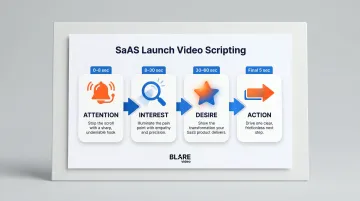
Scripts that skip problem agitation fail for one reason: the viewer never feels the stakes, so there's no urgency to act.
Script structure gets buyers to the door. Visual execution determines whether they walk through it.
Visual Storytelling Principles That Separate Good From Great
- One metaphor per concept. If you need three analogies to explain one feature, simplify the feature or the script
- Match your visual energy to your product's core value. Bolt's kinetic animation reflects checkout speed; Figma's rapid UI pacing mirrors design velocity
- Brand identity dictates style. A technical, precise brand needs sharp and minimal visuals; a creative, bold brand needs personality to match
According to Wyzowl's 2023 research, 89% of people say watching a video convinced them to buy a product or service, and 82% of marketers report positive ROI from video. For SaaS launches specifically, where buyers are evaluating multiple look-alike tools simultaneously, the video that frames the problem most clearly tends to win the shortlist.
Best SaaS Product Launch Video Examples for 2026
These six examples were chosen for their ability to reframe the buying decision, not just demonstrate features. They span different industries, budgets, and visual styles to provide a range of inspiration—but all of them engineer a mental shift in the first 30 seconds.
Slack — Long-Form Product Launch
Slack's "Meet the new Slack" launch deliberately breaks the "keep it under 2 minutes" rule with a 4-minute deep dive into their next-generation platform. The video walks through a complete real-world workflow for both technical and non-technical users, addressing how teams operate when AI agents, CRM data, and conversational interfaces converge in one workspace.
Why this works: Depth beats brevity when the product changes how entire teams operate. The animation keeps it engaging, and practical examples make it concrete for multiple buyer personas—developers evaluating integrations and executives weighing platform consolidation. Slack doesn't rush. It earns every second by showing transformation, not just capability.
| Attribute | Detail |
|---|---|
| Video Style | Live-action with motion graphics and screen recordings |
| Ideal Funnel Stage | Mid-to-bottom funnel, consideration to decision |
| Key Technique | Full workflow walkthrough addressing both developer and non-developer users |
Airtable — "Introducing a New Generation of Airtable"
Airtable's product evolution video introduces Omni, their AI assistant, through before-and-after workflows that show databases running on autopilot. It positions the launch as a "refounding moment"—a fundamental shift in what the platform can do, not just an incremental update.
What makes this effective: AI is a buzzword. Airtable makes it practical by showing specific time saved and decisions automated. The before-and-after contrast makes the value visceral. The "platform evolution" framing also reassures existing users they're not being left behind—they're being elevated.
| Attribute | Detail |
|---|---|
| Video Style | Screen-recording with UI overlays and motion design |
| Ideal Funnel Stage | Top to mid funnel, awareness to consideration |
| Key Technique | Before-and-after workflow contrast centered on one transformed use case |
Figma — "All the Launches at Config 2025"
Figma's Config 2025 highlights reel has no voiceover—just fast, clean screen recordings of new features set to upbeat music. The video makes complex functionality feel effortless by trusting the product's own interface to sell. The rapid pacing respects the viewer's time, and the absence of narration signals confidence in the UI.
Why this works: If your product UI is polished and intuitive, let it speak. The practical lesson: if you need a voiceover to explain what's on screen, the UI may not be ready. Figma's video is a masterclass in interface-led storytelling, and it's built for social sharing at the top of the funnel.
| Attribute | Detail |
|---|---|
| Video Style | Screen recordings only, no voiceover |
| Ideal Funnel Stage | Top of funnel, awareness and social sharing |
| Key Technique | Interface-led storytelling with music to set emotional tone |
Pendo — Unified Product Optimization
Pendo's Pendomonium 2024 launch video shows the complete product loop: user behavior data flows into in-app guidance, which triggers centralized feedback collection, which informs the next iteration—all within one platform. Integration is the hero of the story, not individual features.
The key lesson: The video positions Pendo against the pain of running three separate tools. It demonstrates continuous flow from data to action without switching tabs. By showing handoff points between features, Pendo sells the integrated system, not discrete capabilities. That's a direct answer to a real pain point: tool sprawl.
| Attribute | Detail |
|---|---|
| Video Style | Continuous screen recording with annotated UI flows |
| Ideal Funnel Stage | Mid to bottom funnel, consideration to decision |
| Key Technique | Showing handoff points between features to sell the integrated system |
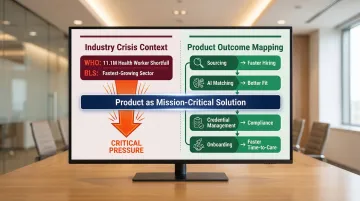
Ceipal — Solving Healthcare's Talent Crisis
Ceipal's urgency-forward launch video opens with a macro industry statistic: the healthcare worker shortage is a crisis impacting patient outcomes. The video then walks through sourcing, AI matching, credential management, and onboarding—connecting every feature to life-impacting outcomes, not just recruitment efficiency.
Why this works: Leading with a real industry crisis creates immediate stakes. The World Health Organization projects a global shortfall of 11.1 million health workers by 2030, and the U.S. Bureau of Labor Statistics forecasts healthcare as the fastest-growing sector through 2034. Ceipal elevates the product from a tool to a mission-critical solution by tying recruitment speed to patient care. The lesson: connect product value to higher-order buyer outcomes.
| Attribute | Detail |
|---|---|
| Video Style | Animated explainer with industry data overlays |
| Ideal Funnel Stage | Top of funnel, awareness and demand generation |
| Key Technique | Crisis framing followed by feature-to-outcome mapping |
Bolt by Superside — Cinematic Brand Launch
Bolt's 60-second explainer, produced by Superside with 2D/3D hybrid animation, feels like an "A24 opening credit" rather than a corporate SaaS video. The motion design delivers the sensation of one-click checkout speed through kinetic visuals. You don't just hear that Bolt is fast—you feel it.
Production insight: The video matches Bolt's "electric dynamism" brand identity. The animation style makes you experience the product's core value (speed and simplicity) rather than just being told about it. This is the benchmark for motion-matched brand storytelling in SaaS.
Superside staffed 18 dedicated creatives and delivered in under 30 days, resulting in a 600% increase in creative output for Bolt that month.
| Attribute | Detail |
|---|---|
| Video Style | 2D/3D hybrid animation, cinematic pacing |
| Ideal Funnel Stage | Top of funnel, brand awareness and paid social |
| Key Technique | Motion language that mirrors the product's core value (speed and simplicity) |
What the Best SaaS Launch Videos Have in Common
Every video on this list engineers a single mental shift in the viewer. Slack earns depth, Airtable reframes what AI can do, and Figma lets its UI speak for itself. Pendo sells integration; Ceipal sells urgency; Bolt sells feeling. Not one of them opens with a feature list.
The Shared Structural Pattern
Each video follows a problem-contrast-solution arc:
- Old/broken way: Fragmented tools, manual work, slow processes, expensive complexity
- New way: The transformed state your product makes possible
- Proof: Specific workflow, visual demonstration, or outcome mapping
This arc is the repeatable pattern. It works because it mirrors how buyers actually make decisions: they need to see the gap between where they are and where they could be.
The Production Implication
Video style should be chosen based on what the product needs to feel like, not what's cheapest or fastest. The right format depends on what you're selling:
- Screen recordings for polished, self-evident UIs
- Animation for abstract or complex value propositions
- Live-action when human trust is the primary conversion driver
- Hybrid when brand identity is strong and differentiation matters
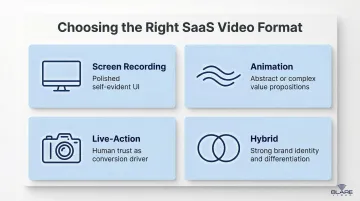
Choosing the right format is only half the equation — execution determines whether the story lands. Blare Video works with technology companies and SaaS brands across Los Angeles, San Diego, Las Vegas, and Phoenix, producing corporate and product videos from concept through post-production.
Conclusion
The best SaaS product launch video is not a production problem—it's a clarity problem. If you can't state the mental shift your buyer needs to make, no animation style will fix it. The videos that work in 2026 start with a reframe, not a feature demo.
Before you write the brief, define:
- What does the viewer believe now?
- What do they need to believe to buy?
- What single shift will get them there?
Build the video around that shift. Then choose the format, length, and visual style to serve that narrative. Production quality matters, but only after narrative clarity is locked.
Once the narrative is clear, the right production partner can bring it to life. Connect with Blare Video for full-service video production — from concept through post-production — across Los Angeles, San Diego, Las Vegas, Phoenix, and beyond. They work with technology companies and corporate brands to produce launch videos grounded in clear narrative, not just polished visuals.
Frequently Asked Questions
How long should a SaaS product launch video be?
60–90 seconds is the sweet spot for top-of-funnel launch and explainer videos. Product demos for mid-funnel consideration can extend to 2–3 minutes. The rule is to earn every second with relevant content, not to hit a target duration.
What is the difference between a product launch video and a product demo video?
A launch video creates awareness and builds excitement around a new product or feature, prioritizing emotion and the problem-solution arc. A product demo digs into specific workflows to help an interested prospect evaluate and decide.
What video format works best for SaaS product launches in 2026?
Animated explainers work well for complex products with abstract value propositions. Screen-recording-led videos work when the UI is polished and intuitive. Cinematic live-action or hybrid formats work best when brand identity is strong. Format choice should serve the product's tone and audience, not default to what's trendy.
How much does a SaaS product launch video typically cost to produce?
Production costs range from a few thousand dollars for simple screen recordings to $15,000–$50,000+ for animated or cinematic work. Wyzowl's 2024 survey found the average 1-minute animated explainer costs $8,457, with costs scaling based on animation style and number of deliverable variations.
Where should SaaS companies distribute their product launch video?
Start with your landing page hero section, then expand to LinkedIn, YouTube, paid video ads, and email launch sequences. YouTube is used by 82% of businesses and LinkedIn by 70%. Build the video modularly so shorter clips can be repurposed across every channel without a separate shoot.
What is the biggest mistake SaaS companies make in their launch videos?
Leading with features instead of the buyer's problem. This results in a polished video nobody watches because it never makes the viewer think "that's exactly my situation." The fix: start the script with the pain, not the product.