Introduction
Brands entering new markets face a fundamental challenge: new audiences don't know them yet. Without existing trust or recognition, even the strongest value proposition struggles to gain traction. According to Nielsen research, increasing brand awareness by just 1% drives a 1% increase in future sales, making visibility the first step toward measurable growth.
Professional video production addresses this trust gap faster than most other formats. Video combines visual identity, narrative, and emotion into a single asset—communicating who a brand is and why it matters before a viewer clicks away.
This guide covers the types of brand videos that accelerate expansion, the five-stage production process that ensures quality, and how to distribute content strategically across platforms and markets. It also outlines what to look for in a production partner built for multi-market growth.
Key Takeaways
- 91% of businesses now use video as a marketing tool, with 85% of consumers convinced to purchase after watching a brand video
- Different video types serve different goals: brand films build trust, testimonials convert skeptics, and event coverage earns credibility with new audiences
- All 5 production stages carry equal weight; skipping or rushing any one of them quietly kills results
- Distribution strategy matters as much as content quality; great videos that only reach existing audiences don't drive expansion
- Choosing a production partner with multi-market capabilities and full-service execution turns video from a one-off project into a growth engine
Why Video Production Is the Engine of Brand Expansion
Video Dominance in Consumer Decision-Making
Video has become the default medium for discovery and evaluation. 91% of businesses now use video as a marketing tool, up from just 61% in 2016, reflecting a fundamental shift in how companies communicate with audiences. Equally telling, 85% of people say they've been convinced to buy a product or service by watching a video.
The reason is effectiveness. Video compresses brand identity, value proposition, and emotional resonance into a format consumed in under two minutes. For brands entering unfamiliar markets, that density does real work — simultaneously explaining what you do and signaling who you are.
The Mechanics of Brand Expansion
Brand expansion requires three specific outcomes: building awareness in new geographic markets, communicating value propositions to unfamiliar audiences, and accelerating the trust-building process that typically takes dozens of touchpoints.
Video addresses all three:
- Builds awareness faster — visual and auditory elements together create stronger recall than text alone
- Demonstrates complex offerings rather than just describing them
- Signals credibility through authentic storytelling, customer testimonials, and professional production quality
SEO and Discoverability Advantages
Video content improves search rankings, increases time-on-site, and reduces bounce rates — all of which amplify organic reach into new markets. Landing pages with embedded video see an 80% to 86% increase in conversion rates, and video thumbnails in search results increase click-through rates by 50%.
AI Overviews are now reducing standard organic clicks by up to 58%. Video counters that pressure — search engines prioritize it, and users engage with it, sustaining visibility where standard text results lose ground.
The ROI Case for Video Investment
Video drives outcomes that show up in revenue, not just reach. Key figures from industry research:
- 85% of video marketers say video directly helped them generate leads
- 83% report it increased sales
- Nielsen data confirms a 1% increase in awareness correlates to a 1% increase in future sales
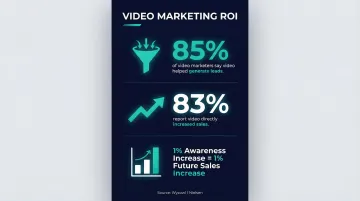
For brands in expansion mode, video production is a revenue-generating asset — one with measurable attribution to both pipeline growth and closed sales.
Types of Brand Videos That Drive Brand Expansion
Different expansion goals require different video types. A brand entering a new market needs awareness content, while one converting a skeptical audience needs proof-based content like testimonials.
Brand Story and Culture Videos
Brand story videos introduce who the company is, what it stands for, and why it exists—critical content when entering a market where the brand has no existing recognition. Authenticity and narrative consistency separate forgettable brand films from ones that build lasting loyalty.
These videos typically feature:
- Founder or leadership interviews
- Company origin stories
- Mission and values narratives
- Behind-the-scenes culture footage
Brand story videos work best early in the expansion funnel, establishing emotional connection before diving into product specifics.
Testimonial and Case Study Videos
Testimonial videos address the biggest barrier to expansion: skepticism from unfamiliar audiences. Customers sharing specific, measurable outcomes reduce perceived risk and accelerate purchase decisions.
This format is most effective in B2B contexts. 84% of B2B decision-makers begin their purchasing process with a reference or recommendation, and case studies rank among the top three trust-building content formats, with 78% effectiveness.
Effective testimonial videos include:
- Specific results and metrics
- Before-and-after narratives
- Customer challenges and solutions
- Authentic, unscripted delivery
Corporate and Event Coverage Videos
Corporate videos—executive interviews, company overview films—and event coverage (conference highlights, product launches) signal organizational credibility and scale. They position the brand as an established player in any new market.
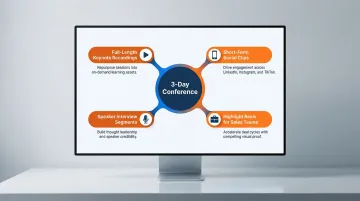
Repurposed event footage extends the reach of a single production investment across multiple platforms and campaigns. A three-day conference can yield:
- Full-length keynote recordings
- Short-form social clips
- Speaker interview segments
- Highlight reels for sales teams
Social Media and Short-Form Video
Short-form video drives top-of-funnel brand expansion. Instagram Reels generate 2.25x more reach than static photos, with 55% of views coming from non-followers.
LinkedIn video averages a 5.60% engagement rate—the highest of any format on the platform—while TikTok holds steady at 3.70%, functioning as a discovery engine for audiences who haven't encountered the brand yet.
Successful short-form video requires:
- Platform-specific formatting (vertical for mobile, square for feeds)
- Hook-driven openings (first 3 seconds determine completion)
- Captions (most social video is watched without sound)
- Clear, singular message per video
Product Demo and Explainer Videos
Demo and explainer videos move audiences from awareness to action by showing exactly how a product or service works—a critical function for complex offerings that words alone can't sell. These are particularly useful when expanding into industries or verticals where the brand's offering is new.
Effective demos include:
- Clear problem statement
- Step-by-step walkthrough
- Real-world use cases
- Visual simplification of complex features
The 5 Stages of Video Production for Brand Expansion
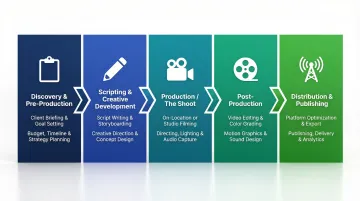
Professional video production is a structured process. "Point and shoot" produces content; structured production produces brand assets. Each stage has defined outputs and decision points. Skipping or underfunding any stage leads to content that fails to represent the brand at the level required for effective expansion.
Stage 1: Discovery and Pre-Production Planning
Pre-production is where strategy lives. This stage defines:
- The video's purpose and expansion goal
- Target audience and market
- Key message and call-to-action
- Format and platform
Pre-production activities include:
- Brief development and strategic alignment
- Scripting and storyboarding
- Location scouting
- Talent casting
- Equipment and crew planning
This is where brand alignment gets locked in before a camera turns on. Decisions made here shape every downstream stage — shortcuts taken now become expensive corrections later.
Stage 2: Scripting and Creative Development
Scripting and concept development translate brand strategy into a narrative arc. This stage covers:
- Tone and voice
- Messaging hierarchy
- Call-to-action structure
- Visual direction
A strong script separates a video that informs from one that moves an audience to act or share. Getting this right requires genuine back-and-forth between the production team and the client — the narrative has to reflect both creative craft and how the brand actually speaks.
Stage 3: Production (The Shoot)
Production is where planning becomes footage. On set, the crew manages:
- Directing talent and coordinating action
- Cinematography (camera movement, framing, composition)
- Lighting (natural, artificial, mixed)
- Sound capture (dialogue, ambient, effects)
- Talent management (blocking, pacing, delivery)
Equipment quality matters. Cinema-grade camera systems like the RED Epic deliver the look that signals brand credibility — shallow depth of field, clean low-light performance, and the resolution required for broadcast or large-format display.
Experienced production crews also manage the variables that catch DIY teams off guard: shifting light conditions, location timing constraints, and the small on-set decisions that determine whether footage is usable in post.
Stage 4: Post-Production
Post-production transforms footage into a brand asset. This phase includes:
- Editing for pace and narrative flow
- Color grading for brand visual consistency
- Sound design and music licensing
- Motion graphics and title treatment
- Final delivery formatting for multiple platforms
This stage typically takes longer than clients expect. Multiple revision rounds are normal — color, pacing, and title treatment each require sign-off before the video is ready for distribution.
Stage 5: Distribution and Publishing
Distribution is the final and often most neglected stage. A video only drives brand expansion if it reaches the right audiences on the right platforms.
Distribution decisions include:
- Platform-native formatting (aspect ratios, file sizes, captions)
- Paid amplification (boosted posts, video ads)
- Website embedding (homepage, landing pages, blog posts)
- Email integration (campaign teasers, nurture sequences)
- Cross-channel repurposing (atomizing long-form into short-form)
Many brands invest heavily in production but fail to allocate budget or strategy for distribution. The result: high-quality videos sitting on a Vimeo page with 12 views. Production spend without a distribution plan is incomplete.
Video Distribution: How to Expand Your Brand Across Markets and Platforms
Different platforms reach different audience segments. A brand expansion strategy requires deliberate decisions about where to distribute which content.
Platform-Specific Distribution Strategy
Website: Embed videos on the homepage, landing pages, and product pages. Landing pages with video see conversion lifts of 80-86%.
YouTube: Optimize for search with keyword-rich titles, descriptions, and tags. YouTube functions as the second-largest search engine, making it essential for discovery.
LinkedIn: Focus on B2B audiences with thought leadership, case studies, and executive interviews. Video engagement on LinkedIn hits 5.60%, making it the highest-performing B2B format.
Social Media: Deploy short-form content (Reels, TikTok, YouTube Shorts) for awareness. These formats prioritize reach to non-followers, making them ideal for market expansion.
Content Atomization: Maximizing Production ROI
A single production investment can be adapted across multiple formats and channels. For example, a 3-minute brand film can be cut into:
- 30-second social ads
- LinkedIn snippets (60-90 seconds)
- Email campaign teasers (15 seconds)
- Website homepage hero video (45 seconds)
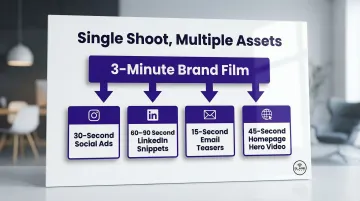
This "content atomization" approach maximizes ROI and ensures consistent messaging across channels.
Geo-Targeted and Market-Specific Distribution
For brands expanding into new cities or regions, paid video campaigns targeted by location allow precise reach into new markets without waiting for organic discovery.
Blare Video operates production crews across Los Angeles, San Diego, Las Vegas, Phoenix, and Tucson — which means brands expanding into those markets can shoot localized content in each city under a single production partner. That keeps messaging consistent while giving each market room for regional customization.
Measuring Video's Impact on Brand Expansion
Key metrics for brand expansion differ from standard engagement metrics. Focus on indicators of new audience reach:
- New follower growth
- Branded search volume increases
- Geographic reach data
- Engagement rates from previously unexposed audience segments
These indicators split naturally into two categories — where the viewer is in their journey determines which numbers actually matter.
Awareness vs. Conversion Metrics
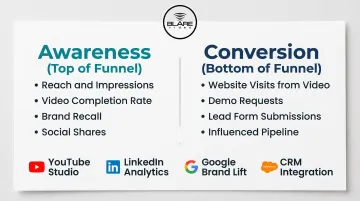
Awareness Metrics (top-of-funnel):
- Reach and impressions
- Video completion rate
- Brand recall and recognition
- Social shares and comments
Conversion Metrics (bottom-of-funnel):
- Website visits from video
- Demo requests
- Lead form submissions
- Influenced pipeline
Both matter in an expansion context. Awareness metrics tell you if the brand is reaching new people; conversion metrics tell you if those new people are taking action. Knowing which stage is underperforming tells you exactly where to adjust — more distribution, better creative, or a stronger call to action.
Practical Tracking and Attribution
Use analytics dashboards to attribute business outcomes to specific video campaigns:
- Platform-native analytics (YouTube Studio, LinkedIn Analytics, Meta Business Suite)
- UTM-tracked links in video descriptions and captions
- Google Brand Lift for awareness measurement
- CRM integration to track video-influenced leads
Review these data points after each campaign cycle. If branded search volume climbs after a video push but demo requests stay flat, the creative is building awareness but the call to action needs work — that's a production brief, not a media spend problem.
How to Choose the Right Video Production Partner for Brand Expansion
Selecting a production partner is one of the most consequential decisions in a video-driven expansion strategy. Evaluate based on these criteria:
Core Evaluation Criteria
- Produced for brands in your vertical or audience segment — review their portfolio for relevant case studies
- Handles concept through post-production in-house, eliminating the need to coordinate multiple vendors
- Covers the video types you need: testimonials, event coverage, brand story, social — versatility matters as expansion goals shift
- Contributes to brief development and challenges assumptions rather than simply executing what's handed to them
Vendor vs. Strategic Partner
A production vendor takes your brief and delivers. A strategic partner helps you write a better brief — and tells you when the original approach won't hit the business goal.
For brands in expansion mode, that distinction is significant. A true partner functions as an extension of your marketing team, aligning creative decisions with growth objectives rather than just filling a production order.
Multi-Market Production Infrastructure
Coordinating separate vendors in each market introduces inconsistency, communication delays, and higher costs. A partner with distributed infrastructure removes that friction.
Blare Video maintains full-service production capabilities across Los Angeles, San Diego, Las Vegas, Phoenix, and Tucson — with experience producing for brands including Google, Taco Bell, and TikTok. That multi-market presence enables coordinated regional campaigns with consistent quality and a single point of contact for project management.
Frequently Asked Questions
How much does a 2-minute video cost?
Production costs vary based on scope, crew size, equipment, location, and post-production complexity. Mid-tier professional videos typically cost between $5,000 and $25,000, while high-end traditional productions range from $30,000 to $300,000+. A professionally produced 2-minute brand video requires meaningful investment to achieve the quality needed for effective brand expansion.
What are the 5 stages of video production?
Every brand video moves through five core stages:
- Pre-production: Discovery, scripting, and storyboarding
- Creative development: Refining the script and brief
- Production: The shoot itself
- Post-production: Editing, color grading, and sound design
- Distribution: Platform publishing and amplification
How to create video content for your brand?
Define your expansion goal and target audience first, then choose the right video type — brand story, testimonial, or demo. From there, develop a clear script and creative brief, invest in professional production, and distribute intentionally across the platforms your new audience actually uses.
What is the 3-7-27 rule of branding?
The 3-7-27 rule suggests it takes approximately 3 impressions for someone to recognize a brand, 7 impressions to remember it, and 27 impressions to develop trust. This practitioner heuristic is rooted in the psychological "mere-exposure effect." Video accelerates that accumulation — each watch delivers both emotional and visual impact at once.
How long does it take to produce a brand video?
Professional brand videos typically take 4 to 8 weeks to produce, with pre-production planning having the greatest impact on the overall schedule. Multi-location shoots, extensive stakeholder approvals, or heavy animation can push timelines toward 8–12 weeks.