Introduction
Los Angeles hosts more working film locations per square mile than any other city in the country, yet marketing managers and brand directors still hit the same wall: navigating permits, locking down the right venues, and coordinating shoot-day logistics on top of everything else.
FilmLA recorded 23,480 total on-location shoot days across Greater LA in 2024, with commercials alone accounting for nearly 800 shoot days in Q1 2025. The infrastructure exists. The challenge is knowing how to use it without losing weeks to logistics.
This guide is written for marketing managers, corporate communications teams, brand directors, and event organizers — not Hollywood feature crews. It covers:
- Why LA works exceptionally well for brand and corporate video
- Which location types perform best for commercial shoots
- How permitting actually functions in Greater LA
- What shoot-day logistics realistically demand
- How to choose a production partner who handles the complexity
Key Takeaways
- LA's geographic diversity lets a single campaign shoot urban, coastal, and natural environments without leaving a 30-mile radius
- Most commercial and corporate shoots require a FilmLA permit — even small productions affecting parking or public access
- Permit applications typically need 3–7 business days minimum; plan 2–4 weeks out for standard shoots, 6–8 weeks for complex ones
- FilmLA permit fees start at $931 for up to 5 locations; drone use requires separate aviation insurance of $2M
- A full-service production partner manages permitting, scouting, crew, and post-production under one roof — so your team isn't juggling a dozen vendors
Why On-Location Filming Gives Corporate Video a Competitive Edge
Real Environments Signal Real Credibility
HubSpot's 2024 Video Marketing Report, based on data from 500+ video marketers, found that consumers increasingly prioritize authentic, relatable content over highly polished production. Peer-based and impromptu content often outperforms scripted, studio-shot alternatives in engagement metrics.
For corporate video, this has a direct implication: a real office environment, an actual conference room, or a recognizable LA streetscape communicates credibility in a way a generic cyclorama wall simply cannot.
Authenticity doesn't mean sacrificing production value — it means the environment reinforces the story. A financial services firm filmed in a sleek Downtown LA boardroom reads differently than the same interview shot against a white studio backdrop, and audiences pick up on that distinction immediately.
LA's Geographic Range as a Production Asset
Within roughly a 30-mile radius of Downtown Los Angeles, a single brand campaign can capture:
- Arts District warehouses, Grand Avenue towers, and glass-wall office exteriors
- Santa Monica beaches, Malibu bluffs, and harbor environments
- Griffith Park's dry chaparral and the sun-bleached hills above Burbank
- Mid-century modern estates and Hollywood Hills hillside properties
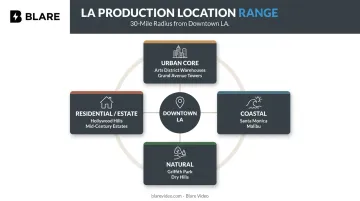
This eliminates the cost and scheduling complexity of multi-city shoots. A two-day production in LA can deliver what might otherwise require separate shoots in three different markets.
Why LA's Production Ecosystem Cuts Turnaround Time
LA's production ecosystem is mature in ways secondary markets aren't. Experienced local crew, equipment rental houses, and post-production facilities are concentrated enough that vendor unknowns are fewer and turnaround is faster.
Blare Video, for example, maintains owned camera systems — including Red Epic and Canon 5Dmk3 cameras — and deploys full crew packages out of its LA operation, which reduces the logistical gap between planning and execution.
Types of On-Location Productions Businesses Film in Los Angeles
Corporate Interviews and Testimonial Shoots
Architectural variety is what makes LA so effective for interview content. A single shoot day can move from a glass-wall conference room to an outdoor courtyard to a rooftop terrace — each setting communicating something different about company culture and professionalism.
Testimonial shoots benefit from this flexibility too. Rather than placing a spokesperson in a neutral studio, LA's location options let brands frame subjects in environments that reinforce context:
- A healthcare company inside a clinical facility
- A tech company against an urban backdrop
- A financial firm within a premium architectural space
Commercial and Brand Advertising
LA's commercial production volume reflects consistent demand from national and regional brands. Commercials logged 796 shoot days in Q1 2025 alone, according to FilmLA data. The city's visual language — from coastal lifestyle imagery to urban architectural landmarks — gives brand advertising a production value that's hard to match elsewhere.
For consumer-facing brands, the ability to shoot lifestyle content at Malibu-adjacent locations on the same day as premium product shots in Downtown architectural settings cuts production schedules significantly.
Event Documentation and Highlight Coverage
Corporate conferences, product launches, and brand activations filmed on-location present a different set of logistical demands than single-camera shoots. Multi-camera setups, live switching, streaming capability, and coordinated coverage across large venues require production infrastructure that goes well beyond a single-operator crew.
Blare Video's event production approach includes live-editing of multiple camera angles through a switcher and 4K streaming capability — relevant for conferences where live broadcast and post-event highlight reels are both required deliverables.
Social Media and Digital Content
Short-form content production in LA benefits from the same geographic proximity that makes multi-location campaigns efficient. HubSpot's research shows that 73% of consumers prefer short-form video to learn about products or services — and LinkedIn reports that video ads earn 30% more comments per impression than static images.
Shooting three to five scene variations in a single day across nearby LA locations is a realistic workflow. Blare Video structures this explicitly — a half-day shoot (four hours) typically yields footage for three 15-second platform-specific videos. Content is shot in 4K for reframing across vertical, square, and horizontal formats.
Executive and Thought Leadership Video
C-suite and spokesperson interviews filmed in well-chosen LA locations carry significantly more visual authority than webcam or generic studio recordings. Urban rooftops and boardrooms with architectural views contribute to the perceived credibility of the subject before they say a word.
For investor relations, recruitment, and PR purposes, location choice functions as a signal: it shapes audience expectations from the first frame.
Best Location Types in Los Angeles for Corporate and Commercial Video Shoots
Downtown LA Urban Environments
Downtown's architectural range is broad: the Arts District offers industrial-warehouse aesthetics, Grand Avenue provides modern civic architecture, and the surrounding neighborhoods deliver gritty-urban and glass-corporate options within blocks of each other.
Common location types include:
- Arts District warehouses — raw industrial interiors, exposed brick, loading dock exteriors
- Grand Avenue corridor — civic architecture, wide plazas, modern glass facades
- Financial District streets — high-rise backdrops, covered walkways, underground parking structures
Permit complexity varies. Public streets require FilmLA permits; privately managed commercial buildings require owner agreements that may or may not trigger additional permit requirements depending on how the production affects public access.
Private Estates and Architectural Residences
For premium brand shoots needing controlled access, consistent lighting conditions, and visual exclusivity, hillside homes and mid-century modern estates are reliable choices. Platforms like Peerspace list these properties with average hourly rates around $103–$109/hour for video shoot bookings, making private venue costs more predictable than public locations.
Private properties allow production teams to control foot traffic, staging areas, and ambient sound — factors that directly affect cost on corporate shoots, where retakes are expensive.
Public Landmarks and Outdoor Spaces
Griffith Observatory, the Santa Monica Pier, and the LA River corridor all carry strong LA identity — useful when a brand narrative needs to be geographically anchored. These locations require FilmLA permits and advance scheduling.
Notable specifics:
- Griffith Observatory — commercial filming on closed days starts at $15,000 exterior-only; interior/exterior from $25,000, plus staffing fees
- Santa Monica locations — Film Santa Monica requires permit applications at least 5 business days before filming
- LA River bed — applications due by 10:00 AM, five business days before first activity; no filming within five days of forecast rain
Natural and Environmental Backdrops
Malibu Creek State Park, Griffith Park, and coastal beaches serve lifestyle, wellness, outdoor product, and agriculture-related brand narratives well. Permitting for these sites involves multiple agencies:
- State parks and beaches — coordinate with the California Film Commission and park staff; applications due at least 96 business hours before filming
- LA County parks — require a FilmLA-issued permit for all commercial filming
Understanding Film Permits in Los Angeles
FilmLA is the official film permit office for the City and County of Los Angeles, as well as multiple surrounding jurisdictions. Most commercial and corporate shoots in LA — including small-crew productions that affect parking or pedestrian flow on public property — require a permit.
Core Application Requirements
| Requirement | Detail |
|---|---|
| Basic permit application window | 3–7 business days minimum |
| Complex permits (stunts, special effects, closures) | 5–7 business days minimum |
| Coverage per application | Up to 5 locations over 7 consecutive days |
| General liability insurance (City of LA) | $1,000,000 minimum per occurrence |
| Drone/UAS insurance | $2,000,000 aviation certificate required |
| Application submission deadline | By 10:00 AM on the area deadline — late applications are rejected |
Application fees are nonrefundable. Late submissions are rejected outright, with no exceptions.
Key Fee Structures
- Permit Application Fee: $931
- Permit Rider (business hours): $148.75
- Drone/special activity admin: $78 per involved location
- FilmLA Monitor: $44.50/hour
- LA City Rec and Parks: $450/day
- LA County parks/beaches: $400/day
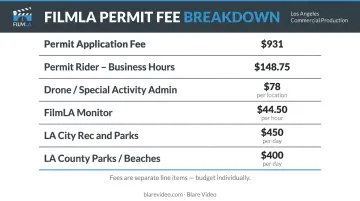
These fees are separate line items — budget for them individually rather than folding them into a single permit cost estimate.
Public vs. Private Property
Private property owner permission does not substitute for a FilmLA permit if the production affects public roads, street parking, or public access. Under LAMC Section 11.00(m), filming without a required permit is a misdemeanor — with penalties up to $1,000 in fines and/or six months in custody.
Drone Filming
Aerial filming in LA requires FAA Part 107 certification and airspace authorization through LAANC for controlled airspace at or below 400 feet. Separately, the $2,000,000 aviation insurance documentation must be submitted to FilmLA by 12:00 PM on the permit application due date. Treat drone permitting as its own pre-production task — it runs parallel to, not inside, the standard application process.
Community Notification
FilmLA distributes Notices of Filming approximately two business days before a shoot, after permit details are finalized. For shoots in residential neighborhoods, extended production parking or filming beyond five days typically triggers a Community Filming Survey. Managing this proactively is your responsibility — ignored surveys can generate complaints or permit complications during production.
Residential filming hours are 7:00 AM–10:00 PM on weekdays and 9:00 AM–10:00 PM on weekends.
On-Location Shoot Day Logistics
Site Assessment and Access Planning
Location scouts before shoot day should cover:
- Confirm production vehicle parking and proximity to the shooting area
- Map load-in routes for camera and lighting gear — urban environments often have narrow corridors
- Verify electrical capacity; HMI and Kino Flo rigs draw significant power, and generator requirements should be locked in advance
- Identify backup staging areas for equipment not actively in use
Skipping a site visit is the most common source of shoot-day problems. Narrow load-in corridors, parking enforcement, and locked freight elevators rarely show up on a floor plan — they show up when a full crew is already standing there.
That groundwork feeds directly into the next planning layer: understanding how light and weather will behave once you're on-site.
Lighting and Weather Windows
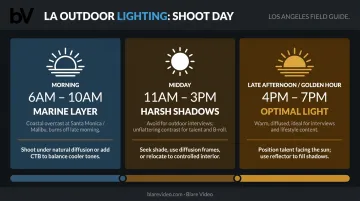
LA's climate is reliably favorable, but a few variables directly affect scheduling:
- Marine layer: Coastal locations like Santa Monica and Malibu frequently have morning overcast that burns off by late morning — plan coastal shoots to start mid-morning or later if natural light consistency matters
- Golden hour: Sunrise and sunset windows shift significantly across seasons; check an accurate sunrise/sunset calculator for your exact shoot date rather than relying on seasonal generalizations
- Midday light: High-noon sun creates harsh shadows for outdoor interview setups; morning or late-afternoon scheduling consistently produces cleaner results
Choosing the Right On-Location Video Production Partner in Los Angeles
Full-Service vs. Freelance Crew
A freelance operator or small crew can handle a straightforward shoot. The gap shows up in project management: permitting knowledge, location scouting, coordinated equipment packages, and predictable post-production delivery are harder to guarantee without dedicated infrastructure behind them.
For marketing teams who aren't running productions regularly, the coordination burden of managing multiple vendors — crew, location, permits, post — across a single project is significant. A full-service production company consolidates that into a single accountable team.
Questions to Ask When Vetting LA Production Partners
Before committing to a production partner, use these questions to assess fit:
- Do they handle FilmLA permitting in-house, or will you be coordinating that separately?
- What's their insurance coverage for on-location commercial productions?
- Can they provide comparable portfolio examples — same format, similar brand category?
- What does post-production delivery look like, and what are realistic turnaround timelines?
- Do they own their equipment, or is it rented per project?
Blare Video's Approach to On-Location Production in LA
Blare Video is an LA-based full-service production company covering corporate, commercial, and event categories — with clients including Google, TikTok, Taco Bell, and Williams-Sonoma. The full production pipeline — location scouting, permitting, filming, and post-production — is handled in-house.
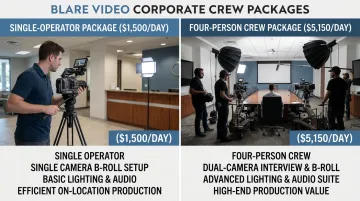
Corporate crew packages are structured around project scope:
| Package | Configuration | Day Rate |
|---|---|---|
| Single-Operator | B-roll setup | $1,500/day |
| Four-Person Crew | Dual-camera interview + b-roll | $5,150/day |
Post-production first cuts deliver within 2–3 weeks, with review handled through Wipster for direct timeline annotation.
Frequently Asked Questions
Do you need a permit to film on location in Los Angeles?
Most commercial and corporate shoots require a FilmLA permit — including those on public streets, parks, or city-controlled property, and even small productions that affect parking or pedestrian access. The only exceptions are genuinely non-commercial, non-disruptive shoots; any doubt, assume a permit is required.
How much does it cost to film on location in Los Angeles?
Costs depend on location type, crew size, and duration. FilmLA permits start at $931 for up to five locations; private venues on Peerspace average $103–$109/hour; and professional crew packages run $1,500–$5,000+ per day. Landmark locations like Griffith Observatory start at $15,000 for commercial shoots.
What are the best neighborhoods in LA for corporate video shoots?
Downtown LA, the Arts District, West Hollywood, Santa Monica, and the Hollywood Hills all offer strong architectural variety and established production infrastructure. Downtown and the Arts District cover the broadest range of corporate and urban-commercial aesthetics in close proximity.
How far in advance should you plan an on-location video shoot in Los Angeles?
Standard shoots need at least 2–4 weeks of lead time for location scouting, permitting, and crew booking. Productions involving drones, street closures, special locations like Griffith Observatory, or large crews should plan 6–8 weeks out to allow for permit processing and contingency.
What is FilmLA and how does it help productions?
FilmLA is the official film permit office for the City and County of Los Angeles, consolidating permits, community notification, and coordination with LAPD and the Fire Marshal into a single application workflow rather than a multi-agency process.
Can businesses film on private property in LA without a permit?
Property owner permission is necessary but not always sufficient. If the production affects public roads, street parking, or public access, a FilmLA permit is still required — regardless of whether filming takes place on private property. Verify with FilmLA directly before assuming private access eliminates the requirement.