Introduction
Most businesses now know they need video. According to Wyzowl's 2026 report, 91% of companies use video as a marketing tool — and 93% of video marketers call it essential to their strategy. The problem isn't deciding whether to produce commercial video. It's producing video that actually works.
A camera and a concept aren't enough. Brands that get real ROI from commercial video treat it as a strategic discipline. That means rigorous pre-production planning, precise on-set execution, purposeful editing, and distribution tied to measurable goals.
This article covers the strategies that make the difference at every stage — from pre-production planning through distribution and measurement — so your next commercial video delivers results, not just footage.
Key Takeaways
- Commercial video production moves through four stages: pre-production, production, post-production, and distribution — each directly affects the final result.
- Start with a defined business goal and target audience; everything else follows from there.
- Visual quality, brand consistency, and authentic storytelling separate effective videos from forgettable ones.
- Distribution and measurement matter as much as production: match your format to each platform and track metrics tied to your original goal.
The 4 Stages of Commercial Video Production
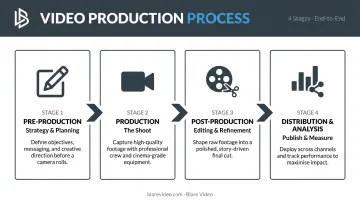
Every successful commercial video moves through four distinct stages. Skipping or rushing any one of them creates compounding problems — a weak brief leads directly to a confused shoot, and a chaotic shoot leaves editors with footage they can't use.
Pre-Production
This is the strategy and planning phase. It covers defining objectives, identifying target audiences, developing scripts and storyboards, casting talent, scouting locations, and building a production schedule. Every decision made here shapes every stage that follows — which makes pre-production the single highest-leverage investment in any production.
Production
The physical shoot. Camera work, lighting, sound capture, directing talent, and capturing footage according to the shot list all happen here. Professional-grade equipment — cinema cameras, proper lighting rigs — directly affects the visual quality viewers associate with your brand.
Post-Production
The editing and refinement phase: assembling footage, color grading, sound design, adding motion graphics, captions, and delivering a finished cut that reflects your brand. Raw footage becomes a usable, channel-ready asset here — or it doesn't, depending on how well the earlier stages went.
Distribution and Analysis
Selecting platforms, optimizing format and length for each channel, publishing, and then tracking performance metrics to evaluate what worked and inform future productions.
Getting these four stages right is what separates forgettable content from video that actually moves an audience — and the strategies that follow break down how to execute each one effectively.
Pre-Production Strategies for Maximum Impact
Pre-production is where commercial videos are won or lost. The most common mistake brands make is treating it as a formality — a quick call before the shoot date. Done properly, it's the most strategic work in the entire process.
Start With a Single, Specific Business Goal
Before scripting a single line, define what the video needs to accomplish. Drive product awareness? Generate leads? Increase event registrations? That goal should shape every creative decision — tone, length, call-to-action, platform, talent.
Producing a video without a defined objective is one of the most expensive mistakes in marketing. Research from BetterBriefs found that 33% of marketing budgets are wasted due to poor briefs and misdirected work — and 78% of agencies say typical client briefs lack clear strategic direction.
Develop a Detailed Creative Brief
A solid brief includes:
- Target audience (demographics, motivations, objections)
- Key message (one clear idea the viewer must leave with)
- Tone and visual style
- Call-to-action
- Distribution channels and platform requirements
Without this document, production teams work from assumptions. That's how costly revisions happen.
Write for a Specific Viewer, Not a General Audience
Effective commercial videos speak to someone, not everyone. Research your audience before scripting — understand what motivates them, what objections they carry, and what emotional response the video should trigger. The more specifically a video speaks to a viewer's pain point or aspiration, the more it resonates.
Use Storyboarding to Prevent On-Set Surprises
Once your script targets the right viewer, storyboarding ensures it translates to screen. A visual plan — even a rough one — helps the team anticipate shots and confirm the concept holds up before shoot day. Storyboards keep productions on schedule by:
- Identifying shot requirements and logistics in advance
- Flagging script-to-screen gaps before they become on-set problems
- Giving the director and client a shared visual reference
- Reducing guesswork that leads to overtime and reshoots
For brands new to commercial production or scaling across multiple markets, a full-service production company reduces costly revisions and shoot-day surprises. Blare Video manages the entire pre-production process: concept development, scriptwriting, storyboarding, location scouting, permitting, and casting. A dedicated producer keeps each project on track and on budget from day one.
On-Set Production Strategies That Elevate Quality
Pre-production builds the plan. Production executes it — and the quality of that execution is what viewers actually see.
Composition, Lighting, and Camera Movement Communicate Brand Values
How a shot is constructed sends a message before a word is spoken.
- Steady, locked-off shots convey professionalism and authority
- Controlled movement (smooth dollies, gimbals) suggests energy without chaos
- Lighting quality shapes how audiences emotionally perceive scenes — soft, even light reads as approachable; harder, directional light creates drama or urgency
This isn't subjective. Wyzowl's 2026 data shows 89% of consumers say video quality directly impacts their trust in a brand. Poorly lit, shaky footage doesn't just look bad — it actively undermines credibility.
Cinema cameras like the RED Epic Dragon — used by Blare Video across commercial projects — capture significantly more dynamic range and detail than consumer gear. Colorists get more to work with in post, and the finished video has a visual quality audiences register immediately, even if they can't explain what sets it apart.
Capture B-Roll and Backup Footage Generously
The single most common post-production problem is editors without enough options. B-roll — supplementary footage of products, environments, reactions, process — gives editors the flexibility to cover dialogue gaps, improve pacing, and reinforce the story.
Experienced directors of photography build B-roll time into every shoot day. That time investment pays off — cutting it short to stay on schedule almost always creates bigger problems in the edit, and sometimes forces a costly reshoot.
On a well-run shoot, B-roll capture should include:
- Product or environment close-ups that reinforce the narrative
- Reaction shots and candid moments for authentic texture
- Process footage (manufacturing steps, service delivery, event details)
- Wide establishing shots that orient the viewer
Direct Non-Actor Talent Effectively
Most commercial videos feature real employees, executives, or customers — not trained actors. Stiff, over-rehearsed delivery kills authenticity.
Blare Video's approach to on-camera coaching: skip the script, facilitate a conversation. Their directors build a relaxed atmosphere where spokespeople talk naturally rather than perform. When the setup is right, a first-time on-camera subject can deliver something far more persuasive than a polished script ever would.
Post-Production Strategies to Sharpen Your Message
Great footage doesn't automatically produce great video. Post-production is where pacing, visual identity, and message clarity are either locked in or lost.
Match Edit Rhythm to Platform and Tone
Cuts that are too slow lose viewers; rapid cuts without breathing room overwhelm them. The right pace depends on two factors: the video's tone and its destination.
- Social media ads: faster cuts, front-load the hook within the first 3 seconds
- Corporate explainers and brand stories: measured pacing, space for the message to land
- TV commercials: balanced rhythm with strong visual payoffs at key moments
TikTok recommends establishing a hook within the first 6 seconds. Meta's guidance for Instagram feed ads puts peak performance at under 15 seconds. A single edit rarely serves all platforms equally — which is why creating channel-specific cuts from a master is worth the investment.
Apply Branded Visual Elements Consistently
Color grading, logo placement, branded lower thirds, and on-screen text aren't just finishing details. They're how viewers learn to recognize your brand across multiple touchpoints. Consistent brand presentation drives 10–20% revenue growth on average, according to research from Marq.
Blare Video's post-production workflow covers DaVinci color correction, custom motion graphics, intro/outro logo animations, and branded supporting text — all calibrated to client brand guidelines rather than generic templates.
Optimize for Sound-Off Viewing
A large share of social video is watched with sound off. Meta's internal testing found captioned video ads increased view time by an average of 12%, and a Verizon Media/Publicis Media study found 80% of consumers are more likely to watch an entire video when captions are available.
Design for mute from the start. These three elements drive performance whether or not the viewer ever turns the volume up:
- Captions: synchronize with spoken dialogue so nothing is lost on silent autoplay
- Readable on-screen text: reinforce key messages without relying on audio
- Visual storytelling: structure shots to communicate the narrative independently of sound
Distribution, SEO, and Performance Measurement Strategies
A strong video delivered to the wrong platform in the wrong format will underperform. Distribution is what turns a well-produced commercial into measurable results.
Optimize for Each Platform's Specifications
There's no universal format. Platform requirements differ significantly:
| Platform | Recommended Length | Aspect Ratio |
|---|---|---|
| Instagram Feed | Under 15 seconds for best performance | 1:1 or 4:5 |
| TikTok | 15–60 seconds; hook within first 3 seconds | 9:16 vertical |
| 15–30 seconds recommended | 16:9 horizontal | |
| YouTube (non-skippable) | 15 seconds standard | 16:9 horizontal |
| Broadcast TV | 15–30 seconds | 16:9 |
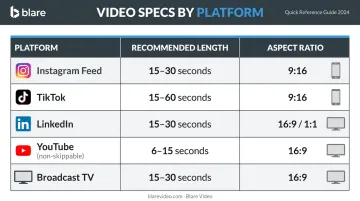
Adapt the master video into channel-specific cuts rather than publishing one version everywhere. Blare Video delivers finished cuts in horizontal, square, and vertical formats as part of their standard post-production workflow — something worth confirming with any production partner before the edit begins.
Use Video to Support SEO and On-Site Engagement
Embedding video on landing pages increases dwell time, and 82% of marketers say video helped increase website dwell time, according to Wyzowl. Google's documentation on video SEO confirms that properly optimized videos can appear in Search results, Video mode, Google Images, and Discover — giving your content multiple organic entry points.
Two practical moves:
- Embed the commercial on relevant landing pages with a proper video schema markup
- Publish a version on YouTube with keyword-optimized titles and descriptions to capture search traffic independently
Track Metrics That Match Your Original Goal
Every production starts with a goal. Measurement should match it:
- Awareness goals: view count, watch time, reach
- Lead generation goals: click-through rate, landing page conversions
- Engagement goals: shares, comments, saves
Measuring the wrong metrics creates a false read on performance. A brand video with 500,000 views but zero conversions may still be succeeding — if awareness was the objective. Tie your analytics framework back to the business goal defined in pre-production, and use what you learn to brief your next production more precisely.
Frequently Asked Questions
What are the 4 stages of commercial video production?
The four stages are pre-production (strategy, scripting, storyboarding, and logistics), production (the physical shoot), post-production (editing, color grading, sound design, and motion graphics), and distribution (publishing, platform optimization, and performance tracking). Each stage builds on the previous one.
How long should a commercial video be?
It depends on the platform and goal. Social media ads perform best at 15–60 seconds; brand stories and explainer videos can run 1–3 minutes. Hold attention long enough to deliver your core message and call-to-action, then stop.
What makes a commercial video effective?
A clear business objective, storytelling focused on a specific audience's needs, high production quality, a strong call-to-action, and distribution on the right platforms. Remove any one of these elements and performance drops.
How much does commercial video production cost?
Costs depend on crew size, equipment, shooting days, and post-production complexity. Professional packages typically range from a few thousand dollars for straightforward shoots to $50,000+ for high-end commercial work.
How do I choose the right commercial video production company?
Review their portfolio for style and production quality, confirm they offer full-service capabilities from concept through delivery, check client references, and verify they can execute in your geography and timeline. Companies like Blare Video, which operates crews across 20+ US markets, offer consistent quality whether you're shooting in Los Angeles, Chicago, or Atlanta.
Can commercial videos be repurposed across multiple platforms?
Yes. A single master shoot can yield social media cuts, website embeds, email clips, paid ad variations, and broadcast versions. Plan for multi-format delivery before the shoot so framing accommodates every required aspect ratio.