Introduction
B2B buyers don't read brochures the way they used to. When a procurement team evaluates a new SaaS platform or a CFO is weighing a fintech solution, video has become the fastest path from confusion to conviction.
The numbers back this up. According to the 2024 Content Preferences Benchmark Survey from Demand Gen Report, 62% of B2B buyers are drawn to video and audio content, and 49% say it actively helps them make purchasing decisions.
The challenge? B2B buying is complicated. Long sales cycles, multiple stakeholders, and technical value propositions make it genuinely hard to communicate what you do — fast. A well-crafted explainer video addresses all three at once.
This article breaks down what separates great B2B explainer videos from forgettable ones, with six real-world examples worth studying alongside the formats, funnel stages, and common mistakes every B2B marketer should know.
Key Takeaways
- 80% of B2B buyers find short-form content appealing — explainer videos are the format built for this reality
- The best examples lead with the buyer's problem, not the brand's credentials
- Format (animated vs. live-action) matters less than strategic clarity about audience and goal
- Videos under two minutes retain far more viewers than longer alternatives
- Reusing one video across LinkedIn, email campaigns, and sales decks compounds its ROI without extra production cost
What Makes a Great B2B Explainer Video?
B2B explainer videos aren't just shorter corporate videos. They serve a specific cognitive function: collapsing complex value propositions into something a busy decision-maker can grasp in under two minutes. That single constraint — audience attention — drives every production choice that follows.
Structure That Mirrors the Buyer's Mindset
The best B2B explainers follow a clear arc:
- Open with the pain point — within the first five seconds, the viewer should recognize their own problem on screen
- Introduce the solution — frame it as an outcome, not a company announcement
- Show the benefits — quantify the business impact where possible, not just feature capabilities
- Close with a specific CTA — one action, clearly tied to the buyer's next step
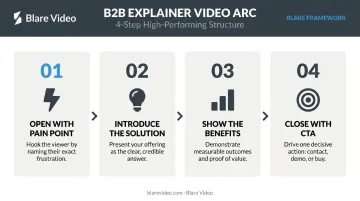
This arc works because it maps directly to how a B2B buyer evaluates a new vendor — problem recognition first, solution credibility second, and a clear path forward at the end.
Keep It Short — Seriously
Vidyard's 2024 Video in Business Benchmark Report, based on analysis of over 943,000 videos, found 65% completion rates for videos under one minute — compared to 20% for videos over 20 minutes. Wistia's guidance identifies the two-minute mark as the point where engagement starts dropping meaningfully.
The implication for B2B: if you can't make your case in two minutes or less, your script needs another edit — not a longer runtime.
Visuals That Earn Their Place
Visuals should reinforce the message, not decorate it. That means:
- Animated flow diagrams for software integrations
- Motion graphics when data needs to feel tangible
- Live-action footage when human presence builds the trust animation can't replicate
The same discipline applies to brand consistency. When a video's tone, visual palette, and voiceover align with your broader marketing materials, it reinforces professionalism. When they diverge, the mismatch creates friction at precisely the wrong moment — during a prospect's evaluation process.
The Best B2B Explainer Video Examples
These six examples were chosen to show range — different industries, formats, and strategies. Each one teaches something specific.
Slack – Email vs. Slack
Slack's "Email vs. Slack" video (runtime: 1:10) turns the brand's own logo into an animated character to show how chaotic email threads get replaced by organized, channel-based communication. No generic stock characters. The brand assets are the story.
| Attribute | Detail |
|---|---|
| Style/Format | 2D motion graphics using brand logo elements |
| Key Strength | Instant brand recognition; problem-solution told in under 90 seconds |
| B2B Lesson | Use your brand's visual identity as a storytelling asset, not just a logo at the end |
Using something familiar — the logo — to make an unfamiliar workflow feel immediately intuitive is the move. It requires no explanation; viewers orient themselves within seconds.
Google Drive – Collaboration Explainer
Google Drive's collaboration explainers use minimal animation — primary colors, clean geometric shapes, relatable workplace scenarios — to show distributed teams working together on files in real time. There's no jargon about cloud storage architecture. Just people sharing a presentation.
| Attribute | Detail |
|---|---|
| Style/Format | Minimal 2D animation with clean geometric shapes |
| Key Strength | Complexity removed; features shown through real-life use cases |
| B2B Lesson | Simple visuals reduce cognitive load and keep decision-makers focused on benefits |
By stripping away technical complexity, Google communicates product confidence. The simpler the video looks, the more clearly the value proposition comes through.
Ahrefs – SEO Course & Explainers
Ahrefs blends motion graphics with live UI screencasts to walk viewers through real workflows: finding broken links, analyzing backlinks, outranking competitors. The complete SEO course video on YouTube has amassed over 4 million views and 86,000 likes — strong evidence the educational format works.
| Attribute | Detail |
|---|---|
| Style/Format | Motion graphics + UI screencast hybrid |
| Key Strength | Educates while selling; empowers the viewer before the CTA |
| B2B Lesson | Educational explainers build credibility and shorten the consideration phase |
By delivering genuine value first — teaching something actionable — Ahrefs makes the viewer want to use the product before the sales pitch begins. Treating viewers as intelligent peers is the mechanism behind that trust.
Hootsuite – What Is Hootsuite?
Hootsuite's platform overview video (runtime: 1:16) uses the brand's signature green palette and dynamic tool display to show how the platform consolidates social workflows across channels. The energy, pacing, and language all mirror how a social media manager actually thinks.
| Attribute | Detail |
|---|---|
| Style/Format | 2D animation with strong brand color usage |
| Key Strength | Audience-mirroring design; shows the full solution ecosystem |
| B2B Lesson | Your video should feel like it was made specifically for one type of buyer |
A video that speaks directly to one persona converts better than one trying to reach everyone.
MailChimp – Facebook Ads Feature Launch
MailChimp's Facebook Ads explainer treats product information as an aesthetic experience. The animation is art-directed — carefully composed graphics flowing in sync with the script. It doesn't feel like a product demo. It feels like a brand statement.
| Attribute | Detail |
|---|---|
| Style/Format | Highly stylized 2D illustration-driven animation |
| Key Strength | Art-directed visuals that reinforce brand premium positioning |
| B2B Lesson | Production quality signals product quality in B2B environments |
For B2B buyers comparing vendors, that impression sticks. Every frame that looks crafted — rather than assembled — raises the perceived value of what's being sold.
Tatari – Streaming Incrementality Explained
Tatari, a TV advertising measurement platform, uses narrative animation to explain complex attribution methodology — separating control and test groups visually so non-technical marketing buyers can follow the logic without a data science background.
| Attribute | Detail |
|---|---|
| Style/Format | Narrative-driven 2D animation with data visualization elements |
| Key Strength | Complex attribution logic made accessible via visual metaphors |
| B2B Lesson | Multi-stakeholder B2B products need explainers that speak to both technical and business audiences simultaneously |
This is one of the harder things to get right in B2B video: making something rigorous feel approachable. Tatari does it by letting the visuals carry the technical complexity while the voiceover keeps the business case front and center.
Types of B2B Explainer Videos and When to Use Them
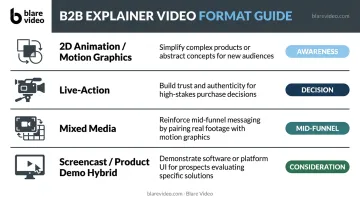
Format should follow message and audience — not budget alone. Here's how the four main types map to B2B use cases and funnel stages.
The Four Core Formats
| Format | Best For | Funnel Stage |
|---|---|---|
| 2D Animation / Motion Graphics | SaaS, fintech, abstract service concepts that can't be filmed | Awareness |
| Live-Action | Professional services, corporate brands where human presence builds trust | Decision |
| Mixed Media | Products needing both credibility and data visualization | Mid-funnel |
| Screencast / Product Demo Hybrid | Software platforms where showing the UI beats describing it | Consideration |
A Practical Heuristic
If the concept can be filmed, consider live-action first. Human presence — a real executive, a client testimonial, an on-site facility shot — carries authenticity that animation can't replicate at the bottom of the funnel, where a prospect is deciding between two finalists.
If the concept can't be filmed (a data attribution model, a cloud integration workflow, a financial planning methodology), animation becomes essential.
Blare Video produces across all four formats, from 2D animation and motion graphics to live-action corporate productions shot on RED Epic camera systems. For B2B clients at the decision stage, testimonial videos, executive interviews, and on-site industrial documentation tend to carry the most conversion weight.
Past clients include LeanData, Moss Adams, and IMERYS.
Common Mistakes B2B Brands Make With Explainer Videos
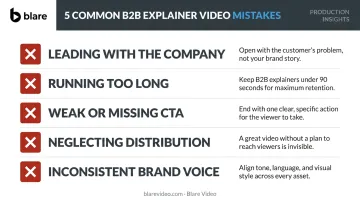
Most underperforming B2B explainer videos share the same handful of problems.
Mistake 1: Leading with the company, not the buyer The first five seconds determine whether a viewer stays. Opening with company history or a logo animation loses the prospect before the value proposition lands. Start with their problem.
Mistake 2: Letting the video run too long B2B marketing teams try to include too much in a single video. Vidyard's data is clear: completion rates drop sharply as length increases. Under two minutes is the target. Every line of script that doesn't advance the buyer's understanding should be cut.
Mistake 3: A weak or missing CTA Ending with a logo and tagline is a wasted opportunity. Every B2B explainer needs one specific next action tied to where the buyer is in the funnel — "Schedule a demo," "Download the case study," or something equally concrete.
Mistake 4: Treating distribution as an afterthought A great video published only on the homepage is an underutilized asset. CMI's 2025 B2B Content Marketing research found 85% of B2B marketers say LinkedIn delivers the best platform value. Beyond LinkedIn, explainer videos belong in email nurture sequences, sales decks, and solution-specific landing pages — anywhere a buyer encounters the brand during evaluation.
Mistake 5: Inconsistent brand voice When a video's tone doesn't match the rest of the company's marketing materials, it signals disorganization. B2B buyers are comparing multiple vendors at once — a mismatched video can quietly tip the evaluation against you, even if the product is strong.
Frequently Asked Questions
What is the Rule of 7 in B2B?
The Rule of 7 is a marketing principle stating a prospect needs to encounter a brand's message at least seven times before taking action. According to the University of Maryland, that repeated exposure builds the familiarity and trust that drives purchasing decisions. Explainer videos distributed across LinkedIn, email, websites, and sales decks help B2B brands accumulate those touchpoints efficiently.
What is the best channel for B2B video distribution?
LinkedIn is the top B2B platform, with 85% of B2B marketers citing it as their highest-value channel. Even so, explainer videos perform best across multiple touchpoints — landing pages, email nurture sequences, and sales presentations — so buyers encounter them at every funnel stage.
What is the ideal length for a B2B explainer video?
Keep it under two minutes. Both Vidyard and Wistia identify two minutes as the completion drop-off point for professional content. Deliver your core value proposition and CTA within that window; cut anything that doesn't move the buyer forward.
What's the difference between animated and live-action B2B explainer videos?
Animated explainers excel at visualizing abstract concepts, software workflows, and data-driven ideas that can't be filmed. Live-action formats — interviews, testimonials, on-site footage — are more effective at the decision stage, when personal credibility is needed to build final trust with a prospect choosing between finalists.
Where should B2B explainer videos appear in the marketing funnel?
- Top of funnel: Animated brand or awareness videos on the homepage and social ads
- Mid-funnel: Product demo or mixed-media explainers on solution pages and in email sequences
- Bottom of funnel: Live-action testimonials and case study videos in sales decks and proposal follow-ups
How do I know which video format is right for my B2B brand?
Start with the question: can this concept be filmed? If yes, lean toward live-action for credibility. If not — complex data models, cloud integrations, abstract service workflows — animation becomes essential. Budget matters, but message and audience should drive the format decision first.
Conclusion
The best B2B explainer videos share a clear pattern: they open with the buyer's problem, deliver the value proposition at pace, and close with one purposeful action. Format — animated, live-action, or mixed — matters far less than strategic clarity about who you're talking to and what you want them to do next.
Before commissioning any explainer video, answer three questions: Where in the funnel will this video live? What specific objection or knowledge gap needs to close? What does success look like in measurable terms? Those answers should drive every creative and production decision that follows.
If you're ready to move from examples to execution, Blare Video provides full-service B2B video production: concept, scripting, live-action production, and post. The team has produced corporate videos, testimonials, product explainers, and event content for clients including LeanData, Moss Adams, IMERYS, and Google.
Production capabilities span more than 20 US markets, including Los Angeles, New York, Chicago, Dallas, and San Francisco. Whether you need a live-action testimonial series or a mixed-media product explainer, get in touch to talk through your project.