Introduction
Consumer attention scatters across dozens of platforms simultaneously, and brands have shorter windows than ever to communicate their value. Video now outpaces static content in virtually every environment where audiences spend time.
Animated video is a measurable brand communication tool, not a creative indulgence. Brands investing in it do so because animation moves real metrics: recognition, comprehension, conversion, and content efficiency across channels.
This article covers the specific advantages animated video production services offer, which business outcomes they affect, and how to extract the most value from each production.
Key Takeaways
- Animated video builds brand recognition through visual storytelling audiences retain far better than static content
- Animation makes complex products and services understandable — shortening sales cycles and reducing pre-sales support load
- One animated production can be repurposed across your website, social media, email campaigns, and onboarding materials
- 91% of businesses now use video marketing — brands skipping animation are competing at a disadvantage
- To maximize ROI: set clear goals per video, maintain consistent brand visuals, and track performance across every channel
What Are Animated Video Production Services?
Animated video production is a professional process that combines scriptwriting, visual design, motion graphics, and audio production to create branded video content — no live sets, actors, or location shoots required.
The format covers a wide range of deliverables:
- Explainer videos — break down products, services, or processes for new audiences
- Brand story videos — communicate company identity and values through narrative
- Product demos — show how a solution works without requiring a physical demonstration
- Social media animations — short-form content optimized for feed and story formats
- Onboarding videos — internal training and employee education content
- Corporate communications — investor updates, compliance messaging, executive briefings
For brand strategy purposes, animated video is a communication tool — one that translates complex messaging into a format audiences are more likely to watch, share, and act on than written content alone.
Blare Video, which produces content for clients including Google, Taco Bell, and TikTok across major US markets, treats animation as part of a full-service production capability alongside live-action and corporate video. In practice, the most effective campaigns use both: animation to simplify and visualize, live-action to humanize and build trust.
Key Advantages of Animated Video Production Services for Your Brand
The advantages below aren't about aesthetics. They're grounded in how animation affects brand perception, audience behavior, and marketing performance.
Advantage 1: Stronger Brand Recognition and Recall
Animated video creates a multi-sensory brand experience that static content can't replicate. Colors, characters, motion style, typography, and background treatment can all be customized to match brand guidelines precisely. The result is a consistent visual language that reinforces identity across every touchpoint.
Brands that keep their visual presentation consistent across channels eventually earn something more valuable than awareness: audiences start recognizing them on sight. Specific colors, character styles, and motion patterns become shorthand for the brand itself — which sharpens recall at the moment of purchase.
According to LinkedIn's video ads research, video ads earn 30% more comments per impression than static images in the LinkedIn feed. Engagement at scale drives visibility, and visibility drives recognition — especially in B2B environments where buyer attention is limited.
One practical advantage animated video holds over live-action: it can be updated to reflect rebrands or new messaging without a full reshoot. Adjust the color palette, swap out copy, or modernize character design and the core animation infrastructure stays intact. That makes animated content a durable long-term asset rather than a one-cycle production investment.
KPIs most affected: Brand recall rate, social media engagement rate, return visitor rate, brand sentiment scores
When it matters most: New brands building awareness, established brands launching a product line, companies undergoing a rebrand or entering a new market
Advantage 2: Clarity for Complex Products, Services, or Processes
This is animation's most underused advantage. For industries where the product or service requires explanation before a purchase decision is even possible (healthcare, financial services, SaaS, manufacturing) animation solves a problem that text and static visuals simply can't.
Abstract concepts, invisible processes, multi-step workflows, and financial mechanisms can all be visualized in motion. A software platform's data flow, an insurance product's coverage structure, a medical device's mechanism of action: each becomes easier to grasp when scripted, illustrated, and animated correctly.
The data behind this is direct. Wyzowl's 2026 video marketing research shows:
- 96% of people have watched an explainer video to learn about a product or service
- 93% of video marketers say video increased user understanding of their product or service
- 85% of people say a video convinced them to buy a product or service
- 57% of video marketers say video helped reduce support queries
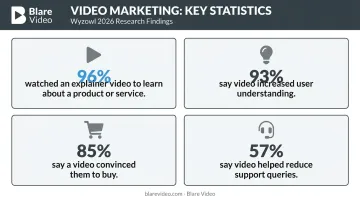
When prospects understand what a product does and how it solves their problem, sales cycles shorten and pre-sales support volume drops , both of which directly affect cost-per-acquisition and conversion rate.
That pattern plays out in practice. Blare Video has applied this in financial services, producing animation for People Helping People (PHP) that explained insurance and investment choices through animated characters. The same approach applies to whiteboard video work for enterprise software clients, where complex platform features get translated into clear, watchable narratives.
Internal communications benefit equally. Onboarding new employees, explaining compliance procedures, or documenting manufacturing processes becomes faster and more consistent when animated video replaces long-form documentation.
KPIs most affected: Landing page conversion rate, sales cycle length, customer support ticket volume, employee onboarding completion rates
When it matters most: B2B brands with multi-feature products, SaaS companies, healthcare and financial services organizations, any brand entering a category where education precedes purchase
Advantage 3: Versatile Content That Performs Across Every Channel
A professionally produced animated video isn't a single-use asset. It's a modular piece of brand content that can be adapted, repurposed, and deployed across the full marketing mix with minimal additional cost.
The same core video can be:
- Reformatted for website hero sections or product pages
- Trimmed into 15–30 second cuts for paid social and organic feeds
- Embedded (or linked via thumbnail) in email campaigns
- Used as an opener in sales presentations and pitch decks
- Repurposed as onboarding content for new customers or employees
Wistia's 2026 State of Video report notes that videos on homepages, video galleries, and product pages earn the highest play rates , reinforcing the value of placing animated explainers where buyer intent is already elevated.
The efficiency case is straightforward: one animated video investment generates usable content across multiple channels at once. Producing separate, platform-specific creative for each channel multiplies both cost and consistency risk.
Blare Video's approach to social media video already includes multi-format delivery (horizontal, square, and vertical versions), and that same logic applies to animated productions. A single master animation becomes the foundation for a full content system rather than a one-channel expense.
KPIs most affected: Cost-per-content-asset, email click-through rate, social media video completion rate, landing page conversion rate, marketing channel reach
When it matters most: Multi-channel campaigns, companies with lean in-house content teams, brands maintaining consistent messaging across geographically dispersed markets
What Happens When Brands Skip Animated Video Production
The absence of animated video isn't neutral. It creates specific, measurable disadvantages that accumulate:
- Lower engagement, faster drop-off: Wyzowl reports that 91% of businesses now use video marketing, and 92% of marketers plan to maintain or increase video spending. Static-only brands compete for attention against a majority already publishing video.
- Weaker differentiation: Without a consistent animated visual identity, brands struggle to stand out in crowded digital feeds — making emotional connection with audiences harder to build.
- Missed conversions: For brands with products that need explanation, forcing prospects to self-educate through text is a conversion killer. Many abandon the process before reaching a decision.
- Reduced content efficiency: Without reusable video assets, marketing teams produce platform-specific content repeatedly — increasing costs and introducing inconsistency over time.
- Damaged credibility before the first conversation: 89% of consumers say video quality impacts their trust in a brand, according to Wyzowl's 2026 data. Low-quality or absent video can weaken perceived professionalism before a conversation starts.
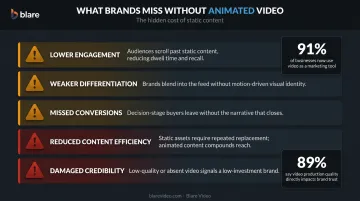
76% of companies now publish at least one video per month. Publishing cadence is becoming a baseline visibility expectation, not a differentiator.
How to Get the Most Value from Animated Video Production Services
Animated video delivers its strongest impact when treated as an ongoing strategic investment rather than a single project. Here are three practices that consistently separate high-performing video programs from one-off efforts.
1. Define a measurable objective before production begins
Every video should answer one question before scripting starts: what specific action or outcome does this video drive? Awareness, product education, lead conversion, and onboarding each require different creative approaches. Blare Video's pre-production process structures this through an initial consultation and concept development phase, aligning creative decisions to business objectives before a single frame is animated.
2. Maintain visual consistency across productions
Brand recognition is cumulative. Use the same color palette, typography, character design, and tone of voice across every animated video. Disconnected one-off productions don't build a brand — they fragment it.
3. Measure performance and act on what the data shows
Track the KPIs that correspond to each video's objective:
- Awareness videos: social engagement rate, video completion rate, view-through rate
- Education/explainer videos: time-on-page, support ticket volume, product page conversion rate
- Conversion videos: landing page conversion rate, click-through rate on CTAs, lead volume
- Onboarding videos: completion rate, time-to-productivity metrics
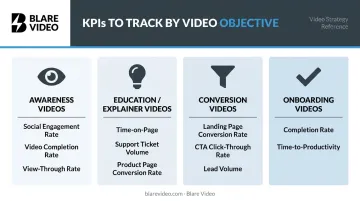
Brands that revisit this data after each release can make targeted creative adjustments — shortening intros that lose viewers early, reworking CTAs with low click-through rates, or refining messaging that doesn't convert. That feedback loop is what turns a good video into a better one.
Conclusion
Animated video production services offer three advantages that reinforce each other: they build recognition through consistent visual storytelling, reduce complexity to accelerate purchase decisions, and generate versatile content assets that work across every marketing channel.
Each video produced adds to a body of branded content that collectively strengthens audience familiarity, trust, and conversion likelihood. Brands that start building that library early don't just get more content — they get more consistent, recognizable, and trusted over time.
The brands seeing the strongest results from animation aren't commissioning one explainer video and calling it done. They're treating it as a sustained communication practice, where each production builds on the last — refining the voice, deepening audience familiarity, and lowering per-asset costs as the process matures.
Frequently Asked Questions
What types of animated videos work best for brand marketing?
Explainer videos, brand story videos, and social media animations are the most common formats. The best choice depends on your goal: explainers for education, brand stories for awareness, and short-form animations for social engagement and conversion.
How is animated video different from live-action video for branding purposes?
Animation gives you full creative control over every visual element, no location or talent constraints, and the ability to update content without a reshoot. For brands with complex messages or tight production timelines, it often delivers equivalent quality at lower cost than live-action.
How much does animated video production typically cost for businesses?
Cost varies based on video length, animation style, visual complexity, voiceover requirements, and revision rounds. Simple 60-second explainers typically run less than a full brand story with custom characters — get a scoped quote from your production partner once you've defined your format and goals.
Can animated videos be effective for B2B brands, not just B2C?
Animated video is especially powerful in B2B contexts. It simplifies complex products, speeds up sales cycles, supports internal onboarding, and performs well on platforms like LinkedIn where B2B audiences are most active.
How long should an animated brand video be?
For most marketing uses, 60–90 seconds is the practical sweet spot. Wyzowl's research shows 71% of marketers say 30 seconds to 2 minutes performs best. Use shorter cuts (15–30 seconds) for social media and longer formats for detailed product explainers or onboarding.
How do I measure whether an animated video production investment is working?
Track video completion rate, landing page conversion rate, CTA click-through rate, and social engagement metrics. For explainer and onboarding videos, also monitor support ticket volume and sales cycle length — these downstream metrics often show the clearest impact.