This guide breaks down what drone video actually costs at each tier, which variables drive prices up or down, what a professional quote should include line by line, and how to build a realistic budget before approaching providers.
Key Takeaways
- Drone video ranges from $150–$500 for basic packages to $2,000–$7,000+ for high-end commercial productions
- Hourly rates typically run $200–$500/hr; full-day rates fall between $1,000–$3,000
- The biggest cost drivers: pilot experience, post-production complexity, and airspace requirements
- Real estate and event shoots land at the lower end — corporate brand films and ad campaigns push toward the top
- Going with the cheapest bid often means hidden costs: FAA compliance issues, missing insurance, or footage that needs reshoot
How Much Does Drone Video Production Cost?
Drone video pricing doesn't follow a simple formula. Even projects of similar scope — same flight time, same location type — can differ by thousands of dollars depending on deliverable requirements and the experience level of the team. Clients who don't understand this often underbudget, hit scope creep mid-project, or end up with footage that doesn't meet their actual needs.
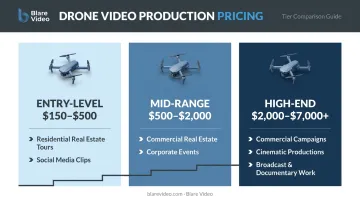
The market breaks down into three practical tiers:
| Tier | Typical Range | Best For |
|---|---|---|
| Entry-Level | $150–$500 | Residential real estate, social media clips |
| Mid-Range | $500–$2,000 | Commercial real estate, corporate events, brand promos |
| High-End | $2,000–$7,000+ | Commercial campaigns, multi-day shoots, cinematic production |
According to UAV Coach's 2025 drone services pricing guide, drone videography typically runs $200–$500 per hour or $1,000–$5,000 per project, with full-day rates reaching $1,000–$3,000.
Entry-Level Drone Video ($150–$500)
This tier covers a short edited clip or set of aerial stills from a single-location shoot with minimal post-production. Pilots at this level are typically beginner-to-intermediate certified operators working with consumer-grade hardware.
Best suited for:
- Small residential real estate listings
- Basic social media content
- Event b-roll where polish isn't the priority
Mid-Range Commercial Drone Video ($500–$2,000)
Mid-range packages include multi-angle footage from an experienced pilot, color grading, licensed music, and a 1–3 minute edited video. Compliance with airspace requirements is standard at this level.
Best suited for:
- Commercial real estate listings and property tours
- Corporate event coverage
- Brand advertising and promotional content
Thumbtack's 2025 aerial pricing data puts a 60–90 second edited drone clip at $400–$450 — a useful real-world benchmark for this range.
High-End Professional Drone Video ($2,000–$7,000+)
At the top tier, you're getting cinematic-quality capture using professional-grade drone systems, multi-day shoots, full post-production with motion graphics, and integration into a broader production workflow. Thumbtack's data puts a 30-minute 4K production in the $5,000–$7,000 range.
Best suited for:
- Large-scale commercial campaigns
- TV and film productions
- Corporate brand narratives requiring broadcast-quality output
Key Factors That Affect Drone Video Service Rates
Understanding what moves the price helps you anticipate cost swings before you request quotes — and avoid sticker shock when proposals come back.
Pilot Experience and FAA Certification
Commercial drone operations require an FAA Part 107 Remote Pilot Certificate. The FAA is clear: no person may manipulate the controls of a small UAS for commercial purposes without holding the required certificate or operating under direct supervision of a qualified remote pilot in command.
The FAA proposed $341,413 in civil penalties against 27 drone operators for unsafe or unauthorized operations between October 2022 and June 2024, with individual violations potentially reaching $75,000 under the FAA Reauthorization Act of 2024. Always verify Part 107 certification before signing a contract.
Experienced, certified pilots with strong portfolios command higher rates — and justify them. Credentials, portfolio quality, and equipment level all factor into where a pilot sits on the rate scale.
Drone Equipment and Camera Quality
The drone model matters. Consumer platforms like the DJI Mini 4 Pro (under 249g, 4K/60fps) work for basic real estate and social content. Professional-grade systems like the DJI Mavic 3 Enterprise are built for commercial work: 4/3 CMOS sensor, 130 Mbps bitrate, and 45-minute flight time on a single charge.
For cinematic or corporate-grade productions, always ask providers to specify exactly what hardware will be used on your project before signing off.
Location and Airspace Restrictions
Under 14 CFR 107.41, operations in Class B, C, or D controlled airspace — or within Class E surface areas around airports — require prior Air Traffic Control authorization. The FAA's LAANC system automates this process, providing near-real-time authorization at or below 400 feet at 726 airports as of late 2024.
Urban shoots near airports or in major metro areas like Los Angeles, Chicago, or New York add administrative time and scheduling complexity. Build at least a few extra business days into your timeline for authorization processing when shooting in controlled airspace.
Post-Production and Editing Requirements
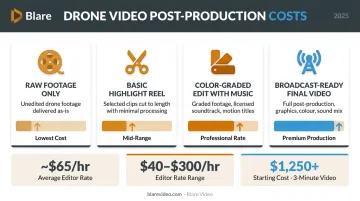
Editing is often the largest hidden cost in a drone video quote. Raw footage delivery is far cheaper than a polished, color-graded, music-licensed final video, and the cost difference is substantial.
Thumbtack's 2025 video editing data shows video editors charging $40–$300 per hour, with most projects landing around $65/hour. A 3-minute video with basic 2D graphics and audio enhancements starts around $1,250. Cost drivers include source footage volume, final edited length, motion graphics, voice-overs, and music licensing.
When reviewing a quote, confirm whether editing is included, and specifically what level of post-production is covered.
Drone Video Cost Breakdown: What Are You Actually Paying For?
A drone video quote is rarely just for flight time. It represents several distinct cost components. Understanding each one prevents mismatched expectations when a proposal lands.
Flight Capture and Pilot Labor
Pilot time on-site covers setup, flight operation, and basic footage review. Most entry-level quotes cover this and nothing else — so clients sometimes mistake it for the full project cost.
Equipment, Licensing, and Insurance
Professional operators factor in drone depreciation, FAA certification renewal (required every 24 calendar months), and liability insurance.
The practical threshold to request is $1M in general liability coverage. Providers unable to produce a Certificate of Insurance (COI) before a shoot are a clear red flag for corporate clients.
Post-Production Editing and Deliverables
Editing costs scale with what the final deliverable requires:
- Raw footage only — lowest cost, requires internal editing capability
- Basic highlight reel — light color correction, simple cut
- Broadcast-ready final video — full color grade, audio mix, motion graphics, formatted for intended channel
Deliverable format also matters. 4K MP4 for social media, broadcast specs for TV placement, and high-bitrate ProRes for downstream editing have different production and export requirements.
Travel, Permits, and Weather Contingencies
Additional costs that regularly appear on invoices:
- Travel fees — typically $0.50–$1.00 per mile beyond a local radius
- Rush delivery — same-day or next-business-day turnarounds can add 20–50% to standard rates
- Additional crew — visual observers or second operators add $300–$700 per day
- Weather reschedules — most professional operators reschedule drone shoots at no charge when conditions make safe flight impossible, but tight timelines need buffer days built in
Budget vs. Professional Drone Video Services
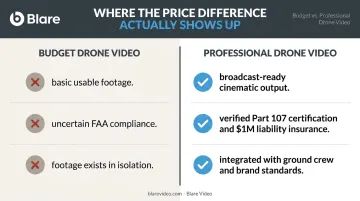
The gap between a $300 drone package and a $3,000 one isn't arbitrary. Here's where it actually shows up:
What separates the price tiers:
- Output quality: Budget operators deliver usable footage. Professional services deliver broadcast-ready, brand-aligned video with cinematic color grading, proper audio sync, and motion that supports your other marketing assets rather than working against them.
- Compliance and insurance: FAA Part 107 certification and liability coverage protect the client, not just the operator. Hiring an uncertified pilot without proper insurance creates legal and financial exposure for whoever signed the contract.
- Integration with broader production: For corporate clients, drone footage rarely exists in isolation. It needs to match ground-level camera work, fit a specific edit, and align with brand standards. Blare Video integrates aerial capture directly into corporate, commercial, and event productions, with certified pilots working alongside ground crews so footage arrives already matched to the rest of the project.
When spending more makes sense:
- Commercial campaigns where footage represents the brand publicly
- Real estate listings at higher price points where visual quality affects perceived value
- Event coverage intended for broadcast, social media, or future marketing use
- Corporate brand films where consistency with other content matters
How to Plan and Estimate Your Drone Video Budget
The right budget starts with defining the intended use. A 30-second social clip and a 2-minute corporate brand film have very different requirements — and quoting without that clarity leads to mismatched proposals every time.
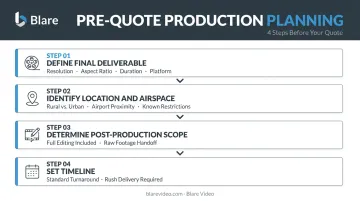
Before approaching providers, define these four things in writing:
- Final deliverable format and length — resolution, aspect ratio, duration, intended platform
- Location type and airspace — rural vs. urban, proximity to airports, any known restrictions
- Post-production scope — full editing included, or raw footage handed off internally?
- Timeline — standard turnaround, or is rush delivery a possibility?
Common Budgeting Mistakes to Avoid
- Focusing only on flight cost while ignoring editing, which often equals or exceeds capture costs
- Skipping certification verification — always confirm Part 107 before signing
- Over-specifying deliverables — requesting 8K resolution for content that will only appear on social media adds cost with no perceptible benefit
- Ignoring weather windows — tight timelines with no buffer day built in regularly cause problems
For projects where aerial footage needs to integrate cleanly into a larger corporate or commercial production, managing a separate drone operator alongside your existing production crew adds coordination overhead that often goes unbudgeted.
Blare Video handles aerial capture alongside ground-level production across 23+ US markets — covering concept through final delivery for corporate, commercial, and event clients.
Frequently Asked Questions
What are typical aerial drone video rates?
Drone videography typically runs $200–$500 per hour or $1,000–$5,000 per project depending on experience level and deliverable type. Most real estate and corporate projects are quoted as flat-rate packages rather than hourly to keep scope clear.
How much do real estate agents pay for aerial drone video?
Residential real estate packages typically run $150–$500 and usually include an edited stills package, a short video clip, and single-location coverage. Commercial properties command higher rates based on shoot complexity and deliverable length.
What is included in a professional drone video package?
A standard professional package includes flight capture, color-graded editing, and a final video file in the agreed format. Deliverable specs — resolution, duration, aspect ratio, and revision rounds — should always be confirmed in writing before signing a contract.
Is drone video worth the cost for corporate and commercial projects?
Yes. Drone footage raises perceived production value and helps brands stand out in competitive markets. 52% of REALTORS now use drone photography or video as a standard marketing tool — a signal of how widely aerial content has become expected across client-facing industries.
What is the 1:1 rule for drones?
The 1:1 rule is a UK CAA requirement, not a US FAA regulation. It requires operators to maintain a horizontal distance from uninvolved people equal to the drone's flight altitude. It does not apply under FAA Part 107, so US-based productions are not subject to this rule.
What is the 120m rule for drones?
Under FAA Part 107 (14 CFR 107.51), drone operators may not fly higher than 400 feet above ground level — roughly 120 meters. An exception applies when flying within a 400-foot radius of a structure, where altitude up to 400 feet above the structure's highest point is permitted. This limit matters for shoots near tall buildings or in urban environments.