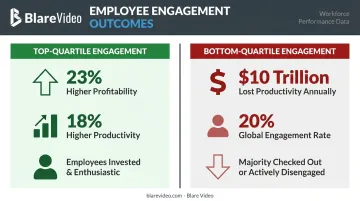
The data reflects the cost. Gallup's 2026 State of the Global Workplace report found that global employee engagement fell to 20% in 2025, costing the world economy $10 trillion in lost productivity. That's not a communication problem you can solve with a better email template.
Video, when used with intent, addresses what text-based communication fundamentally cannot: it creates human connection at scale. For HR and internal communications teams trying to reach distributed workforces, it's one of the most direct tools available.
Key Takeaways
- Video conveys tone, personality, and trust in ways written communication can't match.
- Onboarding, training, recognition, leadership, and testimonial videos each serve a distinct engagement purpose.
- Poor audio and visuals undermine credibility — production quality shapes how employees receive the message.
- Captions, concise runtimes, and authentic storytelling determine whether employees watch or skip your content.
- Completion rates, survey feedback, and HR outcomes show whether your video strategy is working.
Why Video Works for Employee Engagement
Gallup defines employee engagement as the involvement and enthusiasm employees have for their work and workplace. That definition matters because it frames engagement as an emotional state — not just a measure of task completion or satisfaction scores.
Emotional states are shaped by communication quality. And most internal communication is still delivered through the medium least equipped to build emotional connection: text.
What Video Does That Text Can't
Video combines visual, auditory, and narrative elements simultaneously. A 2024 systematic review of 40 studies on video-based learning found significant positive effects on knowledge and retention compared to other formats. Video isn't just more engaging — it's more effective at helping people absorb and retain information.
Video also conveys tone, facial expressions, and body language. When a CEO records a message about a company restructure, employees hear hesitation, confidence, or genuine empathy in ways a memo will never transmit. For remote and hybrid teams without in-person touchpoints, that distinction is critical.
The Business Case
The numbers behind engagement are hard to ignore. Gallup's meta-analysis covering 2.7 million employees across 276 organizations found that top-quartile engagement units outperformed bottom-quartile units by:
- 23% higher profitability
- 18% higher productivity
The flip side is equally stark. At 20% global engagement, the majority of employees worldwide are either checked out or actively working against their organizations. Closing even a fraction of that gap has real financial consequences.
Video can't fix a broken culture on its own. What it can do is reach a distributed workforce at scale while still landing as something personal — and that combination is rare in internal communications.
Types of Employee Engagement Videos That Drive Results
Different engagement goals call for different video formats. Choosing the wrong type — say, a slick brand film when employees need practical onboarding guidance — wastes budget and misses the mark. Here's what each format is actually for.
Onboarding and Culture Videos
Onboarding videos introduce new hires to company values, leadership personalities, and day-to-day culture in a format that's consistent across every location and time zone. Unlike a live session that varies by facilitator or office, a well-produced onboarding video delivers the same message whether someone starts in Phoenix or New York.
Organizations with technology-enabled onboarding are 33% more likely to see improvements in time to productivity, according to Brandon Hall Group research. Video is one of the most direct ways to technology-enable that experience.
Training and Development Videos
Training videos replace dense manuals and passive recorded meetings with structured content employees can revisit on demand. The format change matters — but so does the structure. Breaking complex topics into short microlearning segments improves knowledge retention in ways longer recordings simply don't.
A 2024 systematic review published in ScienceDirect found that microlearning has a consistently positive impact on learning outcomes across the studies reviewed. For workplace training, this translates to shorter modules employees actually complete rather than long recordings they abandon halfway through.
Employee Recognition and Appreciation Videos
Recognition has a measurable retention effect. Gallup's 2024 longitudinal study tracked nearly 3,500 employees and found that well-recognized employees were 45% less likely to have changed organizations after two years.
Recognition videos — whether a brief manager shoutout or a peer nomination highlight — make that recognition visible and shareable. Watching your name appear on screen during a company-wide video lands differently than a private email — the public dimension is what makes the recognition stick.

Executive and Leadership Communication Videos
The trust gap in organizations is real. Edelman's 2024 Trust at Work report, which surveyed nearly 8,000 employees across eight countries, found that executives are 2.5 times more likely than frontline associates to trust their CEO to tell the truth. That gap doesn't close through memos.
Regular video messages from leadership — on strategy shifts or organizational change — create transparency that written communication can't replicate. Employees can see and hear their leaders directly, which builds authenticity and reduces the information vacuum that feeds disengagement.
Employee Testimonial and Culture Story Videos
Testimonial videos featuring real employees discussing their growth, their teams, or their day-to-day experience serve two distinct purposes. For existing staff, they reinforce belonging — seeing colleagues speak candidly about their work is validating. For prospective hires, they function as employer branding content that no job description can match.
That dual-purpose quality is exactly what Blare Video captured for Williams-Sonoma. Filming over 30 employees at the Las Vegas call center, the production documented authentic stories of empowerment and growth. The completed video premiered at a company event, serving both internal morale and external recruitment goals in a single production.
Best Practices for Producing Effective Employee Engagement Videos
Knowing which format to use is step one. Executing it well is what separates content employees remember from content they scroll past.
Keep It Short and Focused
Most internal engagement videos should run 2–3 minutes, with the key message delivered early. Employees don't give internal content the patience they might give a documentary.
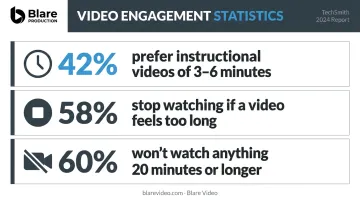
TechSmith's 2024 Video Viewer Trends Report puts this clearly:
- 42% of viewers prefer instructional or informational videos of 3–6 minutes
- 58% stop watching if a video feels too long
- 60% won't watch anything 20 minutes or longer
For training content that genuinely requires more depth, the answer isn't a longer video — it's a series. Breaking a 30-minute training into six focused modules produces better completion rates and better retention.
Prioritize Audio and Visual Quality
Poor production quality doesn't just look bad — it signals low effort, which affects how employees receive the message itself. TechSmith found that 70% of viewers rate clear audio as important, followed by clear visuals at 68%.
This doesn't mean every internal video needs a full film crew. But basic investments matter:
- A decent external microphone
- Controlled, consistent lighting
- A stable camera setup (no handheld shaking)
For high-stakes content — onboarding, leadership communications, culture films — these basics aren't enough. That's where professional production becomes a meaningful factor in how the content lands.
Authentic Storytelling Over Corporate Scripts
The most effective employee videos don't sound scripted. They feature real people speaking in conversational tones about real experiences.The distinction worth making: authentic doesn't mean unpolished.
A skilled director can draw out genuine, natural performances from real employees while maintaining high visual and audio standards. The two aren't in conflict — they just require the right production environment.
Add Captions — Always
65% of people prefer to watch videos with captions or subtitles, and 48% use them always or most of the time, according to TechSmith's 2024 data. Beyond preference, more than 100 empirical studies have documented that captions improve comprehension, attention, and memory retention.
Captions also ensure your content works across every viewing situation:
- Noisy open offices where audio isn't an option
- Quiet environments where employees aren't wearing headphones
- For any employee with hearing differences
That coverage alone makes captions a non-negotiable production step.
The Case for Professional Video Production
There's a real difference between a video that gets made and a video that achieves something.
Smartphones and basic editing software have lowered the production barrier. But for content that shapes how employees perceive the organization — onboarding videos, leadership communications, culture films — quality directly influences reception. A shaky, poorly lit leadership video doesn't just look unprofessional; it erodes the credibility of the message itself.
Professional video production companies bring three things beyond equipment:
- Translates communication objectives into narratives that actually land with employees
- Applies composition, pacing, and editing choices that hold viewer attention throughout
- Delivers post-production polish — color grading, sound mixing, motion graphics — that elevates the final product above DIY alternatives
Blare Video is a full-service production company with experience producing corporate content for brands including Google, TikTok, and Williams-Sonoma, with crews available across 20+ US markets. Their engagement model covers the entire process — from concept development and scripting through filming and post-production — which matters for organizations that don't have in-house production teams to manage the handoffs.
A professionally produced onboarding or training video serves employees across every location for multiple years. Amortized across that usage, the upfront cost looks very different from a one-time expense — and that's before factoring in the consistency gains from standardized content delivery.
How to Measure the Impact of Your Employee Engagement Videos
Producing good video content is only half the equation. Knowing whether it's working requires tracking the right signals.
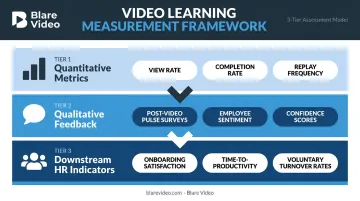
Quantitative Metrics
Start with what the platform data tells you:
- View rate — what percentage of the target audience watched at all
- Completion rate — how far through the video employees got before dropping off
- Replay frequency — segments replayed often suggest high value or areas of confusion
High completion rates on training videos correlate with better knowledge retention. Low completion rates are a signal to revisit length, pacing, or relevance — not to abandon video altogether.
Qualitative Feedback
Platform data shows you what happened — post-video surveys explain why.
Post-video pulse surveys can capture whether employees felt more informed after a leadership communication, more connected after a culture video, or more confident after a training module. That context is something completion rates simply can't give you.
Downstream HR Indicators
The clearest evidence of video engagement impact shows up over time, in HR metrics:
- Onboarding satisfaction scores
- Time-to-productivity for new hires
- Voluntary turnover rates following a structured video engagement program
None of these are video-specific metrics — but tracking them before and after a consistent video rollout is how you connect production investment to real business results.
Frequently Asked Questions
What are the C's of employee engagement?
The C's commonly referenced in HR frameworks include Connection, Communication, Contribution, Commitment, and Culture — representing the core conditions employees need to feel genuinely engaged. Each dimension addresses a different layer of the employee experience, from day-to-day communication to long-term cultural fit.
What types of videos are most effective for employee engagement?
Onboarding, recognition, leadership communication, training, and employee testimonial videos consistently produce the strongest outcomes. Onboarding and testimonial videos tend to have the highest impact on new hire retention, while leadership communications drive ongoing trust.
How long should employee engagement videos be?
Most internal engagement videos perform best at 2–3 minutes. Training content can run up to 5–6 minutes, but anything longer should be broken into a series of shorter modules to maintain attention and improve completion rates.
What is the difference between training videos and employee engagement videos?
Training videos transfer specific skills or knowledge — they're instructional by design. Engagement videos serve a broader purpose: building culture, connection, morale, and a sense of belonging. A safety training video informs; an onboarding culture video connects — both matter, but they're built with different goals.
Should companies use a professional video production team or create videos in-house?
High-stakes content — onboarding films, leadership communications, culture videos — benefits from professional production, where quality directly affects how the message is received. Informal content, like quick manager updates or peer shoutouts, can work well in-house.
How do you measure the ROI of employee engagement videos?
Track a combination of engagement metrics (view and completion rates), qualitative employee survey feedback, and downstream HR outcomes like onboarding satisfaction scores and voluntary turnover rates. Together, these data points reveal whether your videos are actually shifting employee sentiment and behavior.