Introduction
Explaining a cardiac ablation system to an interventional cardiologist requires completely different language, depth, and visuals than walking a patient through what to expect before their procedure — or convincing a hospital procurement committee to approve a six-figure device purchase. Most standard marketing formats can't do all three. Static brochures lack motion, sales decks lack context, and field reps can't be everywhere at once.
U.S. physician accessibility dropped from 60% in 2023 to 45% in 2024, according to Veeva's Pulse Field Trends Report — meaning MedTech companies increasingly need content that educates without a human intermediary. Medical device explainer videos have stepped into that gap.
What follows are the best medical device explainer videos in 2026 — with a breakdown of what makes each one work and what to look for when choosing a production partner.
Key Takeaways
- Medical device explainer videos translate complex mechanisms and clinical workflows into targeted visual stories for clinicians, patients, or investors
- Top 2026 examples balance scientific accuracy, audience-specific messaging, and purposeful animation style choices
- Standout videos cover cardiac ablation, glaucoma drainage, pelvic implants, disinfection technology, and robotic coronary intervention
- Format matters: 3D for anatomy and device placement, 2D for workflow and usability, hybrid for patient-facing content
- Choosing the right production partner means evaluating portfolio depth, medical review processes, and end-to-end production support
What Is a Medical Device Explainer Video and Why It Matters
A medical device explainer video is a short-form video — typically one to five minutes — designed to visually demonstrate how a device works, what clinical problem it solves, and how it should be used. The audience varies: surgeons, procurement teams, patients, or investors.
The format has become essential as devices grow more complex. The FDA had authorized over 1,000 AI-enabled medical devices as of December 2024, according to AdvaMed — and that doesn't account for the robotics, software integrations, and biologics now embedded in routine device categories. A data sheet lists specs. A three-minute animation shows those specs in context — inside a beating heart, or navigating a 2mm anatomical channel — in a way no written document can replicate.
Research supports the medium. A 2024 health-education meta-analysis of 40 studies published in Scientific Reports found video-based learning had a moderate effect on knowledge acquisition (Cohen's d = 0.67) and a moderately high effect on clinical skills development (Cohen's d = 0.76) — stronger outcomes than text-based instruction alone.
Those results carry real implications for how device companies approach training, sales, and patient communication — which is why demand has grown across four distinct use cases.
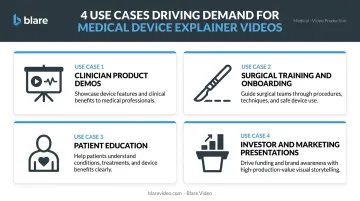
Four Use Cases Driving Demand
- Clinician product demos — showing device differentiation during sales calls and conference presentations
- Surgical training and onboarding — reducing time-to-competency for OR staff and distributors
- Patient education — preparing patients before procedures with accurate, reassuring visual explanations
- Investor and marketing presentations — communicating clinical value and market positioning at trade shows and funding events
Best Medical Device Explainer Videos in 2026
These videos were selected based on clarity of communication, visual quality, audience specificity, and effectiveness in conveying device differentiation — not just production aesthetics.
Atrial Fibrillation Ablation Surgery (AXS Studio)
This 3D animation from AXS Studio walks through a cardiac catheter ablation procedure for atrial fibrillation — covering catheter navigation, morphology flexibility, and pulsed field ablation creating tissue-selective lesions. It was produced for cardiologists, interventional specialists, and device investors.
What separates it from a standard procedure animation is its focus on the why behind each step. The video doesn't just show what the catheter does — it communicates why non-thermal energy delivery matters clinically and how catheter flexibility changes the operator experience. In cardiology sales, that kind of mechanism-level explanation is what moves a device from "interesting" to "I need to see it in my cath lab."
Target Audience: Cardiologists, interventional specialists, medical device investors Format: High-fidelity 3D animation with procedural step narration Key Takeaway: Showing mechanism differentiation — not just function — builds clinical credibility and investor confidence
Ophthalmology Glaucoma IOP Drainage Animation (Scientific Animations)
This product demonstration from Scientific Animations shows a minimally invasive glaucoma surgery device navigating through the eye to place a micro-drainage stent — aimed at ophthalmologists, hospital buyers, and device manufacturers.
Working inside the anterior chamber of the eye is one of the more visually challenging scenarios in medical animation. The video solves it by using transparent tissue rendering to isolate the micro-stent placement, making the surgical pathway and device position immediately readable. Static illustrations of this procedure look like anatomical maps. This looks like the actual surgery.
Target Audience: Ophthalmologists, surgical procurement teams, MedTech investors Format: 3D anatomical animation with cross-sectional transparency effects Key Takeaway: Transparent tissue rendering is essential for demonstrating device placement inside dense anatomical structures
iFuse TORQ TNT™ Implant System (SI-BONE)
This SI-BONE animation demonstrates the surgical installation of a pelvic bone stabilization implant — FDA-cleared under K241504 for pelvic fracture fixation — highlighting the implant's porous thread design and osseointegration. In February 2026, Smith+Nephew announced a distribution agreement with SI-BONE for the iFuse TORQ portfolio, giving this video significant new conference visibility.
The video succeeds because it works simultaneously as a surgical training resource and a product launch asset. The material simulation of bone-implant integration is accurate enough to be clinically useful, and visually persuasive enough for a product presentation. That dual purpose delivers real ROI for companies with limited video budgets.
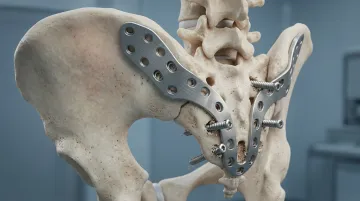
Target Audience: Orthopedic and spinal surgeons, surgical distributors, healthcare administrators Format: High-detail 3D animation with material simulation (bone tissue, implant threading) Key Takeaway: Dual-purpose videos (training + sales) deliver stronger ROI for MedTech companies with constrained budgets
UV Smart D45 Disinfection Device
This UV Smart animation covers their D45 ultrasound probe disinfection device — including the 75-second automated high-level disinfection cycle, accessory compatibility, and workflow integration for ENT specialists in hospital settings. The device carries CE Mark classification (Class IIa under MDR) and ISO 13485 certification.
It's a strong case for 2D animation done well. The information hierarchy is clear, the brand alignment is consistent, and the workflow explanation requires zero guesswork. The video was also paired with a companion infographic — a practical combination for conference leave-behind materials and digital sales outreach where not every buyer will watch the full video.
Target Audience: ENT specialists, hospital infection control teams, device procurement buyers Format: 2D flat animation with companion infographic Key Takeaway: Not every device needs 3D — 2D animation can communicate workflow and usability just as effectively, at a lower cost
Robotic Coronary Artery Intervention (Arcreative Media)
Arcreative Media's animation covers the CorPath robotic platform for percutaneous coronary interventions — an FDA-cleared system (K120834) that allows physicians to perform complex vascular procedures from a radiation-shielded workstation rather than tableside.
The standout quality here is benefit-driven storytelling. Most device animations explain what the technology does. This one leads with what it means for the people using it: less radiation exposure, reduced physical strain, more precise catheter control. For hospital administrators evaluating capital equipment, that framing — physician safety and ergonomics alongside clinical precision — addresses procurement concerns that pure spec sheets never reach.
Target Audience: Interventional cardiologists, hospital leadership, MedTech investors Format: Cinematic 3D animation with procedural and clinical benefit narration Key Takeaway: Leading with physician and patient benefit — not just device specs — increases persuasion value in sales and marketing contexts
What Makes These Videos Stand Out: Three Pillars
Scientific and Procedural Accuracy
Every video on this list was built with clinical accuracy as a non-negotiable constraint, not an afterthought. This matters for two reasons.
Clinicians notice errors immediately — a catheter navigating the wrong anatomy, a device deployed at the wrong angle, or a label that contradicts the IFU can end a sales conversation before it starts. Beyond credibility, the FDA's general controls make clear that graphic materials accompanying a device fall under labeling rules. Misleading visuals carry regulatory risk.
The best production partners treat medical review as a structured process:
- Validate clinical accuracy at the script stage
- Review anatomy and device behavior at the storyboard stage
- Confirm against the IFU before final delivery
Audience-Centered Visual Storytelling
Each video is built around a specific viewer — and the language, depth, and visual style reflect that. The contrast is clear in practice:
- A patient education video uses simple anatomical landmarks, reassuring narration, and minimal jargon
- A clinician-facing product demo uses precise procedural terminology, stepwise mechanism explanation, and visual cues that mirror surgical decision-making
- An investor presentation leads with the clinical problem, market context, and device differentiation before getting into mechanics
Videos that try to cover all three audiences typically engage none of them.
Purposeful Animation Style Selection
Let content requirements drive format choice — budget and trend are secondary. The 2026 examples above demonstrate this clearly:
- 3D animation — best for internal anatomy, device deployment inside tissue, and mechanism-of-action visualization
- 2D motion graphics — effective for workflow explanation, device compatibility, and feature overviews (the UV Smart D45 is proof)
- Hybrid live-action/animation — adds human authenticity for patient-facing content, combining real clinician footage with animated device overlays
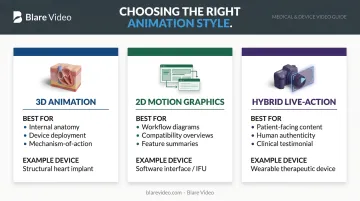
Wyzowl's 2026 video marketing report found that 91% of businesses now use video as a marketing tool, with animation representing a fast-growing share of that output. In medical device contexts, the format decision is ultimately a clinical communication decision. Get the format wrong and you risk losing the viewer before the mechanism-of-action even plays.
How to Choose a Medical Device Video Production Partner
Look for Relevant Portfolio Depth
A studio with strong orthopedic implant work may not have the clinical command to animate cardiac electrophysiology or ophthalmic micro-surgery. Check for:
- Scientific accuracy in previous device work
- Step-by-step narrative structure that reflects real clinical workflow
- Audience-appropriate depth (a training video for surgeons should read differently than a patient explainer)
- Experience in your specific therapeutic area or device category
Verify Their Medical Accuracy Process
Ask directly: How is clinical accuracy validated at the script stage, the storyboard stage, and before final cut? A production partner worth trusting should be able to answer all three specifically — not describe accuracy as a general commitment.
Ask directly about their process at each stage:
- Who validates clinical accuracy — an in-house medical team, contracted clinicians, or your own regulatory staff?
- How is accuracy checked at the script stage, storyboard stage, and before final cut?
- How are revision requests from medical reviewers handled when they conflict with an approved script?
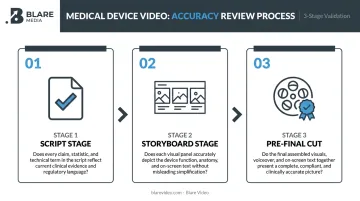
Partners who answer these questions with specifics are far better positioned than those who treat accuracy as a general promise.
Evaluate Full-Service Capability
Medical device videos routinely require coordination across marketing, regulatory, clinical, and legal teams. A production partner who handles concept, scripting, animation, and post-production under one roof reduces the communication overhead and timeline risk that comes with managing multiple vendors.
Blare Video's full-service production teams cover major US markets — including New York, Los Angeles, Dallas, Chicago, and Atlanta — and have produced medical device video series, healthcare commercials, and medical association event coverage. Their six-video series for Tandem Diabetes, which included co-written scripts, animation, and post-production, is a concrete example of what integrated, end-to-end production looks like for a multi-stakeholder healthcare project.
Conclusion
The best medical device explainer videos in 2026 share a common foundation: scientific accuracy, audience-specific storytelling, and deliberate format choices that serve the device and the viewer — not just a production trend.
Whether the final output is a cinematic 3D cardiac animation or a clean 2D workflow explainer, what separates a useful tool from a forgettable product video is how precisely it was built for its intended audience.
Evaluate production partners on their process and portfolio depth, not just their aesthetic style. If a studio can't explain how they approach regulatory accuracy or audience segmentation, visual polish won't carry the video far. For MedTech organizations ready to work with a team that covers both, Blare Video offers full-service healthcare video production — from concept and scripting through final delivery — with crews across major US markets. Get in touch to discuss your project.
Frequently Asked Questions
What is a medical device explainer video?
A medical device explainer video is a short-form video — animated or live-action — that demonstrates how a device works, its clinical benefits, and its proper use for a target audience such as clinicians, patients, or investors. Most run between one and five minutes depending on device complexity and platform.
How long should a medical device explainer video be?
Optimal length depends on audience and platform. A general guideline: 60–90 seconds for social media and web overviews, 1.5–3 minutes for patient education, and 2–5 minutes for clinician training or investor presentations. Shorter is usually better when the core message can be delivered concisely.
What animation style works best for medical device videos?
3D animation excels for internal anatomy and device placement; 2D motion graphics suit workflow explanations and feature overviews; hybrid live-action adds authenticity for patient-facing content. The right choice depends on what the device requires visually and who the viewer is — not trend or budget alone.
How much does a medical device explainer video cost?
Named medical animation sources place custom production broadly in the $5,000 to $50,000+ per minute range, depending on complexity, style, and usage rights — with simpler 2D explainers at the lower end and high-detail 3D animations at the upper end. Medical review requirements and revision scope also affect final cost. Hybrid live-action formats vary widely, so request a direct quote based on your specific scope.
Who uses medical device explainer videos?
Medical device manufacturers, pharma companies, hospitals, surgical training programs, healthcare marketing teams, and patient education departments all regularly commission explainer videos — for product launches, clinical training, conference presentations, and pre-procedure patient communication.
What information is needed to start a medical device video project?
Most production teams need a clear objective and target audience before anything else. Come prepared with:
- Core clinical message or device differentiator
- Script or detailed device brief
- Reference materials (clinical data, regulatory approvals, visual guidelines)
- Target length, delivery platform, and medical/legal review process