Introduction
Most buyers have learned to tune out brand advertising. They've seen enough polished taglines and professional spokespeople to know that marketing copy exists to sell, not to inform. But when a real person — someone with a name, a title, and a recognizable problem — sits down on camera and describes exactly how a product changed their situation, something different happens: the credibility of a peer recommendation, delivered with the reach of a paid media asset.
According to Wyzowl's testimonial survey, 9 out of 10 people trust what a customer says about a business more than what the business says about itself — and 77% of people who watched a brand testimonial video said it helped convince them to buy.
This guide covers everything you need to build a testimonial video strategy that actually moves buyers:
- The psychology behind why these videos work
- Narrative structures that make them compelling
- How to find and prepare the right customers
- Production choices that affect credibility
- Where to deploy finished videos for maximum impact
Key Takeaways
- 9 in 10 buyers trust peer voices over brand claims — testimonial videos are your highest-credibility marketing asset
- Structure every video around a problem → solution → outcome arc, with specific measurable results in the final act
- Choose customers who are genuine advocates with quantifiable wins, not just satisfied customers
- Poor audio kills credibility — bad sound undermines viewer trust even when the story itself is compelling
- Deploy videos across your website, sales toolkit, email sequences, and paid social for full-funnel impact
What Is a Customer Testimonial Video — and Why Does It Work?
A customer testimonial video is a marketing asset where a real, named customer describes their experience with a product or service in their own words — on camera, without a script.
That distinction matters. A scripted brand ad uses actors. A written review lacks voice and expression. A case study PDF centers the brand's narrative. A testimonial video centers the buyer's.
The Psychology Behind the Trust
When people face uncertain decisions, they look to others who've already made them. We instinctively discount what sellers say and give more weight to what peers report — particularly peers who share our situation. Wyzowl's testimonial data found that 2 out of 3 people said they'd be more likely to purchase after watching a testimonial video showing how a business helped someone like them.
The medium matters, too. Facial expressions, tone of voice, and hesitation patterns communicate authenticity in ways text simply can't replicate. Wyzowl's 2026 video marketing research found that 63% of consumers prefer a short video to learn about a product or service, compared to just 12% for text-based articles.
The B2B Dimension
That psychology doesn't disappear in B2B buying — it intensifies. For high-stakes purchases, testimonial videos carry particular weight at the decision stage. Google's research found that 70% of B2B buyers and researchers watched video throughout the path to purchase — with nearly half watching 30 or more minutes of video content. When a prospect is evaluating a $50,000 software contract or a new industrial supplier, a credible peer on camera is worth more than any sales deck.
What makes testimonial videos uniquely powerful:
- They center the customer's voice, not the brand's
- They communicate emotion and authenticity through non-verbal cues
- They function as evergreen social proof across the entire buyer journey
- They help prospects self-identify: "that person's problem is my problem"
The 3-Part Narrative Structure Every Effective Testimonial Needs
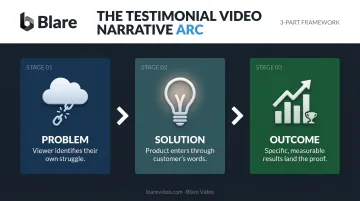
Effective testimonial videos follow a recognizable arc: problem → solution → outcome. Think of it as a story with a clear before and after: a real person facing a specific challenge, then experiencing measurable change. Without this structure, you get vague praise. With it, you get proof.
Outlining the Problem
The first act belongs entirely to the customer's pain — before they found the solution. This is where viewers either recognize themselves or move on.
The more specific the struggle, the more powerful the identification. Prompt your customer with questions like:
- "What was the #1 challenge you were trying to solve before you found us?"
- "What was that problem costing you — in time, money, or missed opportunities?"
- "What had you tried before, and why didn't it work?"
Vague answers ("we needed to improve efficiency") are easy to dismiss. Specific ones ("we were spending 12 hours a week manually reconciling data across three systems") create immediate recognition.
Highlighting the Solution
Once the problem is established, your product enters the story — but through the customer's words, not your marketing language. This is where differentiators emerge organically.
Ask the customer:
- "Why did you choose us over the other options you looked at?"
- "What was the onboarding or adoption experience actually like?"
- "What surprised you?"
The goal is to surface your competitive advantages without scripting them. A customer saying "the setup took less than a day, which no one else could offer" is ten times more credible than a spec sheet making the same claim.
Sharing Quantifiable Results
Results carry the most persuasive weight — but only when they're specific. "Our sales went up" is forgettable. "We reduced customer onboarding time by 40% in the first quarter" gives prospects something to hold onto.
Before the shoot, coach your customer to recall concrete outcomes:
- Ask them to bring any metrics, reports, or records from before and after implementation
- Walk through the timeline: "Three months in, what had changed? Six months in?"
- Help them translate qualitative wins ("the team is less stressed") into quantifiable terms where possible ("we stopped working weekends")
Close the testimonial with a natural recommendation — who else would benefit from this product? This functions as an embedded call to action and helps viewers self-qualify without the video ever feeling like an advertisement.
How to Choose the Right Customer and Prepare for the Shoot
The best story told by the wrong person still underperforms. Selecting the right testimonial subject is as important as any production decision.
Selecting the Right Subject
Look for customers who meet all four criteria:
| Criterion | Why It Matters |
|---|---|
| Genuine advocate with measurable results | Vague enthusiasm reads as hollow on camera |
| Comfortable speaking — not necessarily polished, but natural | Nervousness on camera undermines credibility |
| Mirrors your target buyer persona | Prospects identify with people who look like them |
| Holds a credible title (Director, VP, Owner, etc.) | Title carries social weight, especially in B2B |
Pre-Shoot Preparation
Send guiding questions in advance — not a script. There's a meaningful difference: a script produces robotic delivery; guiding questions help the customer think through their story arc so they can tell it naturally.
Blare Video's directors run pre-shoot prep calls specifically to walk subjects through their story, settle nerves, and keep the on-camera conversation feeling like dialogue rather than testimony. Teleprompters are off the table — scripted delivery is the fastest way to lose the authenticity that makes testimonials credible.
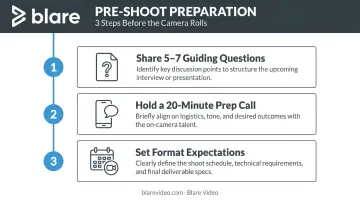
Before the shoot:
- Share 5–7 guiding questions a week in advance
- Hold a 20-minute prep call to walk through the story arc and help them remember specific moments
- Set format expectations — how long the interview will run, what the final video will look like, and how it will be used
Timing the Ask
Prep calls and logistics matter, but none of it works if the timing of your ask is off. Request the testimonial immediately after a clear win — when the result is fresh and the customer's enthusiasm is genuine. Waiting six months means asking them to reconstruct an emotion they've already moved past. Strike when the milestone is recent.
Key Production Elements That Make Testimonials Credible and Compelling
Credibility isn't just about the story. Production quality sends its own signal — and a peer-reviewed study by Newman and Schwarz found that identical content was rated less favorably when audio quality was poor, reducing ratings of speaker competence and viewers' willingness to share the content. Wyzowl's 2026 research reinforces this: 89% of consumers say video quality impacts their trust in a brand.
Location and Visuals
Film in the customer's real environment — their office, factory floor, or store. A lived-in setting adds context clues that reinforce credibility. A sterile studio background strips the customer of their identity and makes the video feel staged.
Multi-camera setups (a wide shot plus a close-up) give editors flexibility and keep the final video visually dynamic. Blare Video's production packages include two-camera interview configurations as standard for testimonial shoots, deploying cameras like the Sony FX6 alongside an A7S3 as a secondary angle.
Audio
Poor audio is the fastest way to lose a viewer's trust. A lavalier microphone clipped to the subject captures clean, consistent dialogue. A directional boom adds redundancy and handles situations where a lapel mic isn't practical. Blare Video's interview packages include both wired/wireless lavalier and boom microphone combinations for exactly this reason — having two sources in post-production is insurance against ambient noise and handling artifacts.
B-Roll
Cutaway footage serves two functions: it keeps the video visually engaging during editing, and it provides visual evidence for what the speaker is describing. If a customer talks about their team's efficiency improving, cut to footage of that team at work. If they describe the product in action, show it.
Post-Production Elements
- Lower-third graphics displaying the customer's name and title — establish credibility in the first five seconds
- On-screen pull quotes — capture key statistics for viewers watching without sound
- Captions — improve accessibility and completion rates on social platforms, where most video plays muted
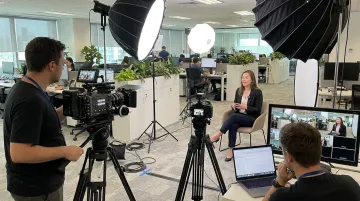
For multi-city clients needing consistent production quality across different markets, Blare Video coordinates locally based crews across 23 US markets — from Los Angeles and New York to Chicago, Dallas, and Atlanta — each equipped with the same camera and audio packages used on its primary shoots, without requiring a traveling crew for each location.
Where to Distribute Your Testimonial Videos for Maximum Impact
A strong testimonial video that lives only on a "customer stories" page most buyers never visit is wasted potential. Distribution strategy determines whether a video earns its production cost.
Highest-Priority Placements
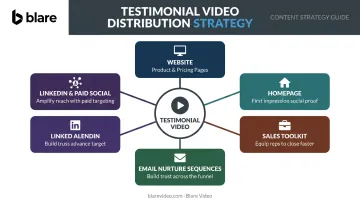
- Product pages and pricing pages — where purchase decisions are made and trust is needed most
- Homepage — establishes credibility for first-time visitors before they explore further
- Landing pages near CTAs — a testimonial immediately before a form or "Get a demo" button addresses the final hesitation
- Sales team toolkit — reps can drop a relevant customer video into follow-up emails, proposals, and pre-demo sequences
Social Media and Paid Advertising
Shorter 30–60 second cuts of longer testimonials perform well as organic posts — LinkedIn for B2B audiences, Instagram for consumer-facing brands. Authentic customer footage tends to outperform polished brand creative in social contexts because viewers trust unscripted footage more than a produced brand spot.
That credibility gap shows up in the data: Wyzowl found that 70% of video marketers use LinkedIn for video distribution, with 50% calling it effective. For B2B testimonials targeting buyers by title and industry, LinkedIn's targeting capabilities paired with authentic customer footage are a high-ROI paid channel worth testing.
Email Sequences and Live Events
- Drop a testimonial video link into a nurture email sequence to re-engage prospects who've gone quiet — a peer story tends to re-engage cold prospects better than another sales email
- Play testimonial videos at trade show booths or conference presentations — live social proof at high-intent moments, when buyers are already in an evaluation mindset
DIY vs. Professional Production: What's the Right Choice?
This decision should be framed around credibility risk, not just budget.
| Production Approach | When It Works | When It Falls Short |
|---|---|---|
| DIY / Smartphone | Social media content, quick proof for internal sales, low-stakes channels | High-stakes placements: homepage, paid ads, enterprise sales process |
| Hybrid | Strong story captured internally, then professionally edited and mixed | When audio or visual quality issues can't be fixed in post |
| Professional production | Flagship testimonials, paid media, website hero sections, new product launches | Rarely falls short if well-planned |
The raw authenticity of a selfie-style video can actually work on platforms where polished content looks out of place. But for a video that will live on your homepage, run as a paid ad, or accompany a proposal to a six-figure client, production quality is part of the credibility argument.
That credibility argument is strongest for companies building a library of testimonials across multiple customer locations. Blare Video operates production teams across major US markets — including Dallas, Chicago, Seattle, New York, and Atlanta — so organizations capturing testimonials from distributed customers get consistent quality and crew standards without the coordination overhead of managing separate vendors in each city.
Frequently Asked Questions
What is a customer testimonial video?
A customer testimonial video is a short video in which a real, named customer describes their honest experience with a product or service in their own words. Unlike scripted advertising, it features an actual customer speaking unprompted, making it a high-trust proof asset for marketing and sales use.
How do you make an effective customer testimonial video?
Start with the right subject and structure, then place the video where buyers are weighing decisions:
- Choose an advocate with measurable, specific results
- Send guiding questions in advance — not a script
- Follow a problem-solution-outcome narrative arc
- Shoot with quality audio and at least two camera angles
- Deploy on product pages, sales follow-ups, and paid social
How long should a customer testimonial video be?
For social media and paid ads, 30–90 seconds. For website product pages or sales use, 2–3 minutes is appropriate. The practical approach: shoot a complete, unrushed interview and cut shorter versions from it in post-production.
What are the guidelines for testimonial videos?
Use real customers in their own words, include specific measurable results, avoid scripts or teleprompters, ensure professional audio quality, get written consent before publishing, and always display the customer's name and title on screen.
How much does a customer testimonial video cost?
Production costs vary by scope. According to Clutch's video production pricing guide, most agencies charge $100–$149 per hour. A professionally produced single-subject shoot typically runs $2,000–$6,000+ depending on crew size, locations, and post-production deliverables.