
Introduction
Testimonial videos are among the most persuasive tools in a marketer's arsenal — but they're also among the most legally exposed. The FTC has sent notices of penalty offenses to more than 700 companies regarding fake reviews and misleading endorsements, signaling just how seriously regulators treat endorsement compliance.
The stakes are both financial and reputational. A non-compliant testimonial video can trigger FTC fines, industry-specific penalties under HIPAA or FINRA, and consumer trust erosion that's hard to reverse. According to PwC's Trust in US Business Survey, four in ten customers stop purchasing from a company due to a lack of trust.
What follows is a practical breakdown of the legal frameworks governing testimonial videos — including industry-specific rules for healthcare and financial services, production practices that support compliance, and the most common mistakes that expose companies to liability.
Key Takeaways
- FTC rules require testimonials to be truthful, reflect real experience, and disclose any material connection — payment, free products, or sponsorship
- Regulated industries — healthcare, financial services, and psychology — face additional compliance layers beyond standard FTC rules
- Written consent is legally required in regulated industries and strongly recommended everywhere else
- On-screen disclosures must be clear, prominent, and impossible to miss
- Common failures: missing result disclaimers, outdated consent forms, and undisclosed incentives
Why Compliance Matters in Testimonial Videos
The FTC's Consumer Reviews and Testimonials Rule, effective October 21, 2024, authorizes courts to impose civil penalties for knowing violations — currently capped at $53,088 per violation as of January 2025.
That figure compounds fast. A testimonial video running across three platforms with two non-compliant claims isn't one violation; it could be several.
The Trust Equation
Beyond fines, deceptive marketing damages something harder to rebuild than a budget line: consumer trust. The Spiegel Research Center found that purchase likelihood for a product with five reviews is 270% greater than for a product with none — but that lift disappears when consumers suspect the reviews are fake or misleading.
Brands that follow the rules signal transparency — and transparent marketing consistently outperforms promotional content that consumers can't trust. Compliance protects your budget; it also protects the audience's willingness to believe you.
FTC Guidelines: The Foundation of Testimonial Video Compliance
The FTC's Endorsement Guides (16 CFR Part 255) set the compliance standard for all testimonial advertising. Every business running customer testimonial videos needs to understand these core requirements.
Truthfulness and Substantiation
Every testimonial must reflect the genuine experience of the person giving it. If a featured result is exceptional — not what a typical customer experiences — a clear disclaimer is required. Phrases like "Results not typical" or "Individual results may vary" are common, but the FTC is explicit: these disclaimers don't automatically fix a misleading overall impression. The video as a whole must not deceive.
The business using the testimonial, not just the person in it, is legally responsible for substantiating any claims in the video.
Material Connection Disclosures
If the person giving a testimonial was paid, gifted free products, or has any financial relationship with the brand, that connection must be disclosed. The disclosure must be:
- Clear and conspicuous — meaning it cannot require any viewer action to find
- Present in the video itself, not only in a caption or description field
- Both visual and audible when the endorsement is made in both formats
There is no FTC-mandated minimum font size or exact number of seconds on screen. The standard is whether an ordinary viewer would likely notice, read, and understand the disclosure. In practice, avoid:
- White or low-contrast text that blends into the background
- Brief flashes that disappear before the viewer can process them
- Placements timed to end before a viewer's eye reaches that area of the screen
The Fake Testimonial Prohibition
The 2024 Rule explicitly bans creating, buying, or disseminating fake consumer reviews or testimonials. This includes AI-generated avatars used to simulate customer voices or identities — if the customer doesn't exist, the testimonial is prohibited, regardless of how realistic it appears.
Industry-Specific Compliance Rules: HIPAA, FINRA, and APA
Certain industries face compliance requirements that stack on top of FTC rules. Getting the base FTC requirements right is not enough if you're operating in healthcare, financial services, or psychology.
Healthcare (HIPAA)
Any patient information used in a testimonial video — images, voice, name, condition, treatment, or provider relationship — may constitute Protected Health Information (PHI) under HIPAA. Verbal consent alone won't satisfy this requirement.
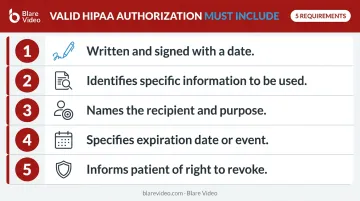
A valid HIPAA authorization must:
- Be written and signed with a date
- Identify exactly what information will be used or disclosed
- Name the recipient and purpose
- Specify an expiration date or event
- Inform the patient of their right to revoke at any time
Even with a signed authorization, content should avoid specific diagnoses, medications, or clinical outcomes where possible. Testimonials framed around general experience ("This practice improved my quality of life") carry far less risk than those referencing specific treatment details.
Financial Services (FINRA and SEC)
For broker-dealers, FINRA Rule 2210 sets out specific content and disclosure requirements for any testimonial that goes public:
- Pre-approval by a registered principal before any testimonial goes live
- Fair and balanced presentation — no cherry-picking only positive outcomes
- Mandatory disclosures stating that the testimonial may not represent other customers' experiences and provides no guarantee of future performance or success
- Disclosure of whether compensation exceeding $100 was paid
Registered investment advisers fall under a separate regime: the SEC Marketing Rule (effective November 4, 2022), which requires clear disclosures about client status and compensation, plus written agreements for compensated testimonials above the de minimis threshold.
Psychology and Licensed Professional Services (APA)
APA Ethics Code Standard 5.05 prohibits psychologists from soliciting testimonials from current therapy clients or others who may be vulnerable to undue influence. The restrictions don't disappear once the therapeutic relationship ends.
For former clients and psychology practices, the safest path involves:
- Obtaining fully written consent before any testimonial is recorded
- De-identifying sensitive clinical details from the final video
- Using aggregated language ("the majority of clients report improved outcomes") rather than individual client stories
Essential Production Best Practices for Compliant Testimonial Videos
Compliance doesn't start in the edit suite. It starts before the camera rolls.
Pre-Shoot Preparation
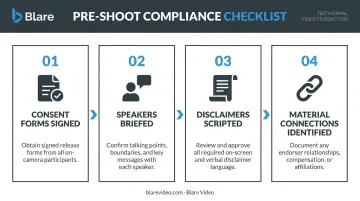
A solid pre-shoot checklist should confirm:
- Consent forms are signed — specifying platforms, duration, and the right to revoke
- Speakers are briefed — they understand they should not make specific outcome guarantees
- Disclaimers are scripted — either as spoken dialogue or prepared as on-screen graphics ready for post-production
- Any material connections are identified — so disclosure language can be drafted in advance
Blare Video's pre-production process includes a dedicated planning call between the client, a Blare representative, and the crew before any shoot, making it the right moment to confirm these elements are in place before filming begins.
Structuring the Testimonial
The most defensible testimonial format follows a problem-solution-outcome narrative grounded in the individual's real experience. Specific claims tied to verifiable personal results ("I reduced my onboarding time by two weeks") are more defensible than sweeping generalizations — provided they're accurate and appropriately disclaimed if atypical.
Avoid coaching subjects toward language they can't genuinely substantiate.
On-Screen Disclosure Standards
On-screen disclosures must be:
- High contrast — dark text on a light background or vice versa
- Legible font size — large enough to read on a mobile screen, not just a desktop monitor
- Sufficient duration — on screen long enough for an ordinary viewer to read and understand (practitioner guidance generally points to a minimum of 4–5 seconds, though no FTC numeric standard is formally codified)
- Positioned prominently — not overlaid on a busy background or placed where viewer attention is elsewhere
Blare Video's post-production capabilities include motion graphics and supporting text packages built for multi-platform delivery. Editors produce content in horizontal, vertical, and square formats, which matters because a disclosure legible at 16:9 on YouTube may need resizing or repositioning for a 9:16 mobile ad placement.
Production quality carries weight for another reason, too. A testimonial that looks staged triggers viewer skepticism even when the content itself is compliant. Proper lighting, clean audio, and stable framing signal authenticity and reduce the risk that viewers — or regulators — question whether the testimonial is genuine.
Common Compliance Mistakes to Avoid
Most compliance failures aren't deliberate. They're the result of overlooked details that seem minor during production but create significant liability in distribution.
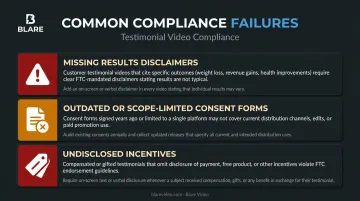
Missing "results not typical" disclaimers. This is one of the most frequently cited FTC violations. If a featured outcome is exceptional, it must be disclaimed. There's no safe threshold below which an atypical result becomes safe to present without context.
Outdated or scope-limited consent forms. A release signed for "website use" does not cover paid advertising, social media repurposing, or YouTube. Consent forms must specify every intended platform and use case. Forms that predate social media or programmatic advertising are a particular liability.
Undisclosed incentives. If a testimonial subject received a discount, free product, or any compensation, that connection must be disclosed directly in the video. The disclosure can't live in the caption, a description field, or fine print viewers scroll past.
Platform disclosures — like YouTube's "includes paid promotion" label — don't substitute for a video-level disclosure under FTC guidelines.
Conclusion
Testimonial video compliance isn't a one-time checklist item. It requires consistent attention across consent collection, production decisions, disclosure execution, and distribution choices — and must be revisited as regulations update or distribution platforms change.
The most practical approach is to treat compliance as part of the production process from day one, not a post-production legal review. Partnering with a production team that builds consent protocols, disclosure standards, and platform-specific requirements directly into the shoot means fewer problems and stronger results.
Blare Video works with healthcare organizations, financial services firms, and corporate clients across the US to produce testimonial videos where legal requirements and creative quality are handled together — not in sequence.
Frequently Asked Questions
What are the guidelines for testimonial videos?
Testimonial videos must be truthful, reflect the genuine experience of the speaker, disclose any material connection (payment or gifts), and include disclaimers when results shown are not typical — all under FTC Endorsement Guides. Healthcare, financial services, and psychology practices face additional requirements layered on top.
Do I need written consent before filming a testimonial video?
Yes. Written consent is legally required in regulated industries (HIPAA, FINRA) and best practice for all testimonial productions. The form should specify how footage will be used, on which platforms, and for how long. A verbal agreement or a form limited to "website use" does not meet the standard.
What disclosures are required in a testimonial video under FTC rules?
Two disclosures are typically required: a material connection disclosure (if the person was compensated or incentivized) and a results disclaimer (if the outcome shown is not typical for customers). Both must appear in the video itself: clear, conspicuous, and unavoidable.
Are video testimonials allowed in healthcare marketing?
Yes, with strict conditions. A HIPAA-compliant written authorization is required, content should avoid specific clinical details even with consent, and patients retain the right to revoke authorization at any time. Verbal consent alone does not satisfy HIPAA.
Can financial advisors use client testimonial videos?
Broker-dealers can, under FINRA Rule 2210: content must be fair and balanced, pre-approved by a registered principal, and include disclosures that past performance doesn't guarantee future results. Investment advisers fall under the separate SEC Marketing Rule, which carries its own disclosure and written agreement requirements.
What makes a testimonial video non-compliant?
The most common triggers: missing or hidden disclosures, unverified outcome claims presented as typical, fake or AI-generated testimonials, and incentivized reviews without disclosure. In regulated industries, missing written authorizations or misleading performance representations create additional exposure.