Introduction
B2B marketing teams are facing a real squeeze. Complex offerings, multi-stakeholder buying committees, and sales cycles that stretch across months make it genuinely difficult to communicate value — let alone stand out in a feed full of competing content.
Video has become the format that cuts through. Not because it's trendy, but because 88% of B2B buyers watched video to learn about products or services in the prior three months, and 95% say video plays an important role in their purchase decisions.
Most B2B teams already know video matters. The harder questions are practical ones: What format fits which goal? When does in-house production make sense versus hiring a professional partner? How do you measure whether any of this is working?
This guide works through each of those questions — covering format strategy, production decisions, and measurement frameworks so your team can build a video program that actually moves the needle.
Key Takeaways
- B2B video targets business buyers across longer sales cycles, with the goals of building trust, educating prospects, and accelerating pipeline.
- Top-performing formats include explainer videos, product demos, customer testimonials, brand films, and event coverage.
- Match video format to funnel stage: awareness, consideration, and decision each require different content.
- Production quality is a credibility signal — poor audio and flat lighting directly undermine buyer trust.
- Distribution and measurement matter as much as the video itself. Track the right KPIs for each format and channel.
What Is B2B Video Production — and How Does It Differ from B2C?
B2B video production covers video content designed for business-to-business communication — think sales enablement, customer testimonials, product education, and executive storytelling. The goal is different from consumer video: credibility and ROI take priority over impulse and entertainment.
The Core Distinction
The difference between B2B and B2C video isn't just the audience. It's the entire purchase dynamic.
| Factor | B2B Video | B2C Video |
|---|---|---|
| Decision-makers | Multiple stakeholders | Usually one consumer |
| Purchase cycle | Weeks to months | Minutes to days |
| Content priority | ROI, credibility, detailed value | Emotion, instant appeal |
| Call to action | Book a demo, contact sales | Buy now, sign up |
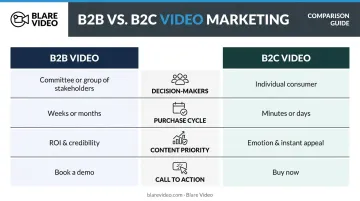
B2B video has to satisfy a CFO, a department head, and an end user — often with the same piece of content. That's a fundamentally different creative challenge.
Format Range
A well-rounded B2B video strategy draws on multiple formats:
- Polished brand films and executive interviews
- Product demos and explainer videos
- Customer testimonial and case study videos
- Event coverage and conference highlight reels
- Short-form social clips repurposed from longer productions
Each format serves a different stage. A case study video that closes late-stage deals will land flat at the top of the funnel — and an awareness brand film won't move a buyer who's already comparing vendors.
Why B2B Video Drives Real Business Results
According to the Content Marketing Institute, 76% of B2B marketers currently use video, and 61% expect their video investment to increase in 2025. Video has moved well past the experimental phase — it's now a core content channel for B2B teams at every stage of the funnel.
Trust and Credibility
Video builds trust in a way that written content rarely achieves. 93% of B2B buyers say video is important for building trust in a company's ability to deliver on its promises. Customer testimonials, thought leadership interviews, and case study videos give decision-makers social proof — and put real faces behind a company's claims. That human element carries real weight when a buyer is evaluating a six-figure software contract or a long-term services engagement.
Conversion and Pipeline Impact
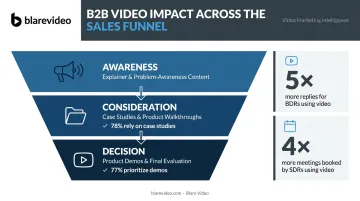
Video accelerates deals when placed at the right funnel stage:
- Awareness stage: Explainer videos and problem-awareness content introduce your positioning
- Consideration stage: Case studies and product walkthroughs address evaluation criteria
- Decision stage: 77% of B2B buyers prioritize product demos at the final decision stage, while 78% rely on case studies in the middle stage
Sales teams using video in outreach also see measurable results — Vidyard reports BDRs using video for first touches get up to 5x more replies, and SDRs using video in qualification book up to 4x more meetings.
SEO and Discoverability
Video content extends organic reach in two ways. First, pages with video hold attention longer — visitors spend 2.6x more time on pages with video than those without, which signals quality to search engines. Second, YouTube functions as a research platform in its own right: Google cites Gartner research showing 65% of B2B buyers were influenced by YouTube during a recent purchase decision.
For B2B brands with technical or educational content, YouTube is a primary discovery channel — not an afterthought.
Types of B2B Videos That Actually Work
Explainer and Product Demo Videos
Explainer videos simplify complex offerings using clear visuals and narration. For SaaS companies, manufacturers, and technical service providers, this format solves a real problem: buyers can't evaluate what they can't understand.
Blare Video has produced this type of content for technology clients including Famous Software — a fresh produce market software provider — and Ricoh, where they created a product launch explainer shot in 8K with a host and spokesperson. Each production covered features, use cases, and value propositions in a format that moves prospects closer to a decision.
This format works best when:
- Prospects are researching but not yet ready for a sales conversation
- A product or service requires visual context to evaluate
- Sales teams need a leave-behind that explains the offering clearly
Customer Testimonials and Video Case Studies
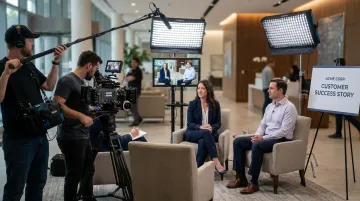
Peer trust converts. When a real client describes a measurable outcome on camera, it carries more weight than any marketing copy. This format is particularly powerful for enterprise software, professional services, financial services, and healthcare vendors — industries where credibility is the primary buying criteria.
Blare Video has produced testimonial video series for B2B clients including IMERYS, a French multinational company, capturing client experiences in a format designed for evaluation-stage buyers.
Corporate Brand Films and Thought Leadership Videos
Brand films establish company identity and values for a business audience. Thought leadership interviews position subject-matter experts as credible voices in their field.
Blare Video produced a brand film for HLC Equity, a family-owned investment firm, covering the firm's history, core team, current focus, and values. The film gives prospective partners a clear picture of who they're dealing with before any direct conversation.
Similar work for Famous Software told the narrative of how their platform serves fresh produce suppliers — connecting company story to customer outcome.
These formats perform well on LinkedIn and company websites for attracting top-funnel prospects and potential partners.
Event Coverage and Highlight Reels
Professional event documentation extends the life of live experiences. Conference keynotes, product launches, trade shows, and corporate summits all generate content that can be repurposed across channels for months.
Blare Video has covered events including LeanData's Ops Stars conference in San Francisco and AppDynamics' three-day conference at the Cosmopolitan in Las Vegas — capturing keynotes, networking moments, and client interviews into polished highlight reels.
With crews across more than 20 US markets, multi-city event documentation is straightforward for companies running national programs.
Social Media and Short-Form B2B Video
55% of B2B marketers say short-form social videos generate the highest ROI of any video format. LinkedIn's video viewing grew 36% year-over-year, and YouTube continues to function as a primary B2B research channel.
Short-form content works best as a complement to longer productions. Blare Video's social media packages are structured around repurposing shoot days into multiple platform-optimized formats — horizontal, vertical, and square — so companies can stay visible between major productions without doubling their budget.
How to Build a B2B Video Marketing Strategy
Step 1: Define Goals and Match KPIs
Every video investment starts with a specific objective. The goal determines the format, length, and channel — and it determines what success looks like.
| Goal | Format | KPIs |
|---|---|---|
| Brand awareness | Brand film, thought leadership | Views, reach, watch time |
| Lead generation | Explainer, gated demo | Click-throughs, form fills |
| Pipeline acceleration | Product demo, case study | Meeting bookings, opportunity influence |
| Customer retention | Onboarding video, updates | Completion rate, support ticket reduction |
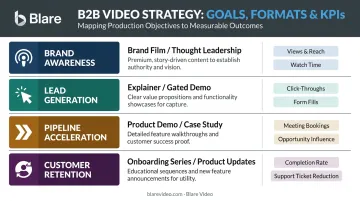
Don't start with "we need a video." Start with "we need to achieve X by Y date."
Step 2: Know Your Audience and Funnel Stage
B2B buying committees include multiple personas — end users, department managers, and C-suite economic buyers — each with different information needs at different stages.
A useful framework:
- End user (awareness): Problem-focused content showing they're not alone
- Manager (consideration): Case studies and ROI data addressing risk and outcomes
- Economic buyer (decision): Demos and testimonials that prove credibility and justify spend
B2B video fails when it tries to speak to everyone simultaneously. A video built for the CFO's evaluation criteria won't engage the end user who needs to understand the workflow. Separate content for separate personas outperforms generic content every time.
Step 3: Choose the Right Format and Plan Production
Format selection depends on four factors:
- Budget and timeline — simpler formats (talking-head interviews, screen demos) require fewer resources
- Message complexity — technical products often need animation or live demonstration
- Distribution platform — LinkedIn favors short clips; YouTube supports longer educational content
- In-house vs. professional production — internal teams can handle some content, but professional partners protect brand quality for high-stakes assets
For high-stakes assets, a full-service production partner handles pre-production (scripting, casting, location scouting), production (multi-camera shoots, lighting, audio), and post-production (editing, color grading, sound design, motion graphics) under one roof. Blare Video operates this way across its markets, so clients avoid the coordination overhead of managing separate vendors for each phase.
Step 4: Distribute Strategically Across Channels
84% of B2B buyers use LinkedIn to share content with peers, making it the top professional distribution channel. Email follows at 78%. YouTube influences purchasing decisions for 65% of B2B buyers. (Statistics via LinkedIn B2B Institute and Demand Gen Report — verify and link before publishing.)
Primary distribution channels by goal:
- LinkedIn: Brand films, thought leadership clips, short-form social content
- YouTube: Explainers, product demos, event coverage
- Website landing pages: Demo videos, testimonials, product education
- Email campaigns: Case study videos, personalized sales outreach
- Sales outreach: One-to-one video messages, product walkthroughs
Posting everywhere dilutes impact. Strategic placement — the right video on the right channel for the right persona — is what moves pipeline.
Step 5: Measure and Iterate
Track format-specific metrics, not just overall views:
- Watch time and completion rate — identifies where viewers drop off
- CTR from video to landing page — measures conversion intent
- Leads attributed to video — connects content to pipeline
- Meeting bookings from video outreach — tracks sales enablement ROI
Compare performance across videos and channels, identify drop-off points to refine scripting and pacing, and use data to justify continued investment to leadership. The programs that compound results are the ones treating each video as a data point, not a finished product.
B2B Video Production Best Practices
These three principles separate B2B video that performs from video that gets skipped.
Prioritize Audio and Lighting First
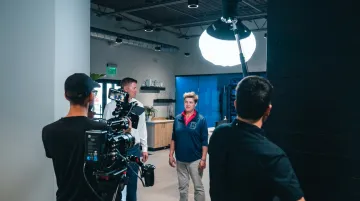
Poor audio is the single fastest way to lose a viewer's trust. 44% of B2B buyers say video quality matters as they navigate the buying journey, and 93% say it affects their assessment of a vendor's ability to deliver. Blare Video uses professional audio systems — Sound Devices mixers, Kino Flos, HMI fixtures, LED panels — because these elements determine whether a video reads as professional or amateur.
Build Each Video Around One Message
The most common mistake in B2B video is trying to cover every feature, benefit, and differentiator in a single production. The result satisfies no one. Effective B2B videos focus on one clear idea with one specific call to action:
- Book a demo
- Download a resource
- Contact sales
Anything beyond that single goal dilutes the message.
Front-Load the Value Proposition
B2B buyers are time-constrained. If your video doesn't establish relevance in the first 10–15 seconds, most viewers won't make it to the second minute. Vidyard data shows videos under one minute retain 65% of viewers to the end — compared to just 20% for videos over 20 minutes.
Structure your script to hook with the pain point, address it clearly in the body, and close with a specific next step that matches the funnel stage.
Frequently Asked Questions
What is B2B video marketing?
B2B video marketing is the use of video content to promote products, services, or brand narratives to business audiences. It spans product demos, testimonials, thought leadership, and event coverage — deployed across the full sales funnel to educate buyers, build trust, and accelerate decisions.
What is the best video marketing strategy?
Start by defining a specific goal tied to a funnel stage, then match the video format to the personas involved in the buying decision. Distribute on channels where those buyers spend time — primarily LinkedIn and YouTube — and measure engagement and conversion data to optimize over time.
How do I improve video production quality?
The highest-impact changes are professional audio, proper lighting, and a tightly written script. Working with an experienced production partner ensures post-production polish — color grading, sound mixing, clean editing — matches the professional image B2B buyers expect from a credible vendor.
How much does a 2-minute B2B video cost?
A professionally produced 2-minute corporate video — covering editing, color correction, and sound design — typically starts around $2,800 for a basic format. Agency hourly rates commonly run $100–$149/hour according to Clutch, with total project costs scaling based on crew size, location, and complexity.
What is the role of digital marketing in B2B?
Digital marketing drives B2B brand visibility, lead generation, and buyer education across the full purchase journey. Video accelerates that trust-building by translating complex information into a format buyers absorb quickly — research consistently shows that exposure to a company's video content increases receptiveness to follow-up sales outreach.