Introduction
B2B healthcare marketing is genuinely difficult. Sales cycles stretch across quarters, and purchase decisions involve procurement teams, clinical directors, IT, and C-suite executives — often all at once. The technical complexity of most healthcare products makes written content alone feel inadequate.
Video cuts through that complexity. A two-minute product demonstration can communicate what a ten-page white paper struggles to convey. A video testimonial from a hospital administrator carries weight that a written quote simply cannot replicate.
According to Wyzowl's 2025 State of Video Marketing report, 93% of marketers say video has increased user understanding of their product or service, and 85% report that video generates leads. Those numbers reflect why healthcare organizations are increasingly treating video as a primary content format, not a supplementary one.
This guide covers the video types that work for B2B healthcare buyers, how to build a strategy around them, what compliance requires, and how to measure whether it's working.
Key Takeaways
- B2B healthcare video targets organizational buyers — hospitals, clinics, health systems, and pharma companies — not individual patients
- Video lets multiple stakeholders evaluate complex products before your first sales conversation
- The highest-performing formats: explainer videos, clinical testimonials, thought leadership interviews, and product demos
- HIPAA compliance and clinical credibility are production requirements, not afterthoughts
- LinkedIn, YouTube, email sequences, and website embeds are the core distribution channels
- Track watch-through rate and pipeline attribution, not raw views
Why Video Works for B2B Healthcare Buyers
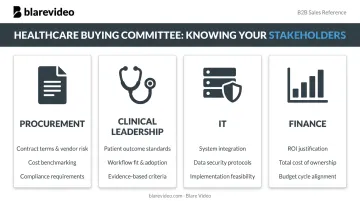
Healthcare buying committees are large. Forrester's 2024 State of Business Buying report found the average B2B purchase involves 13 people, with 89% of purchases spanning two or more departments. In healthcare, that group typically includes:
- Procurement — focused on cost, contracts, and vendor risk
- Clinical leadership — evaluating outcomes, workflow fit, and adoption
- IT — assessing integration, security, and implementation complexity
- Finance — modeling ROI and long-term total cost of ownership
A well-produced video can travel through that committee without your sales team in the room. It delivers consistent messaging to every stakeholder, without distortion or omission.
This aligns with a broader shift in how buyers research. Gartner research shows 75% of B2B buyers now prefer a rep-free buying experience — they want to evaluate vendors on their own terms, through content they find and share themselves. Demand Gen Report's 2024 data reinforces that: 72% of B2B buyers share content with colleagues, and 57% of those colleagues consume it independently.
Video also addresses healthcare's core challenge: complexity. Medical devices, health IT platforms, and population health services don't lend themselves to quick written summaries. Video combines narration, visuals, and real clinical context to communicate nuanced information to both clinical and non-clinical decision-makers — often in under three minutes.
Healthcare buyers are also unusually risk-averse. Procurement mistakes can affect patient outcomes, operational continuity, and regulatory standing. Video that shows real clinical results and puts credible experts on screen builds that trust before the first sales conversation — and it tends to filter out low-intent buyers in the process.
The Right Video Types for B2B Healthcare Marketing
Not all video formats serve the same purpose in a healthcare buying cycle. Here's what works, and when:
Explainer Videos
Explainer videos simplify complex medical products, services, or protocols for buyers who may not have deep clinical or technical backgrounds. They're particularly effective for health IT platforms and multi-feature medical devices where the value proposition is difficult to summarize.
Wyzowl reports that 96% of people have watched an explainer video to learn about a product or service. For healthcare vendors, this format works across multiple audience types — a clinical director and a CFO can both extract what they need from a well-structured explainer.
Testimonial and Case Study Videos
Video testimonials from healthcare organizations carry a specific kind of weight. A hospital administrator describing how your platform reduced readmission rates is more persuasive than any marketing copy you could write.
Demand Gen Report's 2024 Content Preferences Benchmark Survey found 78% of B2B practitioners rely on case studies during the middle stage of solution evaluation, and 63% prioritize user reviews late in the funnel. In video format, these formats become significantly more credible — you're not reading a summary, you're watching a peer from a similar institution describe their experience.
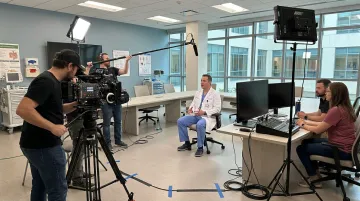
Blare Video has produced testimonial and case study videos for organizations including Community Medical Centers, Bakersfield Heart Hospital, and Kern Family Health Care, plus a six-video product demonstration series for Tandem Diabetes. Crews that have worked inside clinical environments understand the access, sensitivity, and subject matter expertise these productions require.
Thought Leadership and Expert Interview Videos
Long buying cycles create a specific problem: your prospects go quiet for weeks or months while evaluating options internally. Thought leadership video keeps your brand present during that silence.
Interview-format videos with your clinical advisors, medical directors, or industry partners build authority without selling. Topics like EHR interoperability, value-based care transitions, or AI in diagnostics position your team as informed peers rather than vendors.
Panel and fireside chat formats work especially well here — healthcare audiences respond to peer-level expertise, not promotional talking points.
Product Demonstrations
Demand Gen Report found 77% of B2B buyers rely on product demos in late-stage buying decisions. For medical devices, clinical software, and health IT platforms, a demonstration inside a real-world care setting removes ambiguity faster than any specification sheet.
Product demo videos also directly support sales teams. A short, well-produced walkthrough embedded in a follow-up email sequence gives prospects something concrete to share internally — particularly useful when your sales rep doesn't have direct access to every stakeholder.
Brand and Culture Videos
Demos win evaluations; brand videos win long-term partnerships. Healthcare buyers are selecting vendors they'll work with for years — a brand video that communicates your mission, your team's clinical expertise, and your commitment to patient outcomes builds the relational trust that underpins major procurement decisions.
For organizations that need on-location production at healthcare facilities, working with a crew that has direct healthcare experience and national reach matters. Blare Video's production team operates across major US markets — including Los Angeles, Chicago, Dallas, New York, and Atlanta — with on-location crew and post-production support wherever your clients are based.
Best Practices for Building Your Video Strategy
Define Your Audience Segment Before You Produce Anything
B2B healthcare has distinct buyer types, and each needs different messaging:
- C-suite buyers care about ROI, risk reduction, and vendor stability
- Clinical influencers want evidence, peer validation, and workflow fit
- Procurement teams focus on compliance, contract terms, and total cost
- IT stakeholders prioritize integration, security, and implementation timelines
Awareness-stage content should be educational and broad. Decision-stage content should be evidence-driven and specific. Producing a single video for all audiences typically serves none of them well.
Lead with Real Stories, Not Feature Lists
Healthcare decision-makers are trained skeptics. They evaluate vendors constantly and recognize promotional content immediately.
Videos that open with a genuine clinical problem — a readmission challenge, a billing inefficiency, a medication adherence gap — before introducing your solution are far more persuasive than feature-heavy promotional content.
That's why effective testimonial production starts with extensive interviews, not a script. Transcribing full interview content preserves authentic language and produces final cuts that feel earned rather than rehearsed — a key distinction for skeptical healthcare buyers.
Match Video Length to Platform and Purpose
Vidyard's 2025 Video in Business Benchmark Report provides clear guidance: 65% of viewers finish videos under one minute, while only 20% finish videos over 20 minutes.
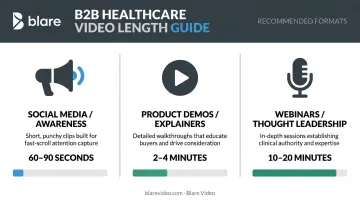
Use this as a practical framework:
| Video Type | Recommended Length |
|---|---|
| Social media / awareness | 60–90 seconds |
| Product demos / explainers | 2–4 minutes |
| Webinars / thought leadership | 10–20 minutes |
Regardless of length, open with a strong hook in the first 5–10 seconds. The drop-off curve is steepest at the beginning.
Repurpose Every Production
A single high-quality video production should generate multiple assets. A few concrete examples for healthcare marketers:
- A 30-minute webinar with a clinical expert → Cut into a 90-second LinkedIn clip, a 3-minute website summary video, and three short email video thumbnails for a nurture sequence
- A product demo filmed at a hospital client site → Embed in the product page, include in sales outreach sequences, and present at trade show booths
- A brand video featuring clinical staff → Extract audio for a podcast episode intro, pull quotes for social graphics, and embed in investor relations pages
Wistia's 2025 research found 89% of marketers repurpose webinar recordings into other assets, with on-demand views continuing to accumulate for three to four months post-event. That means one shoot can drive pipeline value for months — long after the production budget is spent.
Optimize for Search
Most healthcare buyers research vendors before ever making direct contact. Publishing to YouTube with targeted keywords in titles and descriptions, adding full transcripts, and embedding videos in relevant blog posts puts your content in front of buyers during that research phase — often before they visit your website at all.
Navigating Compliance and Clinical Credibility
HIPAA and FDA Requirements
Any video featuring identifiable patients, patient data, or clinical settings requires careful compliance review. HHS guidance requires covered entities to obtain written authorization before using protected health information (PHI) for marketing purposes. Safe Harbor de-identification standards require removal of 18 identifier categories, including full-face photographs.
For pharmaceutical and medical device companies, FDA social media and promotional guidelines govern how products are presented online, including risk-benefit disclosures and postmarketing submission requirements. Have legal and compliance review any clinical claims before publication — not after.
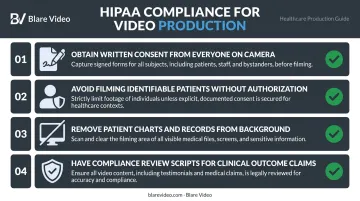
Key practical steps:
- Obtain written consent from every individual appearing on camera
- Avoid filming identifiable patients without explicit authorization
- Don't show patient charts, screens, or records in the background
- Have compliance review scripts for any clinical outcome claims
Clinical Credibility as a Production Standard
51% of B2B buyers in 2024 said content was too generic and irrelevant, up from 38% the year prior (Demand Gen Report). In healthcare, generic content does more than underperform — it signals that your team doesn't understand the clinical environment.
Videos that feature qualified experts on camera, reference accurate data, and reflect real clinical workflows build credibility fast.
Poorly produced content can actively damage trust. Buyers notice a staged clinical setting, imprecise terminology, or production quality that doesn't match the professional environment they work in every day.
Ethical Messaging Standards
Healthcare video content should inform and build confidence, not pressure or mislead. The SHSMD Code of Ethics for healthcare marketing communications emphasizes truthfulness, privacy protection, and informed consent. Specifically, avoid:
- Exploiting patient fear or urgency to drive action
- Making outcome claims that aren't supported by data
- Implying clinical endorsements that haven't been formally obtained
Distribution and Measurement
Where to Distribute
- LinkedIn: Primary channel for reaching healthcare executives, clinical directors, and health system administrators. LinkedIn's professional environment supports both organic video posts and targeted paid campaigns by job title and organization type
- YouTube: Essential for search discoverability. Healthcare buyers researching solutions find video content through organic search — a Gartner study cited by Google found 65% of B2B buyers were influenced by YouTube during a purchase decision
- Email sequences: Video thumbnails embedded in nurture emails drive higher engagement than text-only messages. Vidyard reports video messages generate up to 5x more replies in sales outreach sequences
- Website product pages: Demo and testimonial videos embedded on service pages reduce friction for buyers evaluating you independently. Most B2B healthcare buyers conduct significant research before ever contacting a vendor
Once your videos are in market, distribution alone won't tell you what's working. Track these metrics to understand actual buyer behavior:
Metrics That Matter
- Watch-through rate: Are buyers watching most of your video, or dropping off at 30 seconds?
- Click-through rate: Are viewers taking action — visiting a product page, filling out a contact form?
- Lead form completions: Wistia's 2025 data shows video lead forms average 25% completion, reaching up to 65% when placed at the end of longer content
- Pipeline attribution: Which leads that converted to opportunities engaged with video content during their evaluation?
Pay close attention to drop-off points. When viewers consistently exit at the same moment, that's a precise signal about where your message stops landing — far more useful than any aggregate view count for making targeted improvements.
Frequently Asked Questions
What is B2B healthcare video marketing?
B2B healthcare video marketing is the strategic use of video to promote products or services to healthcare organizations — hospitals, health systems, pharmaceutical companies, or health insurers — rather than individual patients. The goal is to educate organizational buyers, build trust, and support complex purchase decisions.
What makes B2B healthcare video marketing different from B2C?
B2B targets organizational buyers with long decision cycles, multiple stakeholders, and a high need for technical and clinical credibility. B2C targets individual patients with more emotional, simplified messaging and much faster purchase decisions.
What video types work best for B2B healthcare?
Explainer videos, clinical testimonials, expert thought leadership interviews, and product demonstrations tend to perform best. They address the information needs of both clinical and non-clinical decision-makers across different stages of the buying cycle.
How do you keep healthcare video content HIPAA compliant?
Obtain written consent from anyone on camera, avoid showing identifiable patient information (including incidental backgrounds), and have legal or compliance teams review content before publication. Pharmaceutical and medical device companies should also account for FDA promotional guidelines.
How long should a B2B healthcare marketing video be?
Match length to purpose: 60–90 seconds for social awareness content, 2–4 minutes for explainers or product demos, and 10–20 minutes for webinars or panel discussions. Open with a strong hook regardless of format — drop-off is steepest in the first ten seconds.
How do you measure ROI from B2B healthcare video?
Focus on watch-through rate, click-through to product or contact pages, lead form completions, and pipeline attribution — not raw views. In B2B, how long someone watches is a far stronger signal than how many people clicked play.