
That gap — between budget commitment and strategic clarity — is where most corporate video projects go wrong. And it almost always traces back to inadequate planning before cameras roll.
Pre-production is not a procedural formality that production companies use to fill calendar time. It is the phase where budget discipline, brand integrity, and timeline control are either established or sacrificed. What follows explains exactly why — and what the absence of it costs.
Key Takeaways
- Pre-production covers every task completed before filming: scripting, scheduling, location scouting, budgeting, and stakeholder alignment
- Skipping it is one of the most reliable ways to trigger reshoots, budget overruns, and revision cycles
- The three measurable advantages of thorough pre-production: cost control, brand alignment, and timeline predictability
- BetterBriefs found 33% of marketing budgets are wasted on poor briefs — structured pre-production is how that loss gets prevented
- Structured pre-production shortens post-production timelines and cuts the number of revision rounds required
What Is Video Pre-Production?
Pre-production is every task completed before a camera starts recording. That includes defining goals, writing and approving a script, scouting locations, scheduling crew and talent, and getting documented sign-off from all relevant stakeholders. Think of it as the blueprint phase — the work that determines whether shoot day runs smoothly or stalls under the weight of unresolved decisions.
For corporate videos specifically, pre-production carries an additional function: it translates organizational objectives into a concrete production plan that a crew can execute on schedule and on budget. Whether the goal is brand awareness, lead generation, employee communication, or client trust, pre-production is where that goal gets converted into a plan the production team can actually execute.
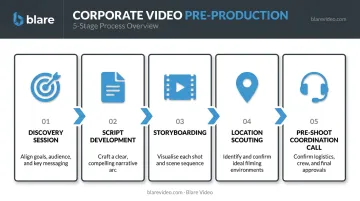
Pre-production is not a single meeting. A complete process typically includes:
- A discovery or fact-finding session to establish objectives and audience
- Script development and review with communications or marketing leadership
- Storyboarding to confirm visual style before a frame is shot
- Location scouting to verify feasibility before permits and rentals are committed
- A final pre-shoot coordination call between the client, crew, and production team
The scope scales with project complexity. A single-location testimonial video requires less runway than a multi-day product launch shoot. But the structure remains the same — and skipping any part of it creates compounding risk downstream.
Key Advantages of Pre-Production for Corporate Videos
The advantages below are measured in outcomes businesses actually track: production cost, brand consistency, time-to-delivery, and revision count. Not abstract creative ideals.
Budget Control and Cost Efficiency
A corporate shoot runs on real-time costs. Crew, equipment, location rentals, and on-camera talent all have hourly or daily rates. Every unresolved question on set (which version of the script the exec is reading, whether that background element is approved) costs money while being answered.
Pre-production eliminates those surprises before the meter is running. A confirmed shot list means the crew films only what is needed. Location scouting confirms whether a space is actually usable before permit and rental fees are committed. Budget conversations happen before contracts are signed, not after a shoot day reveals new requirements.
KPIs impacted: total production cost, reshoot rate, cost per finished minute, budget variance between estimate and actuals.
The reshoot risk is where the financial exposure is highest. Reconvening a crew, rebooking a location, and rescheduling executive talent multiplies costs that were already committed once. Under AICP's commercial production guidelines, specification changes after a bid is accepted are billed as change orders — and production companies are entitled to add their full markup percentage on overages. Pre-production is specifically designed to lock specifications before those financial commitments begin.
For Blare Video, budget alignment happens before planning begins. During the initial exploratory call, all costs and options are presented to the client — and budget approval is confirmed before crew scheduling or any other pre-production expenses are incurred. The assigned producer is then explicitly responsible for keeping the project within that approved figure, with no surprise fees introduced later.
This advantage has the highest impact on: projects with multiple shoot days, external talent, travel requirements, or tight corporate budget cycles where overruns require executive approval.
Brand Alignment and Message Clarity
Corporate videos represent the organization publicly. Off-brand visuals, tone that contradicts the company's communications standards, or a call to action misaligned with campaign strategy can undermine the entire business purpose of the video.
Pre-production is where brand standards, messaging priorities, and audience targeting get locked in. Script reviews with marketing or communications leadership confirm that language and tone match brand guidelines.
Storyboarding validates visual style, logo usage, and color palette before a single frame is captured. Stakeholder sign-off during pre-production means the final review has no surprises.
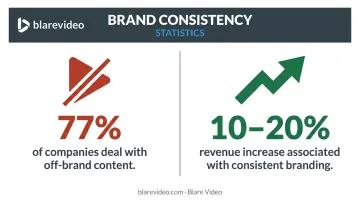
Lucidpress's State of Brand Consistency report found that 77% of companies deal with off-brand content, and that consistent branding across communications channels is associated with a 10–20% revenue increase. For video content distributed at scale — across campaigns, events, or client-facing channels — brand inconsistency is not just an aesthetic problem. It carries measurable business cost.
KPIs impacted: stakeholder approval rate on first review, number of revision rounds, brand compliance outcomes, audience engagement tied to message clarity.
Brand problems in corporate video almost never originate on set. They trace back to a vague brief, where the production team and client team each interpreted the goal differently and no documented agreement existed to resolve that. Pre-production closes that gap explicitly.
For regulated industries, pre-production is a compliance requirement, not just a best practice. Key review obligations include:
- Financial services: FINRA Rule 2210 requires principal approval of retail communications before distribution
- Healthcare and pharma: FDA guidance mandates accurate presentation of benefit and risk information in promotional content
Pre-production builds those review checkpoints into the timeline before production begins — not as a delay, but as a planned milestone.
This advantage matters most for: executive spokesperson videos, client-facing content, product launches, and any video distributed externally or at scale.
Timeline Predictability and Fewer Revisions
One of the most consistent frustrations in corporate video production is a post-production process that drags on. The root cause is almost always the same: unclear direction given before filming generates rounds of revisions after the edit begins.
Pre-production compresses revision cycles by aligning all stakeholders on the final deliverable before the editor touches a single clip. A detailed production schedule gives all departments, including internal approvers, clear milestone dates.
Script approval before shoot day means editors aren't working around uncertain messaging. A complete shot list ensures all required footage is captured in one shoot, not across multiple return trips.
Ziflow's 2023 Creative Workflow Report, conducted with the American Marketing Association, found that 57% of creative projects require 3–5 versions before completion, and 25% require 6 or more. Additionally, 30% of teams absorbed extra costs due to missed deadlines or poor feedback. These are not video-specific findings, but they reflect the same pattern: unclear direction at the start creates expensive correction cycles at the end.
KPIs impacted: days from shoot to delivery, number of revision rounds, on-time delivery rate, post-production hours per project.
In corporate environments, delayed delivery carries downstream consequences beyond the production itself. A conference recap that arrives after the event window closes, a product launch video that misses the campaign start date, or a series that falls behind its publishing cadence — all of these create costs that extend well beyond the production budget.
Blare Video structures post-production packages with two standard revision rounds. Projects that arrive at the edit with a pre-approved script, confirmed shot list, and organized footage consistently move through those rounds faster than projects where direction was still being resolved during filming.
This advantage has the highest impact on: event-driven videos, content series with regular publishing cadence, and organizations producing multiple videos annually where delays compound across the calendar.
What Happens When Pre-Production Is Skipped
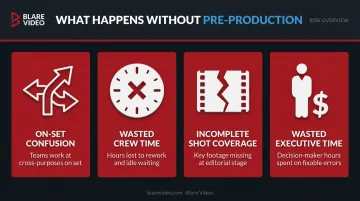
Skip pre-production and unresolved decisions don't disappear — they get made on set, where every minute carries a cost.
The most common outcomes:
- On-set confusion about objectives leads to footage that is technically adequate but strategically useless
- Crew time is wasted while decisions that should have been made in pre-production are made in real time
- Shot coverage is incomplete, requiring a return visit to capture footage that wasn't on a shot list that didn't exist
- Executive or subject-matter-expert time is spent producing footage that doesn't match the final vision
That last point deserves specific attention. A chief executive's time carries a real cost — BLS 2024 data puts the median annual wage for chief executives at $206,420, or roughly $99 per hour at median. A poorly planned shoot day that produces footage requiring complete reshoots means that individual's on-camera time was entirely wasted — and rescheduling it, in most organizations, is not straightforward.
That wasted shoot day is usually just the beginning. Projects that enter post-production without pre-production alignment routinely surface stakeholder disagreements about direction that were never surfaced before the edit. Each revision round extends the timeline, inflates post-production costs, and strains the relationship between the client team and production company.
What looked like a budget-saving shortcut at the start ends up costing more than a structured pre-production process would have.
As Blare Video notes directly from their own production experience: "Sometimes going the cheap route ends up costing you more money. Especially if you have to do it all over again."
How to Get the Most Value from Pre-Production
Pre-production delivers its full value when it begins early: as soon as the video project is approved and a budget range is established. Not after a production company is contracted and a shoot date is tentatively on the calendar.
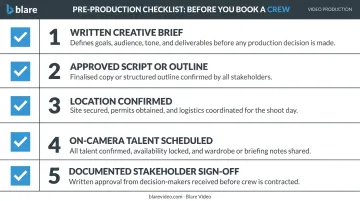
Before a crew is booked, these elements should be completed:
- Written creative brief with defined objectives, target audience, and distribution channel
- Approved script or detailed outline reviewed by all relevant stakeholders
- Location confirmed with permit requirements and rental costs identified
- On-camera talent scheduled with availability locked before shoot day is finalized
- Documented stakeholder sign-off on the core message, visual approach, and key deliverables
Pre-production is not a one-time meeting. It should include checkpoints where the production team and client team confirm alignment before advancing to the next phase. Blare Video builds this into every engagement — the pre-shoot coordination call between client, a Blare coordinator, and crew is standard across all project types, not reserved for complex productions.
That alignment becomes even more critical for organizations working across multiple markets (Los Angeles, Chicago, New York, Dallas, and others). Multi-city logistics require permit coordination across jurisdictions, crew sourcing in each market, and scheduling that accounts for travel, time zones, and location availability. All of that needs to be resolved in pre-production, not discovered on shoot day.
Blare Video's full-service model covers pre-production as an integrated part of every engagement, from exploratory call through script development, storyboarding, location scouting, and pre-shoot coordination. For clients who already have a production plan in place, Blare can also engage at a specific phase rather than from the start.
Either way, the investment in pre-production pays back directly in production efficiency and post-production speed.
Conclusion
Pre-production is where a production either earns its budget or wastes it. Budget discipline, brand alignment, and timeline control don't materialize on shoot day — they're built (or skipped) in the weeks before the crew arrives.
Each step creates the conditions for the next. A clear brief leads to an approved script. An approved script drives a precise shot list. Organized footage makes for a faster edit with fewer revision rounds. For companies producing video regularly, that compounding effect is the difference between a content operation that scales and one that hemorrhages time and budget on every project.
Blare Video's production process — from concept development and script writing through post-production delivery — is built on this foundation. Corporate clients across major U.S. markets get a pre-production process designed for the realities of multi-city shoots: coordinating logistics across locations, navigating internal approval cycles, and providing the budget clarity needed to make informed decisions before a crew is ever booked.
Frequently Asked Questions
What is video pre-production?
Video pre-production is the planning phase before filming begins, covering script development, scheduling, location scouting, budgeting, and stakeholder alignment. It serves as the blueprint for everything that follows on shoot day and in the edit.
How much does corporate video production cost?
Corporate video production costs vary based on scope, length, location, crew requirements, and post-production complexity. A clear pre-production process is one of the most effective ways to establish an accurate budget early and prevent cost overruns once production begins.
How long does pre-production take for a corporate video?
Most corporate videos benefit from two to four weeks of pre-production planning. Larger or multi-location projects need additional lead time for permitting, talent scheduling, and stakeholder approvals before shoot day.
What documents are typically created during pre-production?
Core pre-production deliverables include a creative brief, script or outline, shot list, storyboard, production schedule, and budget breakdown — shared reference points that keep both the production team and client aligned.
Can pre-production reduce corporate video production costs?
Yes. Thorough pre-production directly reduces costs by minimizing reshoot risk, eliminating on-set delays from unresolved decisions, and shortening revision cycles that would otherwise add hours and budget to post-production.
What happens if you skip pre-production for a corporate video?
Skipping pre-production typically results in higher costs, longer timelines, and videos that miss the mark. Stakeholders who weren't aligned before filming often require extensive revisions or full reshoots after seeing the initial cut.