Introduction
Buyers are skeptical. They've seen enough polished ad copy to tune it out entirely — and no amount of brand messaging overcomes the credibility gap the way a real customer speaking on camera does.
According to Wyzowl's testimonial research, 77% of people who watched a brand testimonial video said it helped convince them to buy, and 9 out of 10 people trust what a customer says about a business more than what the business says about itself. For most buyers, that gap in trust is what separates a cold scroll from a genuine inquiry.
Producing a compelling testimonial video isn't about budget — it's about knowing what makes them persuasive. This article breaks down the anatomy of high-performing testimonial videos, then walks through 8 real-world examples across single-customer stories, montages, hybrids, and event-captured formats to show exactly what each one gets right.
Key Takeaways
- Testimonial videos work because they offer visual, peer-level social proof that reduces buyer skepticism
- The strongest examples move from a relatable problem through a solution to a measurable outcome — in that order
- Vague praise converts poorly; specific results and genuine emotion convert well
- The 8 examples span single-subject, montage, documentary, and hybrid formats
- Production quality signals brand credibility — it doesn't need to be expensive, but it does need to be intentional
What Makes a Great Testimonial Video?
The Problem → Solution → Transformation Arc
Every effective testimonial follows the same underlying structure, regardless of format. The subject describes a problem viewers recognize in themselves, explains how they found the solution, and then delivers a transformation — ideally with a specific outcome attached.
This arc works because viewers need to see themselves in the story before they'll believe the result. If the problem doesn't resonate, the transformation feels irrelevant. Get the problem right, and everything else follows.
Specificity Converts. Vague Praise Doesn't.
"They were amazing to work with" tells a prospect nothing. "We cut our processing time by 30% in the first quarter" tells them exactly what's possible.
Research from the Journal of Consumer Research found that concrete language is directly associated with higher customer satisfaction — a one standard deviation increase in concreteness correlated with an 8.9% increase in satisfaction scores. The principle applies directly to testimonials: the more specific the outcome, the more believable and persuasive the claim.
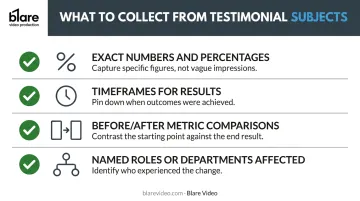
Ask your customer subjects to provide:
- Exact numbers and percentages (not "a lot" or "significantly")
- Timeframes showing how quickly results appeared
- Before/after comparisons tied to a real metric
- Named roles or departments affected by the change
Authenticity Over Polish
Scripted testimonials sound scripted. Viewers catch the cadence of a prepared line almost immediately, and the moment something feels rehearsed, trust evaporates.
The goal isn't perfection — it's credibility. Natural pauses, honest answers, and unscripted moments all signal that the subject is speaking from experience rather than from a teleprompter. Blare Video's approach to testimonial production reflects this: they treat interviews as conversations, not performances, specifically because clients aren't actors and forcing lines undermines the authenticity that makes testimonials effective.
Production Quality as a Trust Signal
Poor audio, bad lighting, and shaky framing don't just look amateur — they reflect on the brand being endorsed. A viewer who sees a low-quality video subconsciously associates that quality with the company the customer is recommending.
Wistia's production research found that a $10,000 video outperformed both a $1,000 and a $100,000 version, with nearly half the cost per install. Quality has a credibility floor, but beyond that threshold, story and execution matter more than budget.
8 Best Testimonial Video Examples — What Makes Each One Work
These examples were chosen to reflect a range of industries, formats, and approaches. Each one illustrates a principle that any brand can apply.
1. HubSpot × Endless Entertainment
The founder of event production company Endless Entertainment walks through how HubSpot helped him shift from cold outreach to inbound leads and measure ROI for the first time. The video makes generous use of B-roll from real events alongside consistent product shots throughout.
Key lesson: The video closes strong. The subject's final line — "people are calling me, begging to sit down with me" — is a quotable, emotionally satisfying payoff. For anyone running a service business, that line does more persuasive work than any feature list. A strong closing quote is what separates a good testimonial from a memorable one.
2. Hootsuite × Stuckey's
Stephanie Stuckey, CEO of the century-old candy brand, narrates a turnaround story anchored by a standout result: 750% growth in online sales over two years. The video runs 2:43 and pairs the interview with product shots and social media dashboard footage.
Key lesson: The metric doesn't just demonstrate results — it validates Hootsuite's core value proposition. When a testimonial ties customer outcomes to a company's bottom-line promise rather than its feature set, it becomes strategically relevant instead of anecdotal. That's what makes the 750% figure land so hard.
3. Shopify × Gymshark
Gymshark founder Ben Francis narrates the brand's growth story, walking through the journey from a garage operation to a billion-dollar brand with cinematic visuals throughout. The origin-story format adds emotional weight that a standard talking-head interview couldn't achieve.
Key lesson: Founder-narrated, cinematic testimonials create something a standard interview can't: viewers don't just trust the brand — they want to be the person in the story. When the customer's journey is genuinely remarkable, the documentary treatment amplifies it. Match production ambition to story ambition, and the result feels earned.
4. Asana × Customer Montage (Work Innovation Summit)
Filmed live at Asana's Work Innovation Summit, the video features multiple customers answering one consistent question about their favorite features. No B-roll, no product shots — just real people in front of a branded backdrop.
Key lesson: Event-captured testimonials trade production polish for unscripted authenticity — and that trade often works in the brand's favor. The single consistent question is what holds it together: without that constraint, a multi-voice montage becomes noise. A minimal format, executed with discipline, can outperform a polished one.
5. Zendesk × Openly
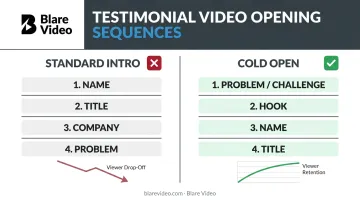
The video opens with Tim Kyse, VP of Customer Experience at Openly, addressing a specific challenge — AI-powered customer experience — before introducing himself or his title. Multiple camera angles, quote graphics, and a visual CTA support the interview throughout.
Key lesson: The cold-open technique works because it leads with relevance before credentials. Starting with the customer's challenge — rather than "Hi, I'm Tim and I work at..." — hooks viewers who recognize the same problem immediately. By the time the name and title appear, the viewer is already invested. It's a sequencing choice that costs nothing in production and pays off in retention.
6. Twilio × CraftJack
The video opens with voiceover narration that provides context and states outcomes upfront — Twilio's official case study cites a 31% increase in new pro-user signups — before transitioning into the customer interview. The full video runs approximately 2:14.
Key lesson: The voiceover/interview hybrid solves a real structural problem: interviews alone lack context, and case studies lack a human face. Leading with narrated outcomes — then grounding them in the customer's own words — gives you the credibility of a case study and the warmth of a testimonial in under two minutes. Most brands default to one or the other; this format works better than either alone.
7. Salesforce + Slack × OpenAI
The video features multiple OpenAI employees across different roles — including Brad Lightcap (COO), Anna Tifft (Account Manager), and Boris Power (Principal Research Engineer) — each speaking to how the product fits their specific responsibilities. Subjects are shown in their actual work environments.
Key lesson: Including perspectives across organizational levels addresses different buyers within a single video. A CTO evaluating the tool and a team lead who'll use it daily both see themselves represented. This broadens persuasive reach without requiring separate videos. When the product serves multiple stakeholders, multi-voice testimonials are more efficient and more convincing than a single senior endorsement.
8. Google Ads × Asutra
Stephanie Morimoto, Owner and CEO of wellness brand Asutra, shares her experience using Google Ads to scale the business — with results including a 470% ROAS from Search campaigns and a 75% increase in Google-generated revenue over three years. The video runs about 1:24 and balances hard data with a personal, accessible narrative.
Key lesson: Data-forward testimonials work best when the metrics are framed around the customer's world — growth, revenue, time saved — rather than product features. The ROAS figure isn't interesting in isolation. Connected to a real founder's business outcome, it becomes a story. That framing is what makes a stat persuasive rather than just impressive.
Patterns Worth Stealing
Every one of these 8 videos follows the same underlying arc — Problem → Discovery → Transformation — even when the format differs completely. The montage uses it. The cinematic origin story uses it. The two-minute hybrid uses it. The arc is the backbone; the format is just the vehicle.
A few other patterns appear consistently:
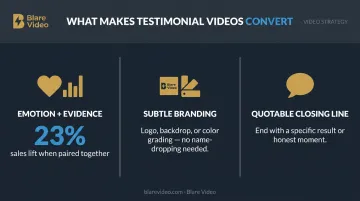
- Emotion paired with evidence performs better than either alone. Nielsen's advertising research found ads scoring above average on emotional resonance generated a 23% sales lift — but the testimonials above don't rely on emotion alone. Nielsen's advertising research found ads scoring above average on emotional resonance generated a 23% sales lift — and every strong example here pairs that emotional moment with at least one concrete, specific result.
- Branding is intentional but not intrusive. A logo in the corner, a branded backdrop, or consistent color grading — each approach lets viewers connect the story to the brand without the subject ever having to name-drop the company.
- The best closing lines are quotable. Strong testimonials end with something the viewer will remember — a specific result, a surprising outcome, or an honest moment that captures the transformation.
How to Create a Testimonial Video That Converts
Pre-Production Decisions That Matter Most
Before any camera rolls, three choices determine the quality of the outcome:
- Choose the right subject. Look for customers with a measurable result who represent your target buyer persona. Someone who's enthusiastic but vague is less useful than someone who can cite a specific before/after.
- Pick the right format. Single story, montage, hybrid voiceover, or documentary each serve different goals. Short social clips need a different approach than a landing page centerpiece.
- Write 3–5 open-ended questions. Questions should guide the conversation without scripting the answers. "What were you struggling with before?" works better than "Can you describe how our product solved your problem?"
Production Essentials
A few non-negotiables apply regardless of budget:
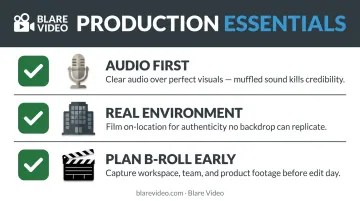
- Audio quality matters more than visual perfection. A slightly soft image is forgivable. Muffled or distorted audio kills credibility.
- Film in the customer's real environment where possible. An office, warehouse, or actual workspace adds authenticity that no backdrop replicates.
- Plan B-roll before the shoot day. Footage of the customer's workspace, team, product in use, or environment gives editors material to support the spoken narrative without relying solely on talking-head shots.
Brands that need outside help can work with a full-service production company like Blare Video, which handles everything from pre-production planning through final delivery across major US markets.
Conclusion
The best testimonial videos don't succeed because of celebrity customers or large production budgets. They succeed because they tell a real story — one with a clear arc, a specific outcome, and a genuine human moment that makes viewers recognize themselves in the narrative.
The 8 examples above cover different industries, formats, and budgets — but the underlying mechanics are the same. Study what works and adapt it to your customer's story, not the other way around.
If you have a customer story worth telling, the next step is figuring out which format fits it best — and then getting it on camera at the quality level that reflects well on your brand. Blare Video offers a free consultation to help you think through both questions and map out a production approach that fits your timeline and goals.
Frequently Asked Questions
What is a testimonial video?
A testimonial video is a filmed account in which a real customer shares their experience with a product or service. Video captures tone, expression, and emotion in ways written reviews can't — which is why they consistently outperform text in driving trust.
Are video testimonials effective?
Yes. Wyzowl's research found that 77% of people who watched a brand testimonial video said it helped convince them to buy, with 2 out of 3 saying they'd be more likely to purchase after seeing someone similar to them featured.
What should a video testimonial include?
Cover four things: the customer's challenge before the product, how they discovered or implemented the solution, a specific measurable result, and a clear recommendation. Specificity in the result matters more than anything else.
How long should a testimonial video be?
Most effective testimonial videos run 60 seconds to 3 minutes. Shorter clips (under 90 seconds) work well for social media and paid ads. Longer formats (2–3 minutes) suit landing pages and sales decks where viewers are already engaged.
How much does a testimonial video cost?
Budget ranges vary widely: a simple single-location shoot with one subject typically starts around $1,500–$3,000, while multi-subject productions with full crew and post-production can run $10,000 or more. Key cost drivers include crew size, shoot days, number of interview subjects, and post-production complexity.
How should testimonials be displayed on a website?
The most effective placements are:
- Embedded on landing pages near your primary CTA
- On a dedicated testimonials or case studies page
- Adjacent to relevant product or service descriptions, where the proof directly supports the buying decision