Introduction
Selling manufactured products to industrial buyers is hard to do on paper alone. A procurement manager vetting five potential suppliers isn't going to read every brochure thoroughly — and a datasheet listing tolerances and certifications tells them nothing about whether your shop floor can actually deliver.
Traditional sales materials describe capabilities. B2B buyers need to see them. They're making high-stakes, long-cycle decisions with input from procurement, engineering, and operations, often without ever setting foot in your facility first.
B2B video production fills that gap. A well-produced factory tour, product demo, or customer testimonial gives procurement committees the evidence they need to shortlist you before a single sales call is scheduled. According to CMI's Manufacturing Content Marketing Outlook, 74% of manufacturing marketers say video produces the best results of any content type they use, and 85% used video in the past year.
This guide covers which video types work, what makes them effective, and how to use them across your sales process.
Key Takeaways
- 74% of manufacturing marketers rate video as their top-performing content type — more than any other format
- Top-performing formats include factory tours, product demos, testimonials, and capability explainers
- Video works at every funnel stage: awareness, consideration, and final procurement review
- Multiple formats — long-form tours, short cut-downs, proposal clips — can come from a single shoot
- Professional production quality matters — 89% of buyers say video quality influences how they perceive a vendor
Why Manufacturing Companies Are Turning to Video for B2B Sales
The Buying Committee Problem
Manufacturing deals rarely involve one decision-maker. Forrester's State of Business Buying 2024 found that an average of 13 people are involved in a B2B buying decision, with 89% of purchases spanning two or more departments. In industrial contexts, that typically means procurement, engineering, and operations all need to sign off — often at different stages.
Each of those stakeholders needs something different:
- Procurement wants pricing, lead times, and certifications
- Engineering wants process specs and tolerances
- Operations wants to know your quality controls won't create downstream problems
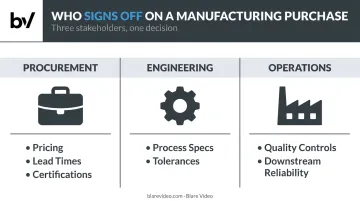
A brochure can't address all of that simultaneously. Video can.
The "Show Don't Tell" Advantage
When an industrial buyer watches a factory tour video, they're not reading a claim about your capabilities — they're watching your CNC machines run, seeing your quality inspection process in action, and getting a real sense of floor scale. That directness moves buyers faster than any spec sheet can.
Buyers who can see your facility, your team, and your actual process are more likely to shortlist you — especially when they're vetting multiple suppliers at once. According to a Thomas survey of industrial buyers, 73% prioritize a supplier's website when evaluating potential partners.
A separate finding: 71% vet fewer than five suppliers before making a decision.
Getting into that shortlist early — through well-produced video content on your site — is a real competitive lever.
The Competitive Gap
Most smaller manufacturers still rely on static content: PDF brochures, product listings, and basic website copy. That means video remains a genuine differentiator for industrial companies willing to invest in it. The CMI data showing 85% adoption is largely skewed toward enterprise manufacturers — smaller shops are far less likely to have professional video assets working for them.
5 Types of B2B Sales Videos That Work for Manufacturers
Factory Tour and Facility Videos
A factory tour video does something no brochure can: it puts a buyer on your shop floor before they've committed to a site visit. For procurement teams vetting multiple suppliers remotely, this kind of visual evidence — real machinery, real processes, real scale — is often what gets a manufacturer onto the shortlist.
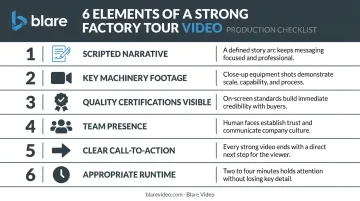
What a strong factory tour video includes:
- A scripted narrative (not raw walkthrough footage)
- Footage of key machinery, processes, and production areas
- Visible quality certifications and inspection steps
- A team presence — faces build trust with buyers
- A clear CTA at the end (schedule a call, request a quote)
- Runtime of 1–2 minutes for broad distribution; longer cuts for specific sales contexts
Blare Video's facility tour for MOS Plastics illustrates this well — the production team built the video specifically to showcase "captivating machinery and intricate processes," with the finished asset used across social media and as a looping display at trade shows.
Product and Process Demo Videos
For custom manufacturers, CNC shops, and precision fabricators, the process itself is the proof of quality. A spec sheet can list tolerances; a demo video can show a part being machined to those tolerances in real time.
Technical buyers get the evidence they need to move forward — without scheduling a factory visit. These videos work particularly well in:
- Product landing pages where buyers are actively comparing suppliers
- Sales proposals to reinforce written capability claims
- Post-outreach follow-ups that keep momentum between calls
Customer Testimonial and Case Study Videos
Procurement teams are risk-averse by nature. A testimonial from a peer company — especially one in a similar industry or application — carries more weight than anything you say about yourself.
An effective industrial testimonial video follows a simple structure:
- The problem the customer had before engaging the manufacturer
- What the manufacturer delivered (capabilities, process, timeline)
- The measurable outcome — reduced lead times, fewer rejects, improved throughput
That structure mirrors how procurement buyers already evaluate suppliers — as a documented case, not a sales pitch.
Explainer and Capability Videos
A CFO or operations director evaluating your proposal may not understand what "±0.001" tolerances mean in practice. A short explainer video showing the real-world implications of precision manufacturing gives them the context to support the decision internally.
Explainer videos are also valuable for communicating proprietary processes, certifications, or materials (like Blare Video's perlite insulation industrial video, which used animation sequences to make a technically complex material accessible to non-specialist viewers).
Company Overview and Brand Storytelling Videos
When two manufacturers offer comparable capabilities and pricing, a company overview video — covering history, quality philosophy, team, and values — is often what tips the final decision.
These videos work best at the top of funnel (website homepage, LinkedIn, ThomasNet profiles) and in final-stage presentations when the committee is making a last comparison.
What Makes an Effective Manufacturing Sales Video
Know Who's Watching
A procurement manager vetting suppliers is watching your video for different reasons than an engineer evaluating process capabilities. These aren't the same viewer, and they shouldn't receive the same video.
Scripting decisions — what to emphasize, what level of technical detail to include, what CTA to close on — should flow from a clear answer to one question: who is watching this, and what do they need to see to take the next step?
Production Quality Is Not Optional
Wyzowl's 2026 video marketing research found that 89% of people say video quality directly affects their trust in a brand. In a B2B manufacturing context, where buyers are making significant financial commitments, poor video quality doesn't just fail to impress — it actively signals risk.
Production standards that protect credibility:
- Stable footage (handheld or poorly mounted cameras undermine professionalism)
- Clean audio — factory ambient noise needs to be managed, not ignored
- Adequate lighting for shop floor environments, which are often dim or unevenly lit
- Professional editing that creates a coherent narrative, not a raw facility walkthrough
Structure the Narrative Around the Buyer's Decision
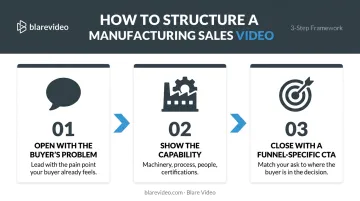
The best manufacturing sales videos follow a consistent logic:
- Open by naming the buyer's problem — the specific challenge this manufacturer solves.
- Show the capability: machinery, process, people, and relevant certifications.
- Close with a specific next step, not a generic "contact us," but a CTA tied to where this video sits in the funnel.
On-Screen Graphics and Captions
Text overlays and on-screen graphics serve a critical function in manufacturing sales videos: they display the numbers that matter — tolerances, material specs, certifications, lead times — so narration doesn't have to carry everything.
Captions extend that same logic to your mobile viewers. LinkedIn has referenced research showing that 92% of mobile video viewers watch without sound — a manufacturing video without captions loses most of that audience before a single claim lands.
Where to Deploy Manufacturing Videos Across the Sales Funnel
Map your video assets to the stage where they'll do the most work:
| Funnel Stage | Video Type | Deployment Channel |
|---|---|---|
| Top of Funnel | Factory tours, brand/overview videos | Website homepage, LinkedIn, ThomasNet |
| Mid Funnel | Product demos, explainers | Sales proposals, email outreach, RFQ follow-ups |
| Bottom of Funnel | Testimonials, case study videos | Final presentations, procurement review decks |
Website and Search Visibility
Since 73% of industrial buyers prioritize a supplier's website when evaluating vendors, video placement on key pages matters. Embedding video on capability and product pages increases dwell time, reduces bounce rate, and strengthens organic search signals — all of which affect whether a buyer finds you in the first place.
Email and Sales Outreach
Video in sales outreach consistently outperforms text-only approaches. The data makes a strong case for adding it at multiple points in the sales process:
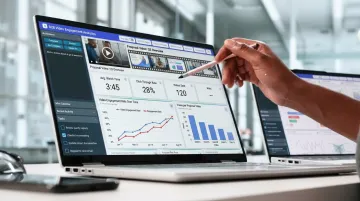
- Sales cadences with at least one video see 50% higher buyer responsiveness, according to Vidyard — a real edge when cold outreach response rates are already low
- Proposals with embedded video see up to 41% higher close rates and 56% higher engagement than text-only versions (Vidyard and Proposify)
Trade Show Follow-Up
A highlight reel or short facility tour sent within 48 hours of a trade show interaction extends the impact of an in-person conversation — reaching buyers while your company is still fresh in their minds.
How to Work With a B2B Video Production Partner
What to Look For
Not every video production company has experience on an active factory floor. For manufacturing clients, the right production partner needs:
- Experience with industrial or B2B clients (not just consumer brands)
- Full-service capability from scripting through post-production
- The ability to manage on-site filming in factory environments — noise, lighting, safety coordination, access logistics
- Post-production capabilities for on-screen graphics, spec overlays, and motion graphics that manufacturing sales videos require
Multi-Location Manufacturing Clients
Manufacturers with facilities in multiple cities face a specific problem: coordinating separate video vendors in each market leads to inconsistent quality, different visual styles, and a inconsistent brand presentation. Blare Video solves this with a national crew network across 23+ US markets, deploying vetted local crews in each location rather than flying a single team coast to coast. That means a manufacturer with plants in Phoenix, Chicago, and Atlanta can film at all three sites under a single production partner, with consistent quality and centralized post-production.
Preparing for Your Manufacturing Video Shoot
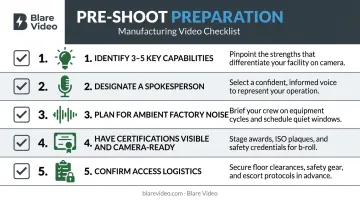
Before the crew arrives:
- Identify 3–5 key capabilities you want buyers to walk away understanding
- Designate a spokesperson or subject matter expert who can speak naturally on camera
- Plan for ambient factory noise — know which areas of the floor are loudest before shoot day
- Have certifications visible — cert plaques, quality control stations, and lab spaces should be clean and camera-ready
- Confirm access logistics — safety briefings, NDAs, and area restrictions should be resolved before shoot day, not on it
Blare Video's pre-production process covers scripting, location scouting, permitting, and crew coordination, so manufacturers don't have to manage those logistics independently.
Frequently Asked Questions
What types of videos are most effective for manufacturing B2B sales?
Factory tour videos, product and process demos, customer testimonials, and company overview videos consistently deliver results for manufacturers. Factory tours and testimonials tend to have the highest impact on procurement decisions because they provide direct visual evidence of capability and third-party validation.
How long should a B2B manufacturing video be?
Factory tours and overview videos work best at 1–2 minutes; product demos can run 2–5 minutes when process complexity warrants it. Match length to funnel position — shorter for top-of-funnel awareness, longer for mid-funnel technical evaluation.
How do manufacturing companies use video in their sales process?
Video appears across multiple touchpoints: embedded on capability pages to attract and qualify inbound leads, attached to sales proposals and RFQ responses, sent as follow-up after trade show conversations, and used in final procurement presentations. Each touchpoint calls for a different video type.
What should a factory tour video include?
A scripted narrative, footage of key machinery and production processes, visible quality certifications, team presence, and a clear call-to-action. Raw walkthrough footage without structure rarely moves buyers — narrative framing is what converts a facility tour from informational to persuasive.
Do manufacturing companies need a professional video production company?
Yes — poor production quality damages credibility with B2B buyers evaluating significant investments. Professional production companies handle scripting, on-site logistics, factory environment challenges, and post-production to deliver a sales-ready asset, not just footage.
How do I measure the ROI of B2B video for my manufacturing company?
Track dwell time and form completions on pages with embedded video, monitor how often sales reps attach video to proposals, and note shifts in sales cycle length. Qualitative signals matter too: if buyers are mentioning your factory tour video on discovery calls, it's working.