Introduction
Medical information is, by nature, complex — and the people who need it most are often the least equipped to navigate it. Patients processing a new diagnosis, clinicians learning updated protocols, public health agencies shifting population behavior: each faces the same obstacle. What's communicated and what's understood are rarely the same thing.
According to the CDC, limited health literacy affects outcomes across a wide range of conditions, diseases, and situations. An AHRQ analysis estimated that roughly 36% of U.S. adults — approximately 80 million people — had limited health literacy based on national assessment data. Text-heavy pamphlets and dense discharge instructions aren't closing that gap.
Video is. A 2024 systematic review of 28 studies covering 5,347 adults found that visual-based interventions — particularly video — improved health literacy and comprehension compared to text-based methods.
This article breaks down five standout healthcare explainer video examples, what makes each one work, and the production principles behind videos that actually change understanding.
Key Takeaways
- Healthcare explainer videos use animation, live action, or motion graphics to make complex medical topics accessible
- The strongest examples lead with empathy or a recognized pain point — not product features
- Key use cases: patient education, disease awareness, medical device demos, staff training, public health campaigns
- Best practices include audience-first scripting, plain language, regulatory accuracy, and built-in accessibility
- Production quality and healthcare expertise both matter; neither compensates for a weakness in the other
What Is a Healthcare Explainer Video (and Why It Matters)
A healthcare explainer video is a short-form video — typically one to three minutes — that uses visual storytelling to communicate a medical concept, product, procedure, or health message in plain, accessible language. The audience could be patients, clinical staff, caregivers, or the general public.
The format works because it combines what written content can't: visuals, narration, and pacing that guide viewers through information at a controlled rate. That combination matters most when the subject is complex, unfamiliar, or emotionally charged.
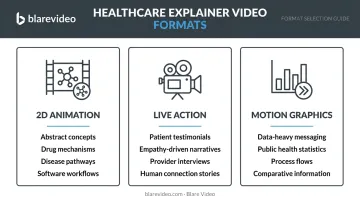
Three Core Formats (and When to Use Each)
| Format | Best For |
|---|---|
| 2D animation | Abstract concepts (drug mechanisms, disease pathways, software workflows) |
| Live action | Patient testimonials, empathy-driven narratives, provider interviews |
| Motion graphics | Data-heavy public health messaging, statistics, process flows |
Format selection is a strategic decision, not an aesthetic one. A molecular biology explainer shot in live action loses clarity; a patient testimonial rendered in animation loses its emotional core. Match the format to the subject matter and the audience's emotional state — not the production budget.
Top Healthcare Explainer Video Examples
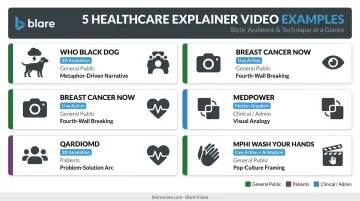
These five examples were selected because each demonstrates a distinct use case, audience approach, and storytelling technique. Taken together, they cover most of what healthcare communicators need to produce.
WHO: "I Had a Black Dog, His Name Was Depression"
Published on the WHO's official YouTube channel in 2012, this animated video has accumulated over 13 million views — extraordinary reach for mental health content targeting a global general audience.
The "black dog" metaphor turns depression into a creature that follows the narrator everywhere. It's a device that turns an invisible, internal experience into something visible and concrete. The hand-drawn illustration style reinforces the personal quality — it feels like someone's diary, not a clinical brochure.
What it avoids is as important as what it includes: no diagnostic criteria, no medication names, no DSM language. The entire video is about what it feels like — because an audience that can't yet name their experience won't seek help from a video that speaks in clinical terms.
| Element | Detail |
|---|---|
| Video Style | Classic 2D illustration / hand-drawn animation |
| Target Audience | General public; people experiencing or supporting someone with depression |
| Key Technique | Metaphor-driven narrative that externalizes an internal experience |
Breast Cancer Now
Breast Cancer Now, the UK's leading breast cancer research and support charity, takes a different approach entirely: live action, direct-to-camera, and emotionally unfiltered.
The video breaks the fourth wall — the subject speaks directly to the viewer — which collapses the distance between screen and audience almost immediately. Rather than opening with statistics about incidence rates or treatment outcomes, it opens with the human reality of a diagnosis. Clinical facts follow naturally from that foundation, not the other way around.
This structure works especially well for condition-awareness videos where the primary job is building enough trust that the viewer stays engaged — empathy first, information second.
| Element | Detail |
|---|---|
| Video Style | Live-action / documentary-style with direct-to-camera address |
| Target Audience | Breast cancer patients and their support networks |
| Key Technique | Fourth-wall breaking to establish immediate emotional connection |
QardioMD
QardioMD's remote patient monitoring explainer targets a very different viewer: physicians and healthcare administrators evaluating whether to adopt a new platform.
The video opens with a problem physicians recognize immediately — time wasted on unnecessary in-person visits for patients who could be monitored remotely. From there, it moves through a clean problem-solution-benefit arc, using motion graphics to demonstrate the platform's dashboard and connected devices. The tone is professional without being dry.
This is the model for health tech explainer videos. It respects the audience's intelligence, doesn't pad the runtime, and earns attention by speaking to a real workflow frustration before ever mentioning a feature.
| Element | Detail |
|---|---|
| Video Style | 2D animation with UI/motion graphics overlay |
| Target Audience | Physicians and healthcare administrators |
| Key Technique | Problem-solution arc anchored in a familiar workflow pain point |
MedPower
MEDITECH's official e-learning partner — offering 300+ role-based training courses — walks into a difficult room: healthcare staff who are skeptical of yet another training platform.
Their explainer uses character animation and a machine analogy to make abstract platform capabilities feel tangible. The analogy bypasses the "training fatigue" response by reframing the platform not as a course library but as a system with moving parts the viewer can see and understand. For internal-facing content where initial motivation is low, that kind of visual reframe carries more weight than any feature list.
| Element | Detail |
|---|---|
| Video Style | Character animation with conceptual analogy |
| Target Audience | Healthcare administrators and training coordinators |
| Key Technique | Visual analogy to make abstract platform features immediately intuitive |
MPHI "Wash Your Hands!" Campaign
Produced by Epipheo for the Michigan Public Health Institute, this animated video took a message that couldn't be more familiar — hand hygiene — and wrapped it in a comic book superhero aesthetic.
The result: a 2024 Silver Winner at the Collision Awards in the Marketing & Communications, General–Education & Training category. The comic book framing gave the campaign a visual identity distinct enough to earn social sharing and public engagement in a crowded health messaging environment.
The lesson is practical: creative investment in visual style is what turned a routine hygiene reminder into award-winning content people actually shared.
| Element | Detail |
|---|---|
| Video Style | 2D animation with comic book / superhero visual language |
| Target Audience | General public across diverse age groups |
| Key Technique | Humor and pop-culture framing to make a routine behavior feel aspirational |
Best Practices for Healthcare Explainer Videos
Know Your Audience Before Scripting Anything
Patient-facing videos need empathetic tone, plain language, and emotionally sensitive framing. Clinical and staff-facing videos can carry more technical depth — but not much more. Mixing up these audiences is the most common production mistake.
Before writing a single line of script, answer these questions:
- Who is watching, and what do they already know?
- What emotional state are they likely in when they press play?
- What is the single most important thing they should take away?
Lead With a Pain Point, Not a Product
One-fifth of viewers bounce within the first 10 seconds of a video, and one-third within 30 seconds, according to Vidyard's video length research. The fastest way to lose that audience is to open with your logo, your tagline, or a feature list.
Open with the problem. The QardioMD and MedPower examples both do this deliberately. The viewer recognizes their own situation before they've been asked to care about a product.
Build Compliance Into the Script Stage
Healthcare videos that contain inaccurate clinical information — even minor errors — can erode institutional trust and create regulatory exposure.
For pharmaceutical and device content, 21 CFR Part 202 treats prescription drug advertising as misleading if it fails to meet regulatory standards. Promotional materials may also require submission via FDA Form 2253 at first use.
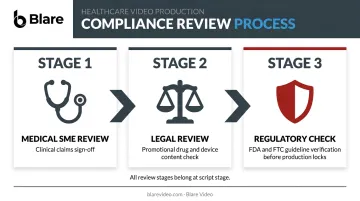
Build a review process that includes:
- Medical subject-matter expert sign-off on all clinical claims
- Legal review for any promotional drug or device content
- Regulatory check against FDA and FTC guidelines before production locks
All of this belongs at the script stage, not after production wraps. Catching inaccuracies in the script costs hours; catching them after animation is complete costs thousands of dollars.
Design for Accessibility by Default
Accessibility isn't an optional add-on — it's a baseline production requirement. At minimum, every healthcare video should address:
- Closed captions and subtitles on all published versions
- Multilingual options for patient-facing content in diverse communities
- Controlled pacing and visual contrast for viewers with cognitive or visual impairments
- Accurate transcripts to improve search indexing and surface content in platform algorithms
Match Length to Genuine Content Needs
General benchmarks from video platform research offer a useful starting framework:
| Video Type | Recommended Length |
|---|---|
| Patient education / awareness | 60–90 seconds |
| Marketing / brand awareness | 60–90 seconds |
| Staff training / device demos | 2–4 minutes |
| Complex procedural instruction | Up to 4–5 minutes |
The instinct to compress everything under 60 seconds for engagement metrics is understandable but often counterproductive. Wistia's 2024 State of Video data found 3–5 minute instructional videos averaged 74% engagement — higher than most general video formats at the same length. Genuine instructional value holds attention.
How to Use Healthcare Explainer Videos Across Your Organization
Patient-Facing Digital Touchpoints
ONC data from 2024 shows 65% of individuals accessed a patient portal that year, with 57% using a mobile app to do so. That's a meaningful distribution channel for short explainer videos addressing common post-visit questions.
A systematic review of patient portal educational content found that 78% of patients perceived portal materials as useful — and 84–89% wanted resources included in portals. Common use cases include:
- Medication instructions and dosage reminders
- Test result explanations in plain language
- Pre-procedure preparation walkthroughs
Internal Training and Staff Onboarding
Large health systems face a specific challenge: delivering consistent training across multiple facilities without relying entirely on in-person sessions. Video solves the consistency problem. The same content, delivered the same way, every time.
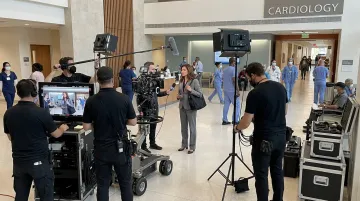
Blare Video's multi-location production experience — including a four-commercial series for Kern Family Health Care shot across multiple facilities over four days — demonstrates what coordinated healthcare production looks like across a dispersed health system. For organizations managing training across dozens of sites, a production partner with that logistics capability matters.
Social Media and Public Health Campaigns
The MPHI hand hygiene campaign is the clearest example: a public health message packaged for shareability, not just comprehension. Short-form video on social platforms reaches audiences that formal health communications often miss.
The most efficient approach builds on a single primary asset. Produce the long-form explainer first, then extract platform-native clips — Instagram Reels, YouTube Shorts — with adapted pacing and captions. One production effort, multiple distribution channels.
Conclusion
The best healthcare explainer videos don't succeed because of production budget. They succeed because someone asked the right questions before the camera turned on: Who is watching? What do they already believe? What do they need to feel or understand to act differently?
The format works across patient education, disease awareness, staff training, and public health campaigns. Videos repurposed across channels also tend to deliver more value the longer they stay in rotation.
For healthcare organizations ready to invest in professional video production, Blare Video has direct experience in the space — including hospital commercials, medical device series, and conference coverage for clients like the American Association of Endodontists. The team handles every phase of production, from scripting through final delivery.
Frequently Asked Questions
What is a healthcare explainer video?
A healthcare explainer video is a short video — typically animated or live-action — designed to communicate a medical topic, procedure, product, or health message in plain language. They're built for a defined audience: patients, clinical staff, or the general public.
How much do healthcare explainer videos cost?
Costs vary based on length, format, and production complexity. Animated explainers from professional studios typically range from $5,000 to $25,000+ for 30–60 second productions, with medical accuracy requirements and review cycles pushing costs toward the higher end.
What is a telemedicine video?
A telemedicine video is a video-based remote consultation between a patient and a healthcare provider, not an explainer video. Explainer videos are often used alongside telehealth platforms to onboard patients before their first virtual visit.
How long should a healthcare explainer video be?
Patient-facing marketing and education videos perform best at 60–90 seconds. Staff training and device demonstration videos can justify 2–4 minutes when the content warrants it.
What animation style works best for medical explainer videos?
2D animation handles most use cases well — it's versatile, cost-effective, and accessible. 3D animation and motion graphics work better for anatomy visualization or device mechanics. Live action is the right choice when authentic patient stories and human empathy are the primary goal.
What are the main use cases for healthcare explainer videos?
The primary use cases include:
- Patient education and health literacy
- Staff onboarding and compliance training
- Medical device and pharmaceutical marketing
- Public health awareness campaigns
- Telehealth platform onboarding