Introduction
Most brand videos share a common problem — not poor cameras or weak editing, but a story that centers the wrong character. The company becomes the hero. The customer watches from the sidelines. And nothing converts.
Donald Miller's StoryBrand framework fixes this. Built on the same narrative structure that makes films memorable, the SB7 model positions your customer as the hero and your brand as the guide who helps them win. That single repositioning reshapes what gets said on camera, how scenes are structured, and why viewers take action afterward.
Research from Stanford cites Professor Jennifer Aaker's finding that stories are remembered up to 22 times more than facts alone. Video already brings emotional range, pacing, and music to the table — StoryBrand gives it the narrative backbone to turn those advantages into action.
This guide covers all 7 StoryBrand elements, what to prepare before filming, the variables that determine whether your video actually works, and the production mistakes that undermine otherwise well-executed work.
Key Takeaways
- The StoryBrand framework has 7 elements (Character, Problem, Guide, Plan, Call to Action, Failure, Success), each mapping to a specific scripting and production decision.
- The most common brand video error: making the company the hero instead of the customer.
- Homepage StoryBrand videos typically run 90 seconds to 3 minutes; plan 30–60 second cuts at the scripting stage, not in post.
- Never film without a completed StoryBrand script — production without narrative clarity produces beautiful footage that doesn't convert.
- Choose a production partner who understands brand narrative, not just cameras.
What Is the StoryBrand Framework and Why Does It Work for Video?
The StoryBrand SB7 framework is a messaging model built on classic story structure: a character has a problem, meets a guide, receives a plan, is called to action, avoids failure, and ends in success. The customer is always the hero. The brand is always the guide.
Video is the ideal medium for this framework because it forces sequencing. You can't show everything at once. Every second of footage either advances the narrative or dilutes it. StoryBrand gives you a clear structure for deciding what goes where.
StoryBrand Video vs. Standard Brand Video
The difference shows up immediately in how each type of video opens — and what it prioritizes:
| Standard Brand Video | StoryBrand Video |
|---|---|
| Centers the company's history, awards, capabilities | Centers the customer's transformation |
| Opens with a logo or founder story | Opens with the customer's world or problem |
| Lists features and services | Shows the before-and-after of working with the brand |
| Ends with a vague tagline | Ends with a specific, low-friction call to action |
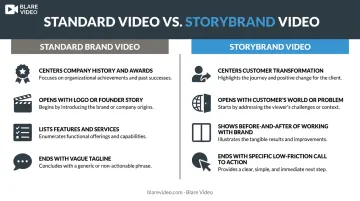
Standard brand videos inform. StoryBrand videos connect — and feeling understood is a faster path to trust than any list of credentials.
How to Apply the 7 StoryBrand Elements to Your Brand Video
Each of the 7 elements maps directly to a scripting and production decision. Skipping any one of them weakens the narrative chain. Here's how each element translates to what you actually shoot and say.
1. A Character — Your Customer Is the Hero
Your video should open on the specific customer your brand serves: their world, their goals, their identity. The goal is for a viewer to watch the first 10 seconds and think, that's me.
A practical test: write a single sentence — "We help [specific customer] who wants [specific goal]" — and confirm that the first 10 seconds of your video visually reflect that person's world. If your logo appears before the customer's face or situation, you've already lost the frame.
2. Has a Problem
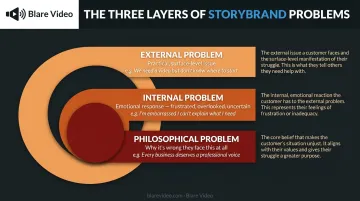
StoryBrand identifies three layers of every customer problem:
- External — the practical, surface-level issue
- Internal — how that problem makes them feel (frustrated, overlooked, uncertain)
- Philosophical — why it's wrong that they have to deal with it at all
Most brand videos only hit the external layer. That's why they feel flat. The internal and philosophical layers are where emotional resonance lives. Your first 15–30 seconds should name or visually represent the problem with enough tension that the customer feels genuinely seen — not just informed.
3. And Meets a Guide
The brand earns its place in the story here — but only when it demonstrates two things:
- Empathy — language that proves you understand the customer's problem (narration tone, interview soundbites)
- Authority — visual proof that you can solve it (client logos, credentials, real footage of work in progress, testimonial clips)
The balance matters. Too much authority reads as arrogant; too much empathy without proof is unconvincing. A 30-second segment pairing real work footage with a customer speaking in their own words hits both.
4. Who Gives Them a Plan
Audiences resist acting when the next step feels unclear. The plan element removes that friction by showing 3–4 simple steps to working with your brand. In video, this is often an animated or on-screen text sequence:
Book a call → We develop your strategy → You start growing
Three steps. Simple language. No jargon. Done.
5. And Calls Them to Action
StoryBrand distinguishes two types of CTAs:
- Direct CTA — Book a call, get a quote, start today
- Transitional CTA — Download the guide, watch a demo, see how it works
Both belong in a brand video at different moments. A video without any CTA is a story with no ending. Viewers feel something, then do nothing.
6. That Helps Them Avoid Failure
Tversky and Kahneman's research estimates that losses feel roughly 2.25 times more significant than equivalent gains. Your video should briefly name what's at stake if the customer doesn't act — stalled growth, wasted budget, lost trust. Keep it specific, not dramatic. The goal is stakes, not fear.
7. And Ends in a Success Vision
Close by painting a vivid picture of the customer's life after working with your brand. Not a feature list — a human outcome. A growing team. A problem solved. A goal reached. This frame is often the most emotionally powerful in the entire video. It's also the most commonly underwritten — most brands rush past it or skip it entirely.
What You Need Before You Start Filming
Production without a completed StoryBrand script is the leading cause of brand videos that look polished but generate nothing. The script isn't the second step — it's the first.
Script and Messaging Clarity
Before a shot list exists, your team needs:
- A character definition (who exactly you serve)
- A problem statement covering all three layers
- Guide positioning (empathy + authority language)
- Plan articulation (3–4 clear steps)
- CTA language — both direct and transitional
- Failure stakes (concise and specific)
- Success vision (emotional, outcome-based)
Interview questions, B-roll choices, and on-screen text all derive from this foundation. Blare Video integrates script development — concept, copy, and storyboarding — into pre-production, so narrative alignment is locked before filming begins.
Visual and Talent Requirements
For a StoryBrand video, the footage itself needs to match the story:
- Real customers or employees speaking on camera in their own words, not reading scripted lines
- B-roll that shows transformation — the before state and the after state, not just product close-ups
- Locations that reinforce the brand's world, not generic offices or studio setups that could belong to anyone
Talent casting — pitch persons, hosts, and voice-over selection — is part of Blare Video's production services, handled before the shoot so clients arrive on set ready to film, not still making decisions.
Production Partner Selection
A StoryBrand brand video needs a partner who thinks in narrative terms, not just technical ones. The script-to-screen alignment has to be built into the process. Blare Video's work with clients like Google, Taco Bell, and TikTok reflects this directly: creative development and narrative clarity shape every production decision before a camera is switched on.
Key Variables That Determine Whether Your StoryBrand Video Actually Works
Two videos can follow the same SB7 framework and produce very different results. These variables are what separate forgettable from memorable.
The Opening 10 Seconds
Google's YouTube research found that ads with prominent logos in the first five seconds increase brand recall — but also increase skip rates. The smarter approach: open on the customer's world, their problem, or an emotionally charged visual. Let the brand enter through the story, not ahead of it.
The first frame should make the viewer feel seen before the brand is ever mentioned.
Emotional Tone and Music Selection
Nielsen's analysis of more than 600 television ads found that commercials with music outperformed those without across creativity, empathy, emotive power, and information power. Music sets emotional tone before a single word is spoken — which makes it one of the most underestimated scripting decisions.
Mismatched music undercuts even a perfectly written script. Score selection should happen during the scripting phase, aligned to the emotional arc you're building, not picked in post-production from a stock library on deadline.
Cinematic Authenticity Over Polished Performance
Real people carry more persuasive weight than polished actors reading scripted lines. The goal is cinematic authenticity — high production value in service of a genuine story. Professional lighting, clean audio, and proper pacing all matter. But those elements should frame a real person saying something true, not substitute for it.
Video Length and Platform Fit
Vidyard's 2025 benchmark — drawn from analysis of over 943,000 business videos — found 65% completion rates for videos under one minute, compared to 20% for videos over 20 minutes. Length guidelines by placement:
| Placement | Recommended Length |
|---|---|
| Homepage hero video | 90 seconds–2 minutes |
| LinkedIn awareness | Under 30 seconds |
| Social media cut | 30–60 seconds |
| General marketing | 30 seconds–2 minutes |
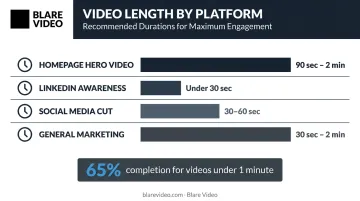
Produce derivative social cuts at the scripting stage. A long video that wasn't designed to be trimmed will lose narrative integrity when you try to compress it later.
Call to Action Placement and Specificity
"Learn more" converts far less than "Book a free 20-minute strategy call." Specific, low-friction CTAs outperform vague ones because they remove the uncertainty of what happens next.
Plan CTA placement across every touchpoint during scripting:
- The video itself (spoken and on-screen)
- The video description and surrounding landing page copy
- Email body text that hosts or links the video
- Both direct ("Book now") and transitional ("See how it works") versions
Common Mistakes When Applying StoryBrand to Brand Video
Most brand video failures trace back to the same handful of errors. Here's what to watch for:
- The brand becomes the hero. A video about your company's founding, awards, and capabilities is one your customer won't finish. They don't care about your journey — they care about their own.
- The problem disappears. Many brands avoid naming their customer's pain or the consequences of inaction. Those are the narrative tensions that create engagement. A video with no problem has no story.
- The plan gets cut. Removing the plan element leaves viewers interested but uncertain. Uncertainty kills conversion even when genuine desire exists — three simple steps remove that friction.
- Filming starts before the script is done. Without a locked script, interview questions are unfocused, B-roll is generic, and editors are left assembling a puzzle with missing pieces. Blare Video treats script completion as a production prerequisite, because footage without narrative direction has no clear destination.
Frequently Asked Questions
What are the 7 steps of StoryBrand?
A Character has a Problem, meets a Guide, who gives them a Plan, calls them to Action, that helps them Avoid Failure, and ends in Success. Each step maps to a specific scripting and production decision in a brand video — they're not abstract concepts but practical creative instructions.
How long should a StoryBrand brand video be?
A homepage hero video typically runs 90 seconds to 3 minutes. Social and LinkedIn cuts should be 30–60 seconds, produced at the scripting stage alongside the hero version. Length should be determined by platform context and narrative completeness, not by arbitrary convention.
What is the difference between a StoryBrand video and a regular brand video?
A regular brand video centers the company as the subject — its history, capabilities, and achievements. A StoryBrand video centers the customer as the hero, with the brand appearing only as the guide that facilitates the customer's transformation.
Do I need a script before filming a StoryBrand brand video?
Yes — always. A completed script determines interview questions, B-roll requirements, CTA language, and on-screen text. Filming without it produces footage that editors cannot shape into a coherent narrative, regardless of production quality.
Can the StoryBrand framework work for B2B brand videos?
Google and CEB research found B2B buyers are nearly 50% more likely to purchase when they perceive personal value — making StoryBrand particularly well-suited for B2B. It moves brands beyond feature-listing into the emotional territory where actual purchase decisions get made.
How much does a professional brand video typically cost?
Clutch's video production pricing research lists many projects in the $10,000–$49,999 range, with interview-based shoots scaling up based on crew size, complexity, and post-production scope. Before locking a budget, prioritize narrative clarity — a well-scripted StoryBrand video at a modest budget will outperform a high-budget video built on a weak story.