Introduction
A product launch is one of the highest-stakes moments in any marketing calendar. You've spent months (sometimes years) developing something worth sharing, and you have a narrow window to make buyers care. Video has become the dominant format brands use to capture that attention fast.
The numbers back this up. According to Wyzowl's 2024 video marketing research, 85% of people have been convinced to buy a product or service after watching a video, and 96% have watched an explainer video to learn more about a product. Video doesn't just inform — it moves people toward a purchase.
The challenge is that results vary widely. A well-executed product launch video builds buzz, educates buyers, and accelerates purchase decisions. A hastily produced one can damage brand perception at exactly the wrong moment.
This guide walks through the four steps a successful product launch video requires — covering the variables that affect performance and the mistakes that sink launches before they start.
Key Takeaways
- Lead with the audience's problem, not a list of product features.
- The four steps: define your goal and audience → develop your script → produce the video → distribute and optimize.
- Pre-production is the highest-leverage stage: script-level misalignments cost hours to fix, but the same issues caught in post cost days and real budget.
- Hook quality, video length, and platform fit most directly affect view-through rates and conversion.
- A video without a distribution plan will underperform regardless of production quality.
What You Need Before You Start
Most product launch videos that underperform fail because key decisions were deferred until production had already begun. Preparation determines everything downstream.
Stakeholders and Internal Alignment
Before a single line of script is written, align the right people internally:
- Product team — provides accurate feature and positioning details
- Marketing team — owns the messaging framework and campaign context
- Sales team — knows which objections buyers raise and what closes deals
- Executive leadership — confirms strategic priorities and sign-off authority
Creative misalignments caught during scripting cost a few hours of revision. The same misalignments caught during post-production cost days and real budget. Get everyone in the room early.
Creative Assets and Brand Standards
A production team needs these materials before work begins:
- Logo files (vector formats)
- Brand color and typography guidelines
- Approved product imagery and any existing b-roll
- Brand voice documentation
- Any messaging frameworks already developed for the launch
Budget and Timeline Considerations
The scope of production (crew size, location, animation vs. live-action, number of deliverables) should be locked before creative work starts. Working with a full-service video production company from this stage keeps scope, timeline, and concept aligned from day one rather than adjusted mid-project.
Blare Video's pre-production process begins with a free consultation to align budget and expectations before any planning work starts: timeline creation, location scouting, scripting, and storyboarding all happen as part of a single coordinated phase.
The 4 Steps to a Successful Product Launch Video
Step 1: Define Your Goal and Know Your Audience
Start with a measurable definition of success. The goal shapes every downstream creative decision:
- Awareness → track view-through rate and reach
- Pre-orders or direct sales → track click-through rate and conversion
- Demo sign-ups → track form completions from video traffic
- Social buzz → track engagement rate and shares
Once the goal is clear, identify the specific audience segment the video is addressing — what problem they have and how the product solves it. Videos targeting "everyone" connect with no one.
Then choose the right format based on goal and audience:
| Format | Best For |
|---|---|
| Product demo | High-intent buyers who need to see the product work |
| Explainer video | New categories or complex products requiring education |
| Testimonial | Late-funnel buyers who need social proof |
| Brand story | Building emotional connection and category awareness |
| Hybrid (demo + story) | Consumer launches where emotion and utility both matter |
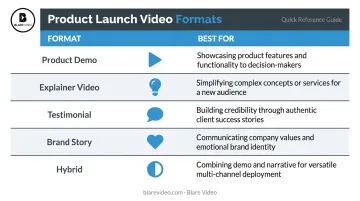
For their Ricoh product launch, Blare Video produced three unique versions of a product explainer — each version designed to perform in a different context within the campaign. That kind of format thinking starts here, at the goal-setting stage.
Step 2: Develop Your Script and Creative Concept
The structure that performs consistently well in product launch videos follows a clear arc:
- Open with the audience's pain point or desire — not with the brand name
- Introduce the product as the solution — specifically, not generically
- Demonstrate 1–2 key benefits — not every feature the product has
- Close with a clear, specific call to action
The Hook (First 5–10 Seconds)
The hook determines whether viewers continue watching or leave. Strong hooks look like:
- A relatable problem stated plainly ("You've spent hours on this and it still isn't working")
- A visual that creates immediate curiosity — something unexpected or visually arresting
- A direct question the viewer genuinely wants answered
Platforms algorithmically favor content with high average view duration. A weak hook doesn't just lose viewers — it limits how widely the video gets distributed.
Storyboarding Before Production
Once the script is approved, translate it into a storyboard before any cameras are pointed at anything. A storyboard lets teams visualize every scene, catch misalignments between the written narrative and the visual story, and avoid expensive re-shoots.
Blare Video builds storyboarding into pre-production as a standard step. It's completed before the shoot and used as a reference map through production and into post.
The most common script mistake is loading the video with features. Keep messaging focused on the one or two most compelling benefits for the specific audience you defined in Step 1.
Step 3: Produce the Video
Non-Negotiable Technical Foundations
Three production elements are table-stakes for a brand launch video:
- Lighting — flat, poorly lit footage signals low budget immediately
- Audio — TechSmith's 2024 viewer research found poor audio tied as the top reason viewers stop watching a poor-quality video; 89% of consumers say video quality impacts trust in a brand
- Stable footage — shaky, handheld footage without intent undermines professionalism
These aren't aesthetic preferences. They're brand credibility variables.
Show the Product in Context
Audiences need to visualize themselves using the product. That means filming in real-world or realistic environments — not just on a white background.
GoPro built its entire launch content strategy around this principle: creator footage demonstrating what the camera captures is the proof of what the camera does.
Apple's "Scary Fast" keynote was shot on iPhone 15 Pro Max to demonstrate low-light performance in a real production context. The product proves itself by being used.
Branding Consistency Throughout
On-screen text, color grading, music tone, and visual style should all align with existing brand identity. The launch video should feel like a natural extension of the brand — not a standalone asset produced in isolation from everything else.
Step 4: Distribute and Optimize for Your Platform
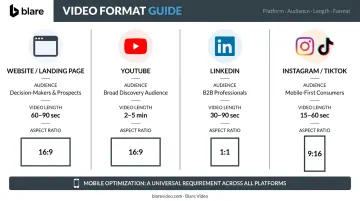
Select platforms based on where your target audience already watches video. Different platforms require different formats, lengths, and aspect ratios:
| Platform | Best For | Key Format Notes |
|---|---|---|
| Website / landing page | Hero placement, high-intent visitors | Longer cuts acceptable (60–90 sec) |
| YouTube | Search discovery, retargeting | 16:9, subtitles strongly recommended |
| B2B audiences, decision-makers | Square or 16:9, professional tone | |
| Instagram / TikTok | Consumer brands, awareness | Vertical 9:16, short-form, captions essential |
Mobile optimization is not optional. The majority of video content is consumed on mobile devices, and vertical or square formats perform measurably better than horizontal cuts on social feeds.
Blare Video produces multiple format deliverables from single shoots — horizontal for YouTube and website, square and vertical for social — with framing decisions made during pre-production so the footage works across all formats without cropping problems.
CTA Placement
The video itself should include a verbal or on-screen CTA. The page or post where the video lives should reinforce it with a visible next step — a form, button, or link. Don't leave conversion to chance.
Post-Launch Performance Tracking
Match your metrics to your original goal:
- Awareness campaigns → view-through rate, reach
- Conversion campaigns → click-through rate, form completions
- Social distribution → engagement rate, shares, comments
Use early data to optimize placement, targeting, and format — treat it as an input to the next cut, not a final verdict.
Key Variables That Affect Performance
Even well-produced videos underperform when these variables aren't controlled. They compound: a weak hook plus a missing CTA can eliminate most of the potential return on a well-budgeted shoot.
Video Length
According to HubSpot's Video Marketing Report, 71% of marketers say the optimal video length is 30 seconds to 2 minutes. Vidyard's benchmark data shows 65% of viewers stay engaged to the end of videos under one minute, while completion rates fall sharply for longer content.
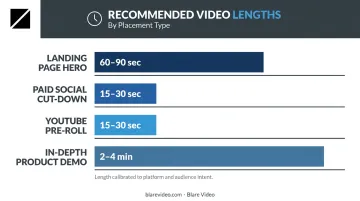
Length should be calibrated to platform and placement:
- Landing page hero: 60–90 seconds acceptable
- Paid social cut-down: 15–30 seconds
- YouTube pre-roll: 15–30 seconds before the skip option
- In-depth product demo: 2–4 minutes for high-intent audiences only
Hook Quality (First 5–10 Seconds)
A strong hook surfaces the audience's pain or desire — it does not lead with the brand name or product specifications. Wistia's data shows viewership drops most sharply in the first 10–15 seconds when the opening fails to match what the audience came expecting.
That drop matters beyond the viewer count. YouTube, Instagram, and TikTok all tie distribution reach to watch-completion signals — so a weak hook suppresses organic reach regardless of what you spend on the shoot.
Tone and Visual Style
Tone signals whether the brand understands its audience. An overly corporate tone for a consumer lifestyle product erodes trust before the message lands. Visual style carries the same weight. Consider the gap between a polished cinematic cut running alongside lo-fi social content, or a warm lifestyle look paired with a stiff script — either mismatch makes the launch feel uncoordinated rather than purposeful. The strongest launch videos align tone, pacing, and visual language with the campaign they're anchoring.
Common Mistakes When Producing a Product Launch Video
Even well-funded launches stumble when production decisions undercut the video's impact. These four mistakes show up repeatedly — and each one is avoidable.
- Skipping or rushing pre-production — creative misalignments caught in scripting cost hours; caught in post-production, they cost days and real budget.
- Leading with features instead of benefits — listing what the product does creates informative but emotionally flat videos that don't drive action.
- Producing without a distribution plan — launch videos built without a defined distribution strategy get formatted for one channel, published once, and never repurposed, so most of their potential reach disappears.
- Burying or omitting the CTA — many launch videos end without directing the viewer's next step. A strong CTA is specific ("start your free trial," "request a demo," "shop now") — not generic ("learn more").
Frequently Asked Questions
How much does commercial video production cost?
Production costs vary based on crew size, shoot duration, format (live-action vs. animation), number of deliverables, location logistics, and post-production complexity. Every project is different, so the most accurate path is to get a scoped quote from a production company based on your specific requirements.
What are the different types of commercial video production?
The main formats relevant to product launches are product demos, explainer videos, testimonial videos, brand story videos, and short-form social content. The right format depends on the audience's stage in the buying journey and the specific goal of the launch video.
How do I announce a product launch?
A product launch announcement typically combines a hero launch video with coordinated distribution across email, the brand website, social channels, and press outreach. Timing and platform sequencing matter as much as the video itself. A staggered release across channels often outperforms a single simultaneous post.
Where is the best place to post videos?
The primary options are your website or landing page, YouTube, LinkedIn for B2B audiences, and Instagram or TikTok for consumer brands. Platform choice should be driven by where your target audience is most active, not by where distribution is easiest.
How long should a product launch video be?
For most launch hero videos, 30 seconds to 2 minutes is the well-supported optimal range. Platform context matters: a hero video on a website can run longer than a paid social cut-down, which should typically be 15–30 seconds.
What should be included in a product launch video?
Core elements include:
- A hook that surfaces the audience's problem
- A focused demonstration of the product's key benefit
- Social proof or credibility signals where available
- A specific call to action telling viewers exactly what to do next