Introduction
Bad audio ends careers — or at least kills event recordings before anyone watches them. According to recent viewer research, 57% of viewers cite audio clarity as the most important factor for engagement, and poor sound quality is tied as the number one reason people abandon video content. For corporate events and conferences where recordings carry long-term value, that's a costly problem.
Costs vary widely depending on event scale, services needed, and whether you require live sound support, post-production cleanup, or both. A small workshop might need just a few hundred dollars for basic amplification. A multi-day conference with livestream distribution can exceed $10,000.
This guide breaks down what you can expect to pay in 2026 — covering equipment, labor, post-production, and the hidden fees that catch many planners off guard.
Key Takeaways
- Event audio enhancement typically costs $300–$1,500 for basic setups, $1,500–$5,000 for mid-range productions, and $5,000–$15,000+ for large-scale events
- Major cost drivers include event size, crew expertise, equipment quality, and post-production complexity
- Post-production audio enhancement is billed separately from live event audio, typically adding $75–$200/hour
- Bundling audio with video production reduces vendor overhead and typically lowers your total project cost
How Much Does Event Audio Enhancement Cost?
Event audio enhancement does not have a fixed price—costs depend on the scope, type of service, and production level needed.
Many event planners make costly mistakes when estimating audio budgets. Underbudgeting leads to poor sound quality on final deliverables, choosing the wrong setup results in inadequate room coverage, and hidden post-production fees catch teams off guard weeks after the event wraps.
Typical Cost Ranges by Tier
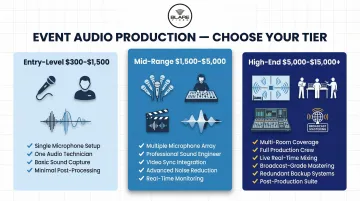
Entry-Level / Basic Setup: $300–$1,500
- Single wireless microphone or basic lavalier setup
- One audio technician for setup and monitoring
- Minimal post-processing or cleanup
Mid-Range / Standard Setup: $1,500–$5,000
- Multiple microphone configurations (lapel, handheld, podium)
- Professional sound engineer for mixing and monitoring
- Mixes and syncs audio with event video deliverables
- Basic noise reduction in post-production
High-End / Full-Service Setup: $5,000–$15,000+
- Multi-room or multi-stage coverage
- Full audio crew including A1 and A2 engineers
- Live mixing and real-time monitoring
- Advanced post-production mastering and sound design
- Deliverables optimized for broadcast or livestream distribution
What's Typically Included (and Excluded)
Entry and mid-range packages include:
- On-site audio technicians and equipment rental for the event duration
- Basic mixing and standard noise reduction
Entry and mid-range packages exclude:
- Travel fees for crew
- Studio-grade mastering or multi-day coverage
- Complex post-production audio editing
High-end packages include:
- Live event support bundled with advanced post-production
- Real-time monitoring and full crew logistics
High-end packages may still exclude:
- Travel logistics and rush turnaround fees
- Specialized services like multilingual audio tracks or accessibility features
Entry-Level Event Audio
Best for: Small workshops, internal team meetings, and single-speaker panels with 50 attendees or fewer — events that prioritize room amplification over broadcast-quality recordings.
At this tier, one audio technician handles setup, monitoring, and breakdown. Expect a basic PA system or lavalier mic setup with minimal recorded audio cleanup.
Mid-Range Event Audio
Best for: Corporate conferences, product launches, multi-speaker seminars, and trade show booths where recorded content will be repurposed for marketing, training, or social media.
This tier adds meaningful production depth:
- Professional sound engineer with event-day experience
- Multiple microphone types (lapel, handheld, podium)
- Audio mixed and synced with event video footage
- Basic noise reduction and dialogue leveling in post-production
High-End Event Audio
Best for: Large corporate galas, multi-day conferences, concert-style events, and any event with a global livestream audience where audio quality directly affects brand perception.
At this level, you're hiring a full crew with specialized roles — an A1 front-of-house engineer and an A2 monitor/RF engineer — each managing distinct parts of the signal chain. Coverage scales to multi-room or multi-stage environments with independent mixing at each location.
Post-production goes beyond cleanup:
- Mastering, sound design, and music integration
- Deliverables formatted for broadcast television or global livestream platforms
- Real-time monitoring during the live event to catch and correct issues as they happen
Key Factors That Affect Event Audio Enhancement Costs
Your final audio bill depends on three moving parts: what equipment the event needs, who operates it, and how much cleanup the recordings require afterward.
Event Type and Scale
A 30-person internal seminar has fundamentally different audio requirements than a 500-person product launch or a multi-stage corporate expo. Larger events require more equipment channels, additional crew members to manage sound across multiple rooms, and more complex post-production to handle hours of multi-track recordings.
Each additional microphone channel, each simultaneous breakout session, and each speaker transition adds complexity and cost.
Equipment Quality and Configuration
Professional-grade microphones, digital audio workstations, mixing boards, and PA systems cost far more to rent than basic consumer setups. High-quality equipment ensures both on-site sound clarity and clean raw recordings that require less corrective work in post-production.
Typical rental ranges for key equipment:
- Wireless microphone systems: $65–$288/day per channel (basic to premium RF-coordinated)
- Digital mixing consoles: $110–$564/day (basic analog to professional multi-channel)
- In-house venue providers often charge at the higher end of both ranges
Size and Experience of the Audio Crew
A solo audio tech handling a small event costs significantly less than a full team including a live sound engineer, monitor engineer, and post-production audio editor.
Experienced engineers—especially those with event-specific expertise—command higher day rates. According to current industry data, freelance A1 (front-of-house) engineers in major markets like Los Angeles, Las Vegas, and New York typically charge $850–$1,000 per day for a standard 10-hour call. A2 engineers (handling wireless coordination and stage monitoring) generally range from $350–$750 per day.
Solo AV technicians for smaller events typically charge $250–$650 per day depending on the market and complexity.
Post-Production Audio Complexity
Post-production audio enhancement—noise removal, dialogue cleanup, music scoring, and mastering for video—is billed separately from live event audio. The longer and more complex the footage, the more editing hours required.
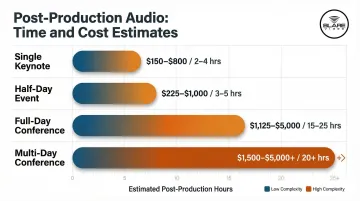
Industry hourly rates for audio editing and mixing currently average $75–$200/hour depending on complexity and the editor's experience. A half-day event with clean source audio might need 3–5 hours of post work, while a multi-day conference with poor room acoustics can run 20+ hours of intensive cleanup and mastering.
Geographic Location
Audio production rates vary by market. Bureau of Labor Statistics data shows sound engineering technicians in San Francisco average $53.65/hour, compared to $43.51/hour in New York and $39.51/hour in Los Angeles. Mid-size markets like Austin and Nashville average around $29/hour.
Hosting in a mid-tier market can cut labor costs 30–40%, though that advantage narrows if crew must travel in from a larger city.
Full Event Audio Cost Breakdown
The total cost of event audio enhancement goes beyond the day-of engineer—here's what planners need to account for across the full production lifecycle.
Equipment Rental or Provision (One-Time, Per Event)
Covers PA systems, microphones, mixing boards, cables, and monitoring equipment. Costs vary based on quality tier and event size.
Typical rental day rates for professional event audio gear:
- Wireless microphones: $65–$288 per channel
- Digital mixing consoles: $110–$564 per day
- Powered speakers: $102–$195 per day per speaker
Venue in-house AV providers often charge premiums compared to third-party rental houses. A digital mixer that costs $275/day from an independent rental company may cost up to $564/day through a hotel's exclusive in-house provider.
On-Site Audio Crew (One-Time, Per Event)
Includes day rates for audio engineers and technicians. Multi-day events multiply this cost. Factor in overtime or call-time fees for early setup and late breakdown.
Union labor agreements mandate double-time after 12 hours and triple-time after 15 hours of work, which can drive up costs fast on long event days.
Post-Production Audio Enhancement (Recurring Per Deliverable)
Audio cleanup, dialogue leveling, noise reduction, music bed integration, and mastering for final video or streaming deliverables. Typically billed hourly at $75–$200/hour depending on complexity and the editor's expertise.
Post-production time scales quickly with event complexity:
- Single keynote (1 hour): 2–4 hours for basic cleanup
- Full-day conference with panels: 15–25 hours of editing and mastering
Travel, Logistics, and Miscellaneous (Variable)
- Travel fees for crew attending off-site or out-of-market events
- Permit costs for outdoor or public venue events
- Rush turnaround premiums for same-day or next-day delivery
- "Shadow labor" or liaison fees charged by venues with exclusive in-house AV providers when you bring in outside crew (typically $145–$150/hour with a 5-hour minimum)
Budget Audio vs. Professional Event Audio: What's the Real Difference?
The gap between budget and professional audio isn't just about sound quality on the day—it affects how useful your event content is long after the room clears out.
Sound Quality and On-Site Performance
Budget setups often produce flat, unbalanced sound on-site and muddy recordings that are difficult to salvage in post-production. Professional audio engineering delivers live clarity for attendees and clean raw files that cut cleanly into polished final deliverables.
A HubSpot video marketing study found that poor audio quality causes listeners to judge speakers as less intelligent, less credible, and less trustworthy—regardless of the content itself.
Content Value and Repurposing Potential
That credibility problem compounds over time. Event recordings with poor audio have a short shelf life as marketing assets, training materials, or highlight reels—diminishing the return on your full production investment.
Clean audio, on the other hand, keeps content working longer. Videos recorded with professional-grade sound can be repurposed across social media, internal training portals, and sales presentations for months after the event.
Equipment Redundancy and Live Reliability
Beyond quality, there's a practical risk factor. Low-cost setups rarely include redundancy—no backup microphones, no spare cables, no fallback mixer. At a live event, there's no second take.
Professional audio crews arrive with contingency gear built into the setup, so a single equipment failure doesn't become a stage-stopping problem.
How to Estimate the Right Budget for Event Audio Enhancement
Building the right audio budget means starting with your event's goals and working backward—not starting with a price and hoping it covers everything.
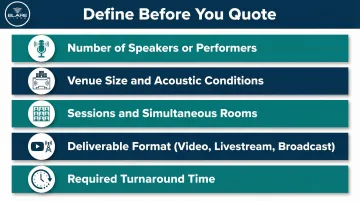
Factors to Define Before Requesting a Quote
- Number of speakers or performers
- Event venue size and acoustic conditions (hard floors, low ceilings, outdoor settings)
- Number of sessions or simultaneous rooms requiring coverage
- Whether audio needs to be deliverable-ready for video, livestream, or broadcast
- Turnaround time required for final edited audio
Consider Bundling Audio and Video Services
Working with a full-service event production partner that handles both audio and video can simplify coordination and often deliver better value than hiring separate vendors for each discipline. Companies like Blare Video—which handles corporate event production across Los Angeles, San Diego, Las Vegas, Phoenix, and beyond—are built for exactly this kind of integrated work.
Integrated production teams eliminate redundant equipment rental, cut back-and-forth coordination between vendors, and simplify post-production by handling audio-video sync from day one.
Get Itemized Quotes
Ask vendors to break out equipment, labor, and post-production separately. That breakdown shows you exactly where to cut costs without sacrificing the elements that matter most.
What Most Event Planners Get Wrong About Audio Costs
Two planning mistakes drive most audio budget surprises:
- Budgeting only for the day-of technician: Post-production audio enhancement—cleaning up dialogue, leveling audio for video, adding music—is a separate line item that can add hundreds to thousands of dollars depending on the final deliverable's complexity.
- Treating audio as an afterthought: Audio typically gets whatever's left in the budget rather than what it actually requires. Poor acoustic planning at the venue selection stage—hard floors, low ceilings, no sound dampening—can raise post-production costs sharply or make recordings unusable.
Event audio enhancement costs vary based on event scale, crew expertise, equipment quality, and post-production scope. Understanding the full cost picture—not just the day-of fee—leads to better planning and stronger deliverables.
Frequently Asked Questions
What is the hourly rate for audio editing?
Professional audio editing rates typically range from $75–$200/hour, according to industry data. Complexity of the source material and the editor's experience level are the main variables. Basic dialogue cleanup sits at the lower end, while advanced mastering and sound design command premium rates.
How much does post-production cost for an event?
Post-production audio costs depend on the length of the event footage, the number of audio tracks, and the quality of the raw recordings. A half-day event with basic cleanup might cost $300–$800, while a multi-day conference requiring full audio mastering and music integration can exceed $3,000–$5,000.
How much does an audio engineer charge for a live event?
Live event audio engineers typically charge $250–$1,000 per day depending on role and market. Freelance A1 engineers in major markets charge $850–$1,000 for a standard 10-hour call, while solo AV techs for smaller events range from $250–$650 per day. Experience level, event size, and geographic location all influence rates.
What's the difference between live event audio and post-production audio enhancement?
Live event audio covers on-site sound management: PA setup, microphone placement, live mixing, and real-time monitoring. Post-production audio enhancement involves editing, cleaning, and mastering the recorded audio after the event to produce polished deliverables for video, training materials, or marketing content.
Can bundling audio and video services save money on event production?
Working with a production company that handles both audio and video under one contract can reduce coordination costs, eliminate redundant equipment rental, and consolidate post-production workflows — typically delivering a more cohesive result at lower overall cost than managing separate vendors.