
Introduction
A single-day commercial shoot can burn through 500+ pounds of CO2 from generator fuel alone — before accounting for crew travel, catering waste, or equipment transport. Equipment trucks, crew travel across multiple locations, diesel generators running between takes, and mountains of single-use catering supplies add up faster than most clients or production companies realize.
The pressure to address this is growing. Corporate buyers in tech, finance, healthcare, and retail increasingly face scrutiny over their entire supply chain, including the vendors they hire for video content. Yet most production teams, and the clients who commission them, don't know where to begin.
This guide lays out a practical, phase-by-phase approach to greener video production. Whether you run a production company or manage marketing budgets for a corporation, you'll find specific, actionable steps that can be applied today without sacrificing quality or budget.
Key Takeaways
- Sustainable production cuts emissions, lowers costs, and increasingly influences enterprise procurement decisions
- The three biggest emission sources are fuel/transportation, energy/utilities, and on-set waste — all manageable with better planning
- Sustainability applies at every phase — pre-production planning, on-set operations, and post-production workflows
- Start with a few targeted changes per project — even small shifts compound into real savings
Why Sustainable Video Production Matters for Your Brand
The business case for sustainable production isn't just environmental — it's commercial.
Bain's 2024 survey of 500 B2B buyers and sellers found that sustainability ranks as a top-three purchasing criterion. 36% of B2B buyers would leave suppliers that miss sustainability expectations, and nearly 50% would pay a 5%+ premium for suppliers that meet them. That's mainstream procurement behavior, not a niche concern.
The Cost Angle Is Just as Compelling
Sustainable production practices tend to reduce costs over time, not increase them. Switching to LED lighting lowers electricity consumption. Tighter schedules cut idle generator run time. Digital pre-production workflows eliminate printing and courier costs. Green The Bid, which publishes widely-used sustainability guidance for commercial production, recommends allocating just 1–3% of a low-budget production's budget toward sustainability measures — a modest investment that often returns more than it costs through efficiency gains.
What This Means for Corporate Clients
Enterprise companies in tech, finance, healthcare, and retail are under pressure from regulators, investors, and consumers to demonstrate sustainability across their operations — including their vendor relationships. When those companies commission video production, their production partner becomes part of that story.
When vetting production partners, clients should ask about:
- Energy practices — LED lighting adoption, generator usage policies, and renewable energy sourcing
- Local crew hiring — whether the company uses crews based near the shoot location to reduce travel emissions
- Waste and catering policies — single-use plastic reduction, sustainable catering options, and recycling protocols
Local production networks matter here. Blare Video operates across 23+ US markets with crews based in each city, which avoids the cross-country travel that typically drives up a production's carbon footprint. For corporate clients evaluating vendors against ESG criteria, that structure is worth asking about.
Understanding the Carbon Footprint of Video Production
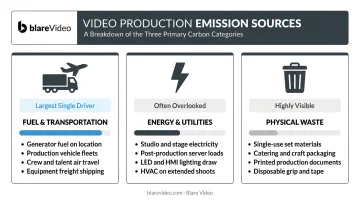
Most people underestimate how much a production actually emits. The breakdown typically falls into three categories:
| Emission Source | Examples | Notes |
|---|---|---|
| Fuel & Transportation | Crew travel, equipment trucks, location logistics | Usually the largest single driver |
| Energy & Utilities | Studio lighting, on-set generators, post-production computing | Often overlooked in digital workflows |
| Physical Waste | Sets, props, catering, single-use materials | Smaller carbon share, but highly visible |
What the Data Actually Shows
Scale is the key variable when interpreting production emissions data. The Sustainable Production Alliance's 2021 carbon report found that tentpole feature films averaged 3,370 metric tons CO2e, with fuel at 48% and air travel at 24% of total emissions. Small feature films averaged 391 metric tons CO2e.
Corporate and commercial productions sit at a very different scale. An AdGreen case study of a two-day Bosch stills and motion campaign measured 1.74 tCO2e total — with travel and transport at 1.01 tCO2e and materials at 0.50 tCO2e. That's a useful benchmark for typical commercial shoots: smaller than Hollywood, but not negligible.
The Digital Footprint People Miss
Post-production carries its own carbon cost that often goes unacknowledged. The IEA estimated streaming video at 36 gCO2 per hour in 2019. Cloud storage, file transfers, and render farm computing all add to the total. Digital delivery still carries a carbon cost. It's simply less visible than a diesel generator on set.
Tools like the AdGreen Carbon Calculator and Green The Bid's production manuals give teams a measurable starting point — tracking emissions per project so you can set realistic targets and show progress over time.
Sustainable Pre-Production Practices
Pre-production is where sustainability decisions carry the most weight. The choices made during planning — locations, crew size, equipment, scheduling, vendor selection — set the environmental ceiling for the entire project. Catching a problem at the planning stage costs a conversation; catching it on shoot day costs money and emissions both.
Go Paperless by Default
Scripts, storyboards, call sheets, briefs, and contracts should all be distributed digitally. The PGA Green Unified Best Practices Guide explicitly recommends distributing production documents electronically. Tablets on set replace printed scripts; e-signatures eliminate in-person contract meetings.
For production companies already running digital post-production workflows (Blare Video, for example, uses Wipster for client review and approvals), applying the same approach to pre-production requires almost no additional effort.
Conduct Virtual Scouts and Remote Meetings
BAFTA albert's 2021 review found that remote production techniques contributed directly to emissions reductions in 2020. Virtual location scouting via video call, drone footage review, and remote production meetings can eliminate a meaningful share of pre-production transport emissions without compromising creative outcomes.
Make Location Strategy Deliberate
- Choose locations geographically close to the majority of crew to reduce travel distance
- Favor studios already fitted with efficient lighting and grid power, which avoids the need for diesel generators
- Treat remote or exotic locations as a deliberate creative choice, not a default — the carbon and cost premium should be justified
Vet Vendors on Sustainability Criteria
Build sustainability into vendor selection from the start:
- Caterers who source ingredients locally and offer plant-based menu options
- Equipment rental companies with newer, energy-efficient gear
- Set suppliers using reclaimed or recycled materials
This works best when it's part of the initial RFP process, not a last-minute add-on.
On-Set Sustainability: What to Do During Production
Lighting: Switch to LEDs
According to the US Department of Energy, LEDs use at least 75% less energy than incandescent lighting. ENERGY STAR adds that incandescent bulbs release 90% of their energy as heat, making them doubly inefficient on set where that heat also drives up air conditioning loads.
Blare Video's production packages already include Litepanels Astra and Dracast LED panels, reflecting how widely this transition has taken hold at the commercial level.
Power: Cut the Diesel Generator
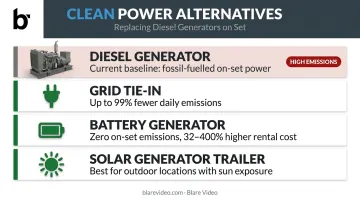
Diesel generators are loud, polluting, and expensive to run. Alternatives worth evaluating:
- Grid tie-ins — Metro Vancouver's clean-power report for film production found grid connections can reduce daily emissions by 99% compared to diesel where grid access exists
- Battery generators — quieter, emission-free on set, though rental costs can run 32–400% higher than standard generators depending on the unit
- Solar generator trailers — a practical fit for outdoor location shoots with adequate sun exposure
Keep production schedules tight. Every hour of idle generator runtime adds unnecessary cost and emissions with nothing to show for it.
Catering and Single-Use Waste
- Replace single-use plastic bottles with refillable water stations
- Use compostable or reusable serviceware
- Work with local caterers who offer plant-based options — the AdGreen Bosch case study found that switching to vegan catering reduced emissions by 365.5 kg CO2e on a two-day shoot alone
- Plan headcounts carefully to minimize food waste; donate surplus to local shelters
Set Materials and Battery Recycling
- Source set pieces from reclaimed, recycled, or rented stock
- After wrap, donate reusable items to schools, community theaters, or film programs. Organizations like EcoSet in Los Angeles and Film Biz Recycling in Savannah, Georgia accept production materials
- Recycle batteries through The Battery Network (formerly Call2Recycle), which operates 20,000+ drop-off locations across the US and has recycled 175M+ pounds of batteries
Post-Production, Digital Workflows, and Carbon Offsetting
Cloud Workflows Reduce, But Don't Eliminate, the Footprint
Cloud-based editing, file sharing, and client review reduce the need for hard drive shipping and in-person approval meetings. AWS reports that storage-heavy workloads moved to the cloud can reduce carbon emissions by up to 88% compared to on-premise alternatives.
That said, digital workflows still carry a carbon cost. Green The Bid cites data suggesting that storing 10 TB on servers for five years produces approximately 4 tons CO2e, while an 18 TB LTO tape generates just 10 kg CO2e — a useful reminder that storage decisions matter. Cloud-first is generally lower-impact, but be deliberate about what you archive and set retention policies per project.
Remote collaboration tools — whether Wipster for client video review, or Microsoft Teams and Slack for team coordination — reduce travel to approval meetings and eliminate the need to gather everyone on-site.
Carbon Offsetting: The Final Layer
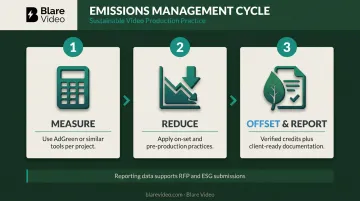
Offsetting addresses the residual footprint after you've reduced what's possible. It's the last step, not a replacement for the practices above. The process is straightforward:
- Measure your per-project emissions using tools like the AdGreen calculator
- Reduce what you can through the practices covered in this guide
- Offset the remainder through verified programs
Verified offset and renewable energy credit programs include:
- Verra Verified Carbon Standard — 1 VCU = 1 metric ton CO2 reduced or removed
- Gold Standard — high-integrity credits funding climate protection projects
- Green-e Energy — certifies renewable electricity and REC transactions for businesses
Track and Report
Keeping records of energy use, travel miles, and waste per project serves two purposes: it builds the data needed to set annual reduction targets, and it gives you something concrete to share with clients during RFP processes and ESG reporting cycles. For enterprise clients running formal vendor assessments, documented emissions data can be the detail that moves your bid forward.
Frequently Asked Questions
What is sustainable video production?
Sustainable video production minimizes environmental impact through energy-efficient equipment, reduced travel, digital workflows, waste reduction, and conscious vendor selection — without compromising creative quality. It applies across the full production cycle, from pre-production planning through post-production delivery.
What are the biggest sources of carbon emissions in video production?
The three primary contributors are fuel and transportation (crew and equipment travel), energy use (lighting, generators, and computing), and physical waste (sets, catering, and props). For a two-day commercial shoot, travel and transport alone can account for over half of total emissions.
How much does sustainable video production cost compared to traditional production?
Upfront investments in LED lighting or better equipment may be slightly higher. Over time, though, energy savings, reduced waste disposal costs, and tighter scheduling typically produce net savings. Green The Bid recommends budgeting just 1–3% of a low-budget production's costs for sustainability measures.
Can small or mid-sized companies implement sustainable video production practices?
Yes. Going paperless, using LED lighting, hiring local crew, and eliminating single-use plastics carry minimal cost and can be adopted on your next project. The Green The Bid low-budget manual is specifically designed for small crews and modest budgets.
What is carbon offsetting in video production and how does it work?
You calculate remaining emissions after reducing what you can, then invest in verified programs — such as reforestation through Verra or renewable energy credits through Green-e — to compensate for what's left. Offsetting works best alongside real reductions, not as a substitute for them.
How do I choose a video production company with sustainable practices?
Ask prospective partners about their energy sources, local crew hiring policies, waste management practices, and whether they track or offset emissions. Production companies with multi-city networks — Blare Video, for example, operates across 23+ US markets — reduce the need for long-distance crew travel, one of the most direct ways to cut a project's carbon footprint.