Introduction
Most patients don't walk into a doctor's office cold. They've already spent time online — reading, watching, researching — before they ever call to book. According to a Google/Compete study, 77% of patients used search before booking a hospital appointment, and 30% who watched a hospital video went on to schedule one. That's not a small number.
Healthcare video marketing carries stakes that most industries don't face. A single piece of content may need to satisfy HIPAA compliance, hold up to medical scrutiny, land emotionally with anxious patients, and still resonate with skeptical clinicians.
The margin for error is thin. A poorly produced or tone-deaf video erodes trust fast — and in healthcare, trust is the whole game.
This post breaks down 10 real-world healthcare marketing video examples worth studying — each one chosen to represent a different format, a different goal, and a different audience. Use them as a strategic reference: study what each one does, why it works, and what you can borrow for your own campaigns.
Key Takeaways
- Healthcare videos work best when empathy leads and promotion follows (or doesn't appear at all).
- The strongest formats include educational how-tos, patient testimonials, physician interviews, behind-the-scenes procedure content, and social campaigns.
- Authentic voices consistently outperform polished-but-generic brand messaging.
- Every example below pairs a clear goal with a defined audience and a production approach built to earn trust.
- Match your next video to one of these formats based on what your audience needs to feel, not just what you want to say.
Why Healthcare Marketing Videos Are Uniquely Challenging
Healthcare marketers operate under constraints that simply don't exist in other industries.
The core challenges:
- HIPAA compliance — any video featuring identifiable patient information requires written authorization. HHS explicitly lists full-face photographic images as identifiers requiring de-identification or consent.
- Medical accuracy — a claim that's imprecise in a consumer brand video is an annoyance; in healthcare, it can damage credibility or create legal exposure.
- Fear exploitation — leaning too hard on patient anxiety to drive action is ethically questionable and, increasingly, a brand risk.
- Multi-audience complexity — the same video may be watched by patients, family caregivers, referring physicians, and payers, each with completely different information needs.
A 2024 PMC study found that YouTube health video usage among U.S. adults grew from 39.7% in 2020 to 58.9% in 2022 — the audience is there and growing. But KFF's 2025 Health Information and Trust poll found that while 55% of adults use social media for health information, fewer than 10% trust most of what they see there. The credibility gap is real.
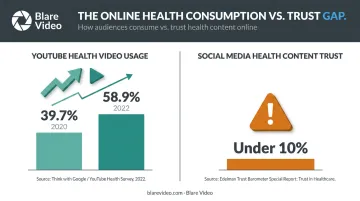
That trust deficit creates a clear opening. Healthcare brands that produce accurate, compliant, empathetic video content can build credibility that paid social ads and generic blog posts rarely achieve.
10 Great Healthcare Marketing Video Examples
Each example below was selected to represent a different format or strategic goal — giving you a practical range of approaches to draw from.
1. Cleveland Clinic — "Empathy: The Human Connection to Patient Care"
This is an emotional brand film that follows patients and staff through a hospital, using on-screen text to surface the invisible inner experiences of everyone present — the man waiting for test results, the nurse who hasn't slept, the visitor who just got bad news.
There's no dialogue. No service pitch. No call to action. Just radical, quiet empathy.
Cleveland Clinic's own Consult QD described it as one of the organization's "most iconic pieces of storytelling." Healthcare IT Today covered it as a must-watch example of empathy-driven content. It spread far beyond Cleveland Clinic's existing audience because the emotional truth resonated with anyone who has ever been in a hospital — as a patient, a caregiver, or a staff member.
Key takeaway: A brand video doesn't need to explain your services. It needs to demonstrate your values.
2. Kaiser Permanente — "Thrive" Campaign
Launched in 2004 and still running a decade later, Kaiser Permanente's "Thrive" campaign is one of the most sustained brand platform examples in healthcare marketing. Rather than leading with illness and treatment, it centers on people living healthy, active lives — with Kaiser positioned as the enabler of that vitality, not just the responder to disease.
The 2014 campaign refresh emphasized ease, digital access, and integrated care. By 2015, the campaign had earned 8 Gold Healthcare Public Relations and Marketing Association awards and more than 11 ADDY awards over its first decade.
Shift the frame from "sick care" to "whole-person care," and you align your brand with where patients want to be — not where they're afraid they might end up. That's a durable position.
Key takeaway: Aligning brand messaging with patient aspirations (thriving) rather than patient fears (illness) creates stronger long-term brand affinity.
3. Mayo Clinic — How-To Video Series (YouTube)
Mayo Clinic's YouTube channel launched in 2006 and has surpassed 1.25 million subscribers. The engine behind that growth? High-volume, search-optimized how-to content that answers the exact questions patients are already typing into Google.
Two standout examples from the channel:
- "Mayo Clinic Minute: Tips to best remove ticks" — published in 2016, with over 9.3 million views
- "How to Use an Insulin Pen" — published in 2014, with over 1.8 million views
The format is consistent and intentionally simple: a physician explains, the camera shows. No production excess. The videos work because they solve an immediate problem for a viewer who came looking for a specific answer — and because Mayo Clinic's name on the video signals credibility.
Key takeaway: Search-optimized educational content is one of the most scalable video formats in healthcare. It serves patients while continuously building organic authority.
4. Mayo Clinic — Doctor Interview / Q&A Format
Alongside its how-to library, Mayo Clinic publishes structured physician interview and Q&A videos covering topics from sports medicine to cardiology. The format is conversational — a doctor answering questions at a comfortable pace, without a script that sounds like one.
Most patients experience physicians as rushed, formal, or hard to reach. A well-executed interview video reframes that dynamic: the doctor becomes approachable, the knowledge becomes accessible, and the institution earns a trust transfer it couldn't manufacture any other way.
Key takeaway: Featuring real physicians in a lightly scripted, conversational format builds credibility faster than any biography page or credentials listing.
5. Mayo Clinic — Behind-the-Scenes Procedure Video
Mayo Clinic has produced behind-the-scenes content showing actual medical procedures — including evaluations that many patients would otherwise find opaque and anxiety-inducing. Seeing a procedure before you experience it changes how you experience it.
Peer-reviewed evidence supports this: a 2023 comparative study of 60 patients found that video-based preoperative education significantly reduced anesthesia anxiety (P = 0.02) and total anxiety (P < 0.001) compared to verbal information alone. A 2024 pediatric meta-analysis found similar results with audiovisual interventions, though heterogeneity across studies is worth noting — results vary by procedure and population.
The claim isn't that procedure videos cure fear. The more defensible truth is that they give patients a clearer picture, which reduces the unknown, which reduces anxiety.
Key takeaway: Behind-the-scenes procedure content is one of the most impactful formats for reducing patient anxiety and improving the care experience — but claims about outcomes should be measured and evidence-based.

6. Mayo Clinic — #StrongArmSelfie Social Campaign
In March 2015, Mayo Clinic launched #StrongArmSelfie as a colorectal cancer awareness effort tied to Colorectal Cancer Awareness Month. The concept: encourage people to post a flexed-arm selfie as a show of strength in support of colon cancer prevention and screening. Mayo served as social media partner for the Fight Colorectal Cancer community.
The mechanic is straightforward and replicable:
- Pick a cause with genuine community relevance
- Create a participation format that's easy and shareable
- Use a branded hashtag to aggregate engagement
- Connect the action to a meaningful health behavior (screening, in this case)
User-generated content works in healthcare for the same reason it works everywhere — peer voices carry more social proof than brand voices.
Key takeaway: Social campaigns that invite participation outperform one-way broadcast messaging. Healthcare brands can build community, not just audiences.
7. Anchor Health Pediatric Hospice — Compassionate Promotional Video
Pediatric hospice care sits at one of the most emotionally difficult intersections in all of healthcare. A promotional video for this kind of organization carries an obvious risk: tip too far toward either clinical detachment or emotional manipulation, and you lose the viewer's trust entirely.
What works in the best versions of this format is restraint. Family voices carry the narrative — not polished actors or scripted claims. The focus stays on comfort, dignity, and presence. The production steps back and lets the testimony do the work.
Done well, this approach avoids both traps:
- Avoids clinical detachment by centering real family experiences
- Avoids emotional manipulation by letting unscripted voices speak
- Builds trust through understatement, not sentimentality
Key takeaway: In emotionally charged healthcare segments, authenticity and restraint earn more trust than production polish. Let the people closest to the experience speak.
8. Monarch Healthcare — Staff Recruitment Video
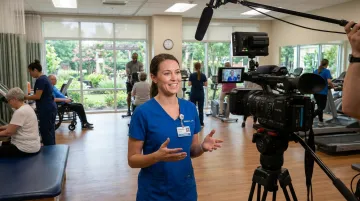
Recruitment is a legitimate and underutilized video category for healthcare organizations competing for clinical talent. Monarch Healthcare's staff recruitment video uses authentic employee testimonials and real facility footage to show — not just claim — what working there looks like.
A recruitment video that leads with mission statements and stock footage of happy patients does little to differentiate. Compare that to a video showing a physical therapist explaining why they stayed, or a nursing supervisor describing how the organization handled a difficult staffing stretch — that creates a credible picture candidates can actually evaluate.
Healthcare organizations that produce strong recruitment content attract candidates who are values-aligned, which tends to reduce turnover over time.
Key takeaway: Recruitment video is one of the clearest ROI opportunities in healthcare video marketing — especially in markets where clinical talent is scarce.
9. Health Tech Brand — Relatable Problem/Solution Video
B2B healthcare marketing — think billing software, EHR platforms, practice management tools — is often painfully formal. The relatable problem/solution format breaks that pattern by meeting the viewer where they actually are: frustrated, overwhelmed, and allergic to another product demo.
The formula is simple:
- Open with an exaggerated but recognizable scenario (the overwhelmed office manager drowning in prior authorizations)
- Earn attention and goodwill through humor or relatability
- Deliver the product message once the viewer is on your side
No technical jargon. No feature lists in the first 30 seconds. The emotional hook comes before the solution reveal — which is the opposite of how most B2B healthcare content is structured.
Key takeaway: Healthcare B2B video doesn't have to be dry. Relatable storytelling that acknowledges real frustrations is highly effective for health tech and services brands.
10. Community / Mission-Driven Outreach Video
A hospital or health system documents its free clinic, neighborhood health fair, or community wellness initiative — and publishes that story as a video. No hard sell. No patient volume claims. Just evidence that the organization shows up beyond its walls.
The format repositions the brand from "a place you go when something is wrong" to "a partner in community health." That distinction matters in competitive markets where multiple systems offer comparable clinical capabilities. When the clinical difference is marginal, brand perception and community trust become the deciding factors for patients choosing a primary care provider or specialist.
Community storytelling is also cost-efficient: production requirements are modest, and the goodwill generated tends to outlast any individual campaign.
Key takeaway: Community-focused video is consistently underinvested in relative to its reputation and trust-building impact.
What the Best Healthcare Marketing Videos Have in Common
Strip away the formats and the budgets, and the 10 examples above share three consistent traits.
1. Human truth comes before information. Emotion precedes information in every high-performing example. Cleveland Clinic opens with the weight of what hospital staff carry. Kaiser leads with the aspiration to thrive, not just recover. Mayo addresses the specific fear of an unfamiliar procedure before explaining it. That sequencing isn't accidental — emotion is what earns the audience's attention long enough for information to land.
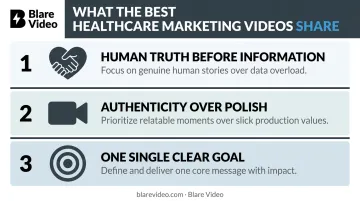
2. Authenticity outperforms polish when the stakes are personal. Several of the strongest videos — recruitment content, family testimonials, UGC campaigns — perform well precisely because they feel unproduced. The key is matching production approach to emotional tone. A pediatric hospice video shot like a pharmaceutical commercial would feel cold and wrong. Shoot a how-to video like a soap opera and it becomes unwatchable. The production level should serve the content, not override it.
3. Every strong video has one goal. Not "raise awareness and drive appointments and build brand trust." One goal. The brief stage determines everything. A focused intent produces a video that moves people toward a specific action. Without it, you get polished content that no one can describe the purpose of a week later.
Conclusion
Great healthcare marketing videos don't succeed by selling harder. They succeed by connecting more honestly: right format, right voice, and a production approach that respects what the viewer is actually going through.
The 10 examples here span emotional brand films, YouTube how-to libraries, social campaigns, recruitment content, and B2B storytelling. Different formats, different audiences, different budgets. The same foundation: a single clear goal, a human story, and production choices that earn trust before asking for anything.
Before you plan your next video, ask what your audience needs to feel — not just what you want them to know. That question determines the format. The format determines everything else.
For healthcare organizations ready to move from reference to production, Blare Video offers full-service video production across major U.S. markets, including Los Angeles, San Diego, Phoenix, Las Vegas, Chicago, New York, and beyond.
The team handles everything from initial concept and scripting through filming and final delivery, with experience in medical commercials, hospital campaigns, testimonial content, and event coverage. If you're working through what format fits your goal, get in touch to start a consultation.
Frequently Asked Questions
What is an example of video marketing?
Cleveland Clinic's "Empathy: The Human Connection to Patient Care" is a textbook example — it promotes the brand without mentioning a single service, instead building trust through emotional storytelling. Video marketing simply means using video to communicate a brand message, build credibility, or move an audience toward a decision.
What makes a healthcare marketing video effective?
Effective healthcare videos combine a single clear goal, an authentic voice suited to the audience, and a format that earns trust before asking for action. Clinical credibility matters too — viewers in healthcare contexts are quick to detect anything that feels manufactured or evasive.
What types of videos work best for healthcare marketing?
The most consistently effective formats are educational how-tos, patient testimonials, physician interviews, behind-the-scenes procedure content, brand films, and community outreach stories. The right format depends on what your audience needs to feel at that stage of their journey.
How long should a healthcare marketing video be?
Short-form content (under 90 seconds) works well for social media and awareness campaigns. Educational and brand videos can run 2–5 minutes if the content holds attention throughout. Platform context matters — a YouTube how-to can sustain longer run times than an Instagram reel.
Do healthcare marketing videos need to comply with HIPAA?
Yes. Any video featuring identifiable patient information — including full-face images — requires proper written authorization under HIPAA. This applies to patient testimonials, procedure footage, and any content that includes recognizable individuals. Consult legal counsel before production begins on any patient-facing content.
How much does it cost to produce a healthcare marketing video?
Production costs vary by format and complexity. Interview-style shoots start around $1,850–$2,600, while cinematic brand campaigns run higher; post-production for a two-minute corporate video typically adds $2,800–$4,500 depending on editing, color, and motion graphics. A production partner can scope a project to fit your specific budget and goals.