The catch? Most brands treat it as an afterthought. They record something quick, post it without a strategy, and wonder why results are flat. The format is simple. The execution is not.
This guide walks through a step-by-step creation process — from platform selection and pre-production planning to shooting, editing, and the key variables that separate high-performing clips from content that gets scrolled past in two seconds.
Key Takeaways
- Short-form video (15–90 seconds) delivers the highest organic reach and ROI of any social content format
- Four things drive results: a strong hook in the first 3 seconds, vertical 9:16 format, tight content structure, and consistent posting cadence
- Batch multiple videos in one shoot session to maintain posting frequency without daily production effort
- Posting watermarked content across platforms triggers algorithmic downranking; always upload natively
- Brands that build a repeatable posting system see compounding reach and discoverability over time
How to Create Engaging Short-Form Video Content for Social Media
Step 1: Define Your Goal and Choose Your Platform
Before picking up a camera, get clear on the objective. Awareness content looks completely different from product education or lead generation, even at 30 seconds. The goal shapes the hook, the structure, and the call-to-action.
Platform choice should follow your audience and objective:
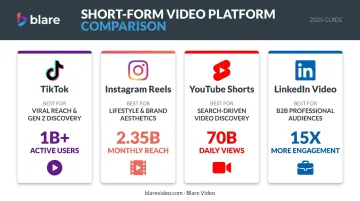
| Platform | Best For | Key Stat |
|---|---|---|
| TikTok | Viral discovery, younger demographics | 62% of U.S. adults 18–29 use TikTok |
| Instagram Reels | Organic reach, visual brands | Reels get 36% more reach than carousels |
| YouTube Shorts | Search-driven discovery, funnel traffic | 50–60 second Shorts get the most views |
| LinkedIn Video | B2B thought leadership | Video viewing up 36% YoY on LinkedIn |
One practical note: trying to post everywhere at once dilutes focus. Start with one or two platforms, establish a consistent rhythm, then expand.
Step 2: Plan Your Content Before You Record
Scripting even a 30-second video shapes everything that follows. Every short-form video needs three structural elements before you press record:
- The hook: stops the scroll in the first 3 seconds
- The core message: the single idea you're delivering
- The payoff or CTA: what you want the viewer to do or feel at the end
Hook structures that actually work:
- Start mid-action, already doing the thing
- Lead with the result, then explain how you got there
- Pose a question the audience is already asking themselves
- Open with a surprising or counterintuitive statement
Planning also applies to your posting cadence. Rather than scrambling to produce content daily, consider a "video day" — batch-shooting multiple short clips in a single session. Blare Video structures their social media packages around exactly this model: one half-day shoot (4 hours) produces three 15-second videos, with a full-day session yielding six. That's a month of content from two focused shoot days.
Long-form footage is another underused source. Event coverage, corporate interviews, and brand films can all be clipped into multiple short-form assets — you don't always need to start from scratch.
Step 3: Shoot With Platform and Viewer in Mind
Always shoot vertically. The 9:16 aspect ratio fills the mobile screen completely and is natively favored by every major short-form platform. LinkedIn data shows vertical 9:16 videos generate a 24% lift in click-through rates compared to other orientations. Horizontal footage repurposed for vertical feeds performs worse on both counts.
On the technical side: Instagram Reels requires a minimum of 720p at 30 FPS, and YouTube Shorts supports square or vertical formats up to 3 minutes.
Two variables viewers notice before anything else:
- Lighting — position subjects facing a window or use a ring/LED light. Flat, dim footage signals low production value immediately
- Audio — poor sound loses viewers faster than almost anything else. Use a lavalier mic or ensure voiceovers are clean before recording begins
For brands that need consistent visual branding, multi-location production, or cinematic quality across a campaign, working with a professional production team removes the technical trial-and-error. The result is output that meets both platform specs and brand standards without the guesswork.
Step 4: Edit for Retention and Reach
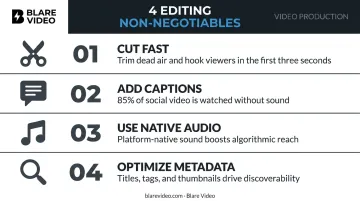
Editing is where short-form video succeeds or fails. A few non-negotiables:
- Cut fast. Eliminate pauses, dead air, and anything that doesn't serve the viewer. Front-load the most compelling visual or piece of information as early as possible
- Add captions. LinkedIn cites research showing 92% of mobile video viewers watch with sound off — captions aren't optional, they're expected. Both TikTok and Instagram confirm captions are used as recommendation signals in their algorithms
- Use native audio. Selecting trending sounds from the platform's own library ensures your video is tagged to that trend, which improves discoverability versus adding audio externally in post-production
- Optimize metadata. Write keyword-rich captions (not just hashtags), use descriptive titles on YouTube Shorts, and treat your caption as a search entry point — especially for younger audiences who use TikTok and Instagram as search engines
When Should You Create Short-Form Video Content?
Short-form isn't the right format for every message. Complex product explanations, in-depth case studies, and detailed interviews are better served in longer formats. Short-form works best when delivering one clear value in under 90 seconds.
Use cases where it consistently delivers:
- Product demonstrations and quick how-to tutorials
- Customer testimonials (30–60 seconds, one clear outcome)
- Behind-the-scenes brand moments
- Event highlights
- FAQ responses
- Trend-based content that shows brand personality
That said, short-form video requires a consistent posting cadence to gain algorithmic traction. Buffer's analysis of 11.4 million TikTok posts found that posting 2–5 times per week produced up to 17% more views per post compared to posting once a week.
If your team can only manage one or two posts per month, plan for slower momentum — and consider batching production sessions to build a content buffer before you launch.
What You Need Before You Start
What you have ready before the camera rolls shapes both production efficiency and final content quality.
Equipment and Technical Requirements
A minimum viable setup for most social content:
- Modern smartphone with a stabilizer or tripod
- Ring light or strong window light source
- Clip-on lavalier microphone
For brands that need higher production value, visual consistency across a series, or multi-location shoots, professional camera equipment and crew become necessary. Blare Video's social media packages, for example, include UHD cameras on gimbals, LED lighting, and wireless lavalier mics built specifically for platform-ready vertical content.
Content and Brand Readiness
Before filming, get alignment on:
- How your brand sounds: tone, word choice, and pacing that stays consistent across clips
- How it looks: colors, fonts, on-screen text treatment, and lower-third format
- What stays the same: the core message or theme anchoring the entire series
A simple one-page brand reference shared with everyone involved in production prevents the inconsistency that erodes channel recognition over time. Running through this during a pre-production call — before any shoot day — saves significant back-and-forth in post.
Platform Account Optimization
Profile completeness affects discoverability. Before posting:
- Include searchable keywords in your bio
- Ensure profile links are active and up to date
- Switch to creator or business mode on each platform to unlock analytics and scheduling tools
Key Variables That Affect Short-Form Video Engagement
Two videos on identical topics can perform completely differently. These are the variables that actually drive results.
The Hook (First 3 Seconds)
Platforms measure early drop-off as a core distribution signal. TikTok's Creator Academy identifies a strong opening shot as a critical factor for increasing watch time and views. YouTube Shorts analytics tracks "viewed vs. swiped away" — giving creators direct data on whether their hook is working.
Test different hook styles per video: question-based, result-first, mid-action. The style that works for one audience or topic may not work for another.
Video Length Relative to Platform
Completion rate is a critical algorithmic signal. A 30-second video watched to the end outperforms a 90-second video watched halfway, even if total watch time is similar.
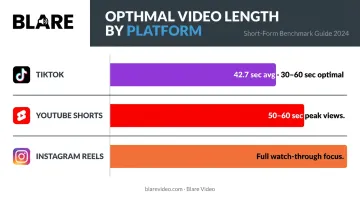
Current benchmarks by platform:
- TikTok: Average video length is 42.7 seconds; 51% of people say the optimal effective video is 30–60 seconds
- YouTube Shorts: Most Shorts are 30–40 seconds, but 50–60 second Shorts receive the most views
- Instagram Reels: No single authoritative benchmark, but Instagram's ranking system explicitly predicts whether a user watches all the way through
Audio and Music Selection
Both TikTok and Instagram treat audio as an active recommendation signal. TikTok's Creator Academy encourages trending sounds; Instagram Reels ranking factors in the audio track and predicts whether a user will visit the audio page to create their own reel.
Using audio from the platform's native library, rather than adding it in post-production, ensures the video is indexed to that trend and surfaced alongside related content.
Caption and Text Overlay Strategy
Captions serve two functions:
- Accessibility — keeps sound-off viewers engaged without missing context
- Keyword signals — TikTok's recommendation system uses caption text as part of video information to determine distribution
Instagram is clear that Reels consisting mostly of text get reduced visibility in recommendation surfaces. Keyword-rich captions alongside real video content, however, actively support discoverability.
Common Mistakes When Creating Short-Form Video Content
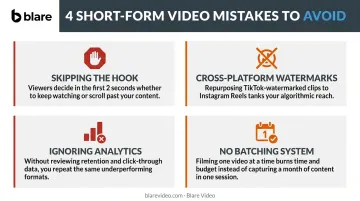
Most short-form video struggles come down to the same four errors. Recognizing them early saves wasted production time and lost reach.
Skipping the hook. Jumping straight into context is the most common error across brand accounts. Scripts get written the way someone would explain something in a meeting — not how a distracted mobile viewer needs to be grabbed in two seconds.
Posting identical content across platforms. Repurposing is smart. Copying a TikTok with its watermark onto Instagram Reels is not. Instagram explicitly reduces visibility of Reels containing watermarks or previously uploaded content — re-upload natively and adjust captions for each platform's audience.
Ignoring analytics after posting. Completion rate, average watch time, and engagement rate reveal which hooks and formats actually work. Skipping this step means repeating what doesn't perform and missing patterns that are hiding in plain sight.
Treating every video as a one-off production. Without a batching and repurposing system, most brands either burn out or post inconsistently. Buffer's TikTok research found a clear correlation between posting frequency and per-post views — cadence compounds over time.
Conclusion
Engaging short-form video is a repeatable system: clear goals, pre-production planning, platform-optimized shooting, and data-informed iteration. Brands that treat it as an ongoing channel — not a one-time effort — build audience reach and search visibility that grows over time.
The most common failures trace back to two things: skipping the planning phase — no hook strategy, no content structure — and posting reactively instead of producing systematically.
For brands that need professionally produced short-form video at scale — social ads, corporate storytelling, event highlights, or product campaigns — Blare Video manages concept, scripting, filming, and final edit across major US markets.
Frequently Asked Questions
Frequently Asked Questions
How long should a short-form video be for social media?
The sweet spot is 30–60 seconds for strong completion rates across most platforms — YouTube Shorts peak around 50–60 seconds, while TikTok averages 42 seconds. Tutorials and storytelling formats can stretch to 90 seconds, provided the pacing stays tight.
What equipment do I need to create short-form video content?
A modern smartphone, basic lighting (ring light or window), and a clip-on lavalier microphone form a solid minimum setup for most social content. Professional camera equipment and crew become relevant when visual branding consistency, multi-location production, or higher production quality are priorities for the brand.
Can I repurpose the same short-form video across multiple platforms?
Yes — repurposing is recommended, but execute it correctly. Remove watermarks, adjust captions for each platform's norms, and always upload natively rather than cross-posting (Instagram actively suppresses watermarked or recycled content).
How do I measure whether my short-form videos are performing well?
Start with completion rate and average watch time — these are the primary algorithmic signals across platforms. Then track engagement rate, saves and shares, and profile visits or link clicks to understand whether content is driving any conversion behavior beyond views.
What types of short-form video work best for B2B or corporate brands?
Expert tips, short customer testimonials, product education clips, behind-the-scenes content, and LinkedIn-native videos perform well in B2B contexts. Production quality matters more in B2B than in consumer lo-fi content — professional output signals credibility to a professional audience.
How often should I post short-form videos on social media?
A consistent cadence of 3–5 posts per week gives the best algorithmic traction on primary platforms. Batch production — filming multiple videos in one session — is the most practical way to sustain that frequency without daily effort.