Introduction
Investor relations video production has moved well past optional. As digital channels become the primary way investors access company information, IR teams that still rely solely on earnings transcripts and PDF presentations are leaving real engagement on the table.
The numbers back this up. Brunswick Group's 2023 Digital Investor Survey found that 96% of institutional investors systematically harvest data from digital and social sources to inform investment strategies, and 87% said they've made an actual investment decision after sourcing information on digital channels.
For IR teams still weighing whether video is worth the investment, those numbers settle the question. This guide walks IR teams and corporate communicators through executing high-quality investor video: which formats to prioritize, how to plan and film executive content, and how to distribute one production day's worth of footage across weeks of investor touchpoints.
Key Takeaways
- 96% of institutional investors use digital and social sources to inform investment decisions — IR video belongs in that mix
- The core IR video formats are investor day presentations, executive interviews, earnings supplements, and short-form social clips
- Pre-production is the highest-leverage phase: script alignment, spokesperson prep, legal review, and compliance checks all happen before a camera turns on
- Production quality signals credibility — poor audio alone measurably reduces perceived speaker authority
- One production day, planned correctly, can generate content for multiple distribution channels over weeks
Why Video Has Become Essential for Investor Relations
The Attention Problem
Today's investors aren't short on information — they're short on time. Earnings transcripts, quarterly reports, analyst notes, and market commentary all compete for the same limited attention window. Written communications require investors to do the interpretive work themselves: reading executive tone, extracting the narrative, and judging leadership quality from text alone.
Video solves this differently. It delivers executive presence, verbal nuance, and narrative structure in a format investors can absorb faster than a 40-page transcript.
The shift to digital is already complete. Brunswick Group's survey found investors rated company IR websites at 8.21 out of 10 for equity research importance, LinkedIn at 7.83, and YouTube at 7.55. These aren't supplementary resources — they're primary research tools.
The Trust Gap Video Closes
There's a specific credibility gap that written communications can't fully address. According to Brunswick's 2026 US Investor Survey, 93% of investors said they will not invest without trust in the executive team, even when financials and market opportunity are strong. And 85% said they had sold a position because they lost trust in leadership.
That trust lives in how executives communicate — not just what they say. For most investors, video is the closest thing to a direct C-suite meeting.
Efficiency Across Channels
One well-produced IR video doesn't live in just one place. A single asset can be distributed across multiple touchpoints simultaneously:
- Investor relations website and earnings webcasts
- LinkedIn and YouTube for broad investor audiences
- Email campaigns targeting analysts and institutional holders
- On-demand replay portals for post-event access
That distribution reach matters. Brunswick Group found that 88% of investors believe companies should maintain a presence on digital and social media — making multi-channel video one of the most direct ways to meet investors where they already are.
Types of Investor Relations Videos
Core Formats Every IR Team Should Know
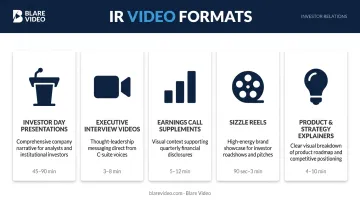
IR teams typically work across five core video formats, each serving a distinct audience need:
- Investor day presentations — live, virtual, or hybrid events where management presents strategy, financial targets, and competitive positioning to the analyst and investor community
- Executive interview videos — structured, filmed conversations with CEOs, CFOs, or business unit leaders that communicate leadership perspective on specific topics
- Earnings call supplements — short-form video recaps or highlights published alongside or after the quarterly earnings call
- Sizzle reels — milestone-focused highlight videos that distill financial progress, strategic wins, or company growth into 2–3 minutes
- Product and strategy explainers — used during major announcements to add visual context that slides alone can't convey
NIRI describes investor days as critical events for educating analysts on the business model and investment thesis, sharing long-term vision, and providing direct management access. Video — whether live-streamed or pre-recorded — is central to executing those goals at scale.
Pre-Recorded vs. Live-Streamed
The choice between pre-recorded and live-streamed video depends on the objective:
| Format | Strengths | Best For |
|---|---|---|
| Pre-recorded | Tight messaging control, higher polish, compliance review built in | Executive interviews, standalone IR content, social clips |
| Live-streamed | Real-time Q&A, unfiltered engagement, high-trust signal | Investor days, earnings calls, shareholder meetings |
| Hybrid | Reaches both in-person and remote investors simultaneously | Investor days with multi-city analyst attendance |
Broadridge supported 1,931 virtual shareholder meetings in the first half of 2025 alone — and 93% of those provided live Q&A capability. The format is established, and investor expectations around access and interactivity are rising accordingly.
Regulatory Context: What IR Video Isn't
IR video is not marketing video. The audience — institutional investors, sell-side analysts, retail shareholders — expects precision and regulatory compliance, not promotional language.
Two regulatory frameworks govern IR video specifically:
- Regulation FD requires simultaneous public disclosure of material nonpublic information. Webcasts and archived IR website postings can satisfy this requirement when properly structured.
- PSLRA Safe Harbor requires that forward-looking statements — guidance, projections, strategic outlook — be clearly identified and accompanied by meaningful cautionary language.
Legal and compliance should review scripts before any camera rolls. That same regulatory discipline applies regardless of where the video ultimately lives — including LinkedIn.
Short-Form IR Video on LinkedIn
Short-form clips — 60 to 90 seconds, optimized for LinkedIn — deliver measurable reach. Brunswick's 2023 survey found 91% of institutional investors made a recommendation or decision based on digital or social media information. A single edited soundbite from a CEO earnings commentary, posted on LinkedIn with proper disclosure, reaches investors where they're already doing research.
Key Elements of an Effective IR Video Strategy
Start With Clear Objectives
Before any camera is turned on, the IR team needs to answer three questions:
- What is the single most important investor takeaway?
- Who is the primary audience — retail investors, institutional buy-side, sell-side analysts, or all three?
- What action or sentiment shift should this video drive — increased confidence in management, better understanding of the growth strategy, or clearer conviction in the financial thesis?
Without answers to these, even a technically excellent video will underperform. Brunswick's 2026 survey found that only 47% of investors said companies do a good job communicating their long-term investment story — and only 27% felt companies effectively communicate their competitive advantage. Those numbers point to a consistent failure in communication strategy, not just execution.
Executive Credibility on Camera
Investors respond to leadership they can see and hear. The research is direct:
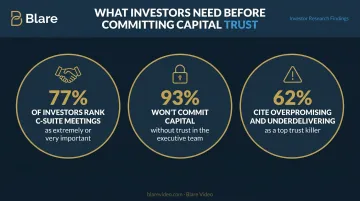
- 77% of investors ranked C-suite meetings as extremely or very important for their research process
- 93% of investors won't commit capital without trust in the executive team
- 62% of investors identified overpromising and underdelivering as a top trust killer
Video creates a scalable version of that direct access. A CEO explaining strategy and growth outlook on camera — clearly and without hedging — builds the kind of confidence that static materials rarely achieve.
Scripts should reflect measured, credible claims. Whatever leadership says on camera will be held against them on the next earnings call.
Think in Campaigns, Not One-Offs
The strongest IR video programs treat content as a campaign rather than individual deliverables. A structured IR content calendar might look like this:
- Pre-event: Executive preview video or strategic context clip
- Event: Live-streamed investor day or earnings call webcast
- Post-event: Highlight reel, individual soundbites distributed on LinkedIn, on-demand replay link in email campaigns
This approach extends the communication value of a single production investment and keeps investors engaged across multiple touchpoints. That continuity matters especially now, as digital channels have largely replaced direct outreach as investors' primary research method.
Pre-Production and Production Best Practices
Pre-Production Is Where Quality Is Won or Lost
Pre-production decisions — script structure, spokesperson selection, location, compliance review — determine the ceiling for everything that follows. Rushing this phase is the most common reason IR videos underperform.
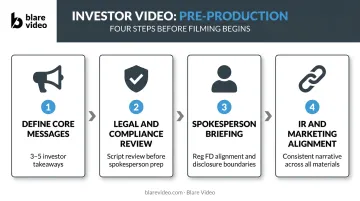
A solid pre-production process includes:
- Define 3–5 core messages the video must communicate: financial performance highlights, strategic growth plan, competitive differentiation, management depth
- Complete legal and compliance review of the script before any spokesperson prepares remarks
- Brief all spokespeople on what has and hasn't been publicly disclosed — NIRI's Standards of Practice specifically recommends this to prevent inadvertent selective disclosure
- Align the IR and marketing teams so the video's narrative is consistent with annual reports, press releases, and earnings call language
Working with a production partner early in this phase — before the shoot date is locked — prevents the scope and timeline problems that most commonly derail IR video timelines.
Production Quality Is a Credibility Signal
Research from USC found that poor audio quality causes viewers to rate speakers as less intelligent and their information as less credible — even when the content itself is unchanged. For investor-facing video, that's not a minor production detail. It's a direct hit to the message.
Baseline production requirements for IR video include:
- Professional camera equipment at 4K or higher resolution
- Clean audio capture — wired lavalier plus boom microphone, not room audio
- Controlled lighting — three-point interview lighting setup, no harsh shadows or blown highlights
- Experienced crew who understand the constraints of an executive's time
For executive interviews, a two-camera setup allows for clean cutaways during editing, which keeps pacing tight without visible jump cuts.
Spokesperson Preparation
Even experienced executives need preparation before an on-camera IR interview. The goal isn't to create a polished performance — it's to ensure the spokesperson can clearly answer:
- Why is this company a standout investment?
- How far have key business initiatives progressed?
- How does leadership plan to respond to competitive dynamics?
Preparation steps that matter:
- Media training, including practice with an actual camera and monitor playback
- Script or structured talking points review — not memorization, but command of the core narrative
- At least one full rehearsal run before the shoot begins
- Alignment on Reg FD boundaries — what can and cannot be said on camera
Teleprompter support and structured talking points guidance during the shoot help executives stay on message without reading verbatim from a script.
Maximize One Production Day
A well-planned shoot day generates far more than one video — and the asset library it builds keeps producing content long after the crew leaves. During a single executive interview day:
- Capture standalone soundbites on 2–3 distinct topics (financial performance, growth strategy, team) that can be posted as separate LinkedIn clips
- Record additional b-roll of operations, facilities, or products that can support future quarterly content without a full production day
- Plan the shoot in both widescreen (16:9) and square or vertical formats so social content is ready without a separate shoot
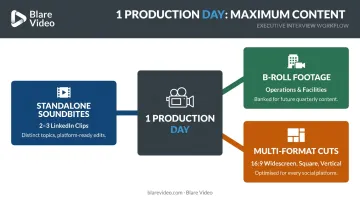
Blare Video's post-production workflow handles multi-format delivery — horizontal, square, and vertical cuts from a single source edit — so IR teams walk away with a full content suite, not just one finished video.
Post-Production, Distribution, and Content Repurposing
Post-Production Elements That Matter for IR Video
The editing phase is where raw footage becomes a credible investor communication. Key post-production priorities:
- Clean pacing — IR audiences have low tolerance for slow sections; cut aggressively to respect their time
- Lower-thirds — identify every speaker by name and title so analysts don't have to guess
- Motion graphics for financial data — animated charts and data visualizations are far more digestible than static slides captured on camera
- Color grading — professional color correction creates visual consistency and a polished, intentional look
- Music selection — understated, forward-moving tracks work best; anything that feels promotional or dramatic works against credibility
Distribution: Meet Investors Where They Are
Each distribution channel serves a different investor touchpoint:
| Channel | Format | Purpose |
|---|---|---|
| IR website | Full-length video, on-demand | Primary research destination |
| Earnings webcast | Live stream + replay | Real-time event + archive |
| Email to analysts/shareholders | Embedded link or thumbnail | Direct distribution to key audiences |
| 60–90 second clips | Ongoing digital presence | |
| YouTube | Full recordings | On-demand, searchable archive |
Broadridge reported that digital delivery of investor communications reached 90% in the 2025 proxy season, with most delivered same-day. Investors expect digital access — and they expect it to work seamlessly across every channel listed above.
The Repurposing Opportunity
One investor day recording contains dozens of distinct content pieces. Distribution across multiple channels also creates a natural repurposing opportunity — the same footage can serve analysts, shareholders, and social audiences with different cuts. From a single event, you can typically pull:
- 3–5 executive soundbite clips from the full presentation (1–2 minutes each)
- 1 highlight reel covering the day's key themes (3–4 minutes)
- Topic-specific vignettes on growth strategy, competitive positioning, or financial targets
- Quotes formatted as static graphics for LinkedIn posts between video releases
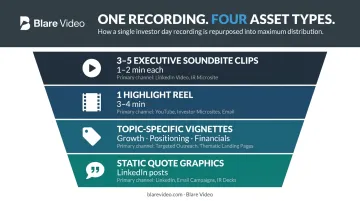
Blare Video's post-production services are built for this workflow. Raw footage is stored long-term for future repurposing, and multi-format editing means each asset gets cut specifically for website, webcast, and social — no second shoot required.
Frequently Asked Questions
What does investor relations do?
Investor relations manages communication between a company and its investors, shareholders, analysts, and the broader financial community. It covers regulatory disclosures, earnings announcements, shareholder meetings, and ongoing messaging about performance and strategic direction.
What's the difference between IR and PR?
IR is a sub-discipline focused exclusively on the financial community, with tighter regulatory requirements including SEC rules and Reg FD, and close integration with legal and accounting teams. Traditional PR targets media, customers, and the public without those regulatory constraints.
What types of videos are used in investor relations?
The most common formats are investor day presentations (live, virtual, or hybrid), executive interview and leadership introduction videos, earnings call supplements, sizzle reels, and product or strategy explainer videos used during major announcements.
How long should an investor relations video be?
Short-form social clips should run 60–90 seconds. Standalone IR videos and earnings supplements typically run 3–5 minutes. Full investor day productions span several hours depending on the agenda and number of management presenters.
Can IR videos be repurposed for other communications?
Yes. A full investor day recording can be edited into executive soundbites, social clips, highlight reels, and internal communications materials. One well-planned production day generates content that extends across internal and external channels for weeks.
How do I prepare a spokesperson for an investor relations video?
Provide media coaching, structured talking points aligned to the company's core investment thesis, and at least one full rehearsal before filming. Ensure spokespeople are prepared to speak clearly on competitive positioning, financial progress, and growth initiatives — and are briefed on what information has been publicly disclosed.