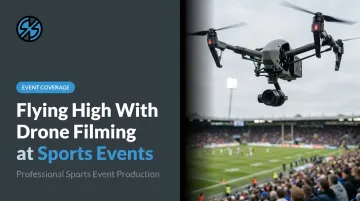
Drone filming in sports has moved well past novelty. ESPN deployed live drones at X Games Aspen as early as 2015. FOX Sports ran a custom high-speed FPV drone at the 2024 Daytona 500. NBC brought two live drones to the Kentucky Derby that same year. The technology is now woven into major broadcast infrastructure — and increasingly, into mid-sized event production too.
The challenge for event organizers and brand marketers isn't access to drones. It's knowing what it actually takes to execute aerial coverage legally, safely, and strategically across US markets where FAA regulations, venue rules, and airspace complexity all come into play.
This article covers how drone filming has evolved in sports, what it genuinely delivers, the regulatory framework you need to understand, how to plan shots that earn their place in the final cut, and how to turn one day of drone footage into months of content.
Key Takeaways
- Drone filming is standard practice in major sports broadcasts, not a premium add-on.
- US commercial drone operations require FAA Part 107 certification, drone registration, and airspace authorization before any flight near a venue.
- The FAA restricts all drones within 3 nautical miles of stadiums seating 30,000+ during games, regardless of venue permission.
- Pre-planned drone shots integrated into a production brief consistently outperform improvised aerial captures.
- One shoot day can deliver a hero event film, social cutdowns, sponsor recaps, and ad openers.
How Drone Filming at Sports Events Has Evolved
From Highlight Reel to Live Camera
Early sports drone footage — roughly 2013 to 2015 — was almost entirely post-production material: promotional clips, course flyovers, pre-event teasers. The milestone that changed the conversation was ESPN's deployment at X Games Aspen in January 2015, documented by Sports Video Group as the first legal live sports TV drone use in North America. The drone carried a Panasonic GH4 and fed 1080p/60 video under closed-set conditions — modest by today's standards, but the proof of concept that opened the door.
By 2024, the Daytona 500 featured two distinct live drone systems: a custom high-speed FPV drone nicknamed "Spicy" and a stabilized gimbal drone delivering 4K footage directly into FOX's broadcast truck. That same year, WBD Sports deployed drones at NBA All-Star Weekend, and NBC ran two live drones at the Kentucky Derby.
The FPV Revolution
FPV (first-person view) drones represent the defining development in sports aerial production. These agile, custom-built rigs can match the speed of elite athletes — useful at NASCAR venues, BMX courses, and ski races where a traditional drone simply can't keep up.
For younger audiences, the footage delivers something genuinely different: a video game perspective dropped into a live event. What's less visible from the broadcast side is the operational weight behind that shot. As FOX's Daytona 500 setup demonstrated, FPV and stabilized aerial footage require separate aircraft, separate pilots, separate safety plans, and separate signal paths — not a single drone doing both jobs.
Technical Barriers That No Longer Exist
Three technical advances eliminated the biggest historical constraint — the requirement for post-production processing before drone footage could air:
- Gimbal stabilization: Modern 3-axis gimbals deliver broadcast-smooth footage even at speed
- 4K/6K sensors: High-resolution capture now meets network broadcast standards without upscaling
- Real-time video transmission: Low-latency RF links feed live drone signals directly to OB trucks
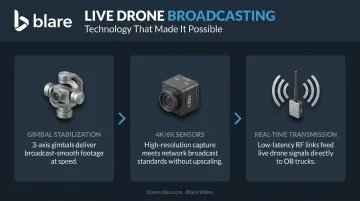
Today, drones can be patched into an outside broadcast (OB) truck and treated as any other camera in a live production environment.
Why Drone Filming Transforms Sports Events
Cinematic Perspective Ground Cameras Can't Replicate
Overhead aerial angles reveal things sideline cameras simply cannot show:
- Field geometry and tactical formations in team sports — how players are positioned before a play develops
- Course terrain and scale at outdoor events — a road cycling stage cutting through mountains, a cross-country course, a marathon start line
- Crowd density and atmosphere — a packed stadium from above communicates the size and energy of an event in seconds
That sense of scale drives perceived production value — and it carries directly into how sponsors and broadcasters assess coverage quality.
Sponsor Visibility and Commercial Value
Drone footage offers a specific type of sponsor exposure ground cameras can't replicate: branded finish-line arches, banner installations, hospitality villages, and event activation zones captured from above. That overhead view frames sponsor presence within the full context of the event — useful for post-event sponsor reports and future sponsorship pitches.
At a broadcast level, uniquely integrated aerial coverage differentiates a media package. An FPV drone tracking a downhill skier at full speed is a fundamentally different product than a standard camera mix, and that distinction has real value when selling broadcast rights or digital platform packages.
Scroll-Stopping Social Media Content
Short aerial clips consistently perform well in the short-form video formats that dominate sports content distribution. Emplifi's research shows brands earn nearly 40% more engagement with Instagram Reels than traditional Instagram video. Separately, 92% of sports organizations were using Instagram Reels as of Q3 2022, according to data reported by BusinessWire.
Aerial clips work well in these formats because they hook viewers within the first few seconds. A sweeping approach shot of a stadium at golden hour is a stronger opening frame than a ground-level crowd shot. For Reels, TikTok, and YouTube Shorts — where the first two seconds determine whether a viewer stays — aerial content earns its keep.
The practical upside: one shoot day yields months of content. A single session can produce:
- A hero event film for your website or broadcast package
- Multiple short-form social cutdowns for Reels and TikTok
- Sponsor recap clips for post-event reporting
- Paid ad openers ready for digital campaigns
Cost Compared to Traditional Aerial Options
Drone production costs a fraction of what helicopter-mounted cameras or cable-suspended overhead rigs cost — a point noted by TVTechnology as a key reason broadcast adoption accelerated. This cost reduction made aerial coverage accessible to mid-sized events and regional competitions that couldn't justify a helicopter.
Exact rates vary significantly based on event duration, location, airspace complexity, and post-production scope. Working with a full-service production company that handles both aerial and ground coverage, like Blare Video across 20+ US markets, avoids the coordination overhead of managing separate vendors.
Sports Events That Benefit Most From Aerial Coverage
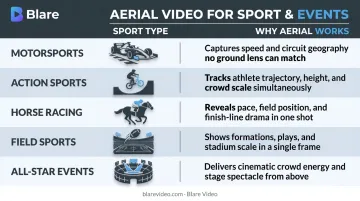
Not every sport benefits equally from drone coverage. Here's where aerial filming delivers the highest visual return:
| Sport/Event Type | Why Aerial Works |
|---|---|
| Motorsports (NASCAR, IndyCar) | FPV drones match vehicle speed; venue scale requires aerial context |
| Action sports (X Games, BMX, skiing) | Course-based layouts visible only from above; FPV creates immersive chase shots |
| Horse racing | Outdoor course scale and field position best shown aerially |
| Field sports (football, soccer, lacrosse) | Overhead angles clarify formations and spatial play development |
| All-star and major events | Arena-scale crowd shots; access-oriented coverage where venue permits allow |
Indoor venues are a different story. Basketball arenas, volleyball courts, and gymnastics facilities limit operational altitude, put crowds in direct proximity to the drone, and trigger FAA operations-over-people rules. Venue authorities also maintain tight control over what flies inside. These environments demand a purpose-built operational plan and explicit venue authorization — not a standard deployment.
FAA Regulations, Safety, and Logistics in the US
Understanding FAA Part 107
Any commercial drone operation in the US — including filming sports events for compensation — falls under FAA Part 107 regulations. The requirements are specific:
- Operators must hold a valid Remote Pilot Certificate (pass the UAG aeronautical knowledge exam; minimum age 16)
- Every drone must be registered with the FAA ($5 per drone, valid 3 years, registration number displayed on the aircraft)
- Flights in controlled airspace require LAANC authorization or a formal FAA waiver before any flight
The distinction between recreational and commercial use matters here. Hiring a hobbyist pilot who lacks Part 107 certification isn't a workaround — it's a compliance violation with real legal liability.
The Stadium TFR: Non-Negotiable
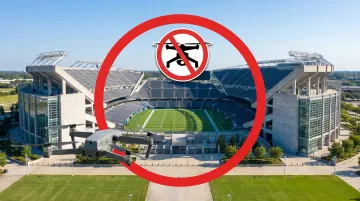
This is the rule that catches most event organizers off guard. The FAA restricts all UAS at or below 3,000 ft AGL within 3 nautical miles of stadiums seating 30,000 or more people during MLB, NFL, NCAA Division I football, and major motor speedway events. The restriction runs from 1 hour before to 1 hour after the event.
Venue permission doesn't override this — FAA authorization is required separately.
The enforcement record is unambiguous:
- A drone delayed the Ravens-Bengals NFL game in Baltimore in November 2023; the FAA investigated
- A Decatur man pleaded guilty in 2025 to illegally operating a drone over Truist Park during the MLB All-Star Game
- The NFL recorded more than 2,800 drone incursions into temporary restricted airspace during the 2023 season alone
Venue Permissions: A Separate Layer
FAA compliance is necessary but not sufficient. Event drone operations also require:
- Landowner or stadium authority approval — major professional venues (NFL, NBA, MLB) often have independent aerial filming policies
- Event safety officer coordination — flight paths must account for crowd positions and safety perimeters
- Local municipality permits where applicable
For flying over or near spectators, Part 107.39 (Operations Over People) applies. The FAA divides eligible aircraft into Categories 1–4 based on injury risk thresholds, with Category 1 capped at 0.55 lb.
Most event-capable drones require Category 2 or higher classification. That means crowd overflight needs explicit waiver approval — not just general Part 107 certification.
Operational Realities
Beyond regulations, the logistics require active management:
- Battery life: The DJI Inspire 3 delivers approximately 28 minutes of flight time under test conditions. Real-world event coverage means multiple charged batteries in rotation and a gap plan for battery swaps during extended shoots.
- Weather: High winds, rain, extreme cold, and low visibility can all ground operations. Professional crews build contingency windows into production schedules and carry ground-level backup options.
Planning Drone Shots for Maximum Impact
Pre-Production Flight Mapping
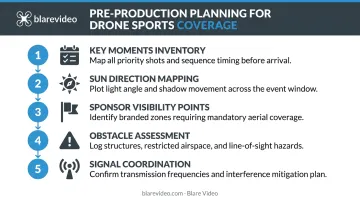
Drone shots planned in advance consistently outperform improvised aerial captures. Pre-production planning for a sports event should cover:
- Key moments inventory — event start, finish line, key plays, podium sequences
- Sun direction mapping — aerial shots into direct sun lose detail fast; plan altitude and angle by time of day
- Sponsor visibility points — identify branded installations visible from above
- Obstacle assessment — power lines, lighting rigs, flag poles, and spectator structures all affect flight paths
- Signal coordination — if the drone feeds live into an OB truck, the transmission path needs testing before event day
The most common mistake in drone coverage is overuse — and a production brief that aligns the flight plan with the event narrative prevents it. When every transition is an aerial shot, none of them land.
Integrating Drone Footage Into the Edit
The most effective placements for drone shots within an event film or highlight reel follow a clear pattern:
- Opening scene-setters — establish scale and atmosphere before action begins
- Transitional shots — connect sequences between different parts of the event
- Closing emotional shots — give audiences a sense of the full scope of what just happened
- Sponsor integration sequences — branded aerial moments captured separately from athlete-focused footage
The test for any aerial shot is simple: does it serve the story? Blare Video's approach to sports event coverage treats each drone shot as an editorial decision within a broader narrative, chosen for what it adds to the story — not because the footage happened to exist.
Post-Production Considerations
High-resolution drone footage (4K or 6K) has direct workflow implications:
- Storage: Raw 4K/6K files are large; plan storage capacity before the event
- Color grading: Drone footage needs to match the color treatment of ground-level cameras — they're often shooting on different sensors
- Stabilization passes: Turbulence, wind, and rapid movement create footage that needs post-stabilization even with gimbal systems
- Multi-angle sync: Drone footage must be synced with ground-level camera timecodes for accurate multi-angle editing
Turning Drone Footage Into a Long-Term Content Asset
One day of aerial filming is a poor investment if it produces only one deliverable. The highest-ROI approach treats drone footage as a reusable asset from the moment of capture.
Structure your brief to maximize reuse:
- Shoot establishing shots at multiple altitudes (not just maximum height)
- Capture key moments from different approach angles, not just one pass
- Film sponsor-facing aerials separately from athlete-focused sequences
- Get wide, medium, and close aerial framings of the same moment where possible
That variety in the raw footage is what makes multiple finished products possible. What one shoot can produce:
- Hero event film (long-form)
- Social media cutdowns for Reels, TikTok, and YouTube Shorts (vertical and horizontal)
- Paid advertising openers (aerial hooks perform well in the first 3 seconds)
- Sponsor recap documentation
- Future event promotional trailers
- Press and media kit assets
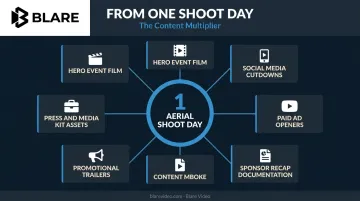
Blare Video's approach to event coverage — capturing footage for same-day social delivery alongside a comprehensive recap film — reflects how multi-output production planning works in practice. Planned correctly, a single aerial shoot day powers weeks of content across channels.
Two emerging formats — 360-degree aerial video for VR experiences and AI-assisted athlete tracking via drone — are in active development within broadcast production. Both remain limited and highly venue-specific in US sports event coverage as of 2025, so they're worth monitoring rather than budgeting for today.
Frequently Asked Questions
How much does a drone videographer cost for a sports event?
Professional sports event drone production in the US varies based on event duration, location, airspace complexity, and post-production scope. No standardized industry rate exists, and published prices from generic directories are rarely accurate for commercial event work. Contact production companies directly for project-specific quotes.
Can you fly a drone over a sporting event?
It depends on airspace, venue rules, and crowd size. The FAA restricts drones within 3 nautical miles of stadiums seating 30,000+ during games, and flying over spectators requires specific operational approvals. Commercial operations require Part 107 certification and typically a separate venue permit. Flying without these is illegal and carries significant liability.
Does the NFL use drones to film?
The NFL received FAA permission for limited drone use for NFL Films and team practices as of 2015, but prohibited drone use on game days in stadiums and parking lots. For current live-game airspace, FAA stadium TFR rules apply — and the league has actively supported legislation to disable unauthorized drones near venues.
What is the best camera drone for sporting events?
High-speed FPV rigs excel at matching athlete speed, while stabilized platforms like the DJI Inspire 3 (8K capable) suit wide coverage and cinematic shots. The right choice depends on event type, resolution requirements, and airspace constraints. Let your production team make that call based on your specific event.
Do you need a license to fly a drone at a sports event in the US?
Yes. Commercial drone operations require an FAA Part 107 Remote Pilot Certificate. Flights in controlled airspace — which includes most venues near airports or in urban markets — additionally require LAANC authorization or an FAA waiver. Always verify your operator is Part 107-certified before signing a contract.
How do I find a professional drone videographer for my sports event?
Look for FAA Part 107-certified operators with verified sports event experience, liability insurance, and an aerial footage portfolio. A full-service production company that handles both aerial and ground coverage eliminates vendor coordination headaches and ensures your drone footage integrates cleanly with the rest of the event.