Introduction
A job description tells candidates what the role involves. It almost never tells them what it actually feels like to show up on Monday morning, who they'll eat lunch with, or whether their manager will care about their development.
That gap costs companies their best candidates — often without anyone realizing it. According to Glassdoor's 2025 research, 83% of job seekers research company reviews and ratings before deciding where to apply — and 53% actively look for more company information after reading a job post.
Employer branding videos exist to close that gap. They give candidates a window into real culture and real people, in a format candidates genuinely trust. This guide covers what to include, which video types to use, how to create them, and three real-world examples worth learning from.
Key Takeaways
- Employer branding videos showcase culture, values, and employee experiences to attract better-aligned candidates
- Authentic employee testimonials, day-in-the-life segments, and genuine DEI representation outperform polished corporate messaging
- Keep social videos under 60–90 seconds — shorter clips consistently earn more views and shares
- Match video format to your specific hiring goal; the right type matters as much as production quality
- LinkedIn, YouTube, Instagram, and TikTok each require different formats, lengths, and hooks
What Is an Employer Branding Video?
An employer branding video is a short-form visual tool that gives candidates a genuine, behind-the-scenes look at what it's actually like to work somewhere — covering culture, people, values, and daily reality, not just open roles.
The distinction from a recruitment video is important:
| Employer Branding Video | Recruitment Video | |
|---|---|---|
| Goal | Build emotional connection with company | Drive applications to a specific role |
| Funnel stage | Top of funnel (awareness, consideration) | Mid/bottom of funnel (conversion) |
| Tone | Storytelling, culture-forward | Direct, CTA-focused |
| Shelf life | 12–24+ months | Tied to open role |
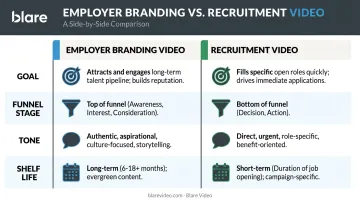
Employer branding videos operate before candidates ever read a job description. They prime people to want to work somewhere, which makes every downstream recruiting effort more effective.
Why Video Is a Must-Have for Employer Branding
Candidates research you before they apply. Where they do that research — and what persuades them — has shifted decisively toward video.
Pew Research Center's 2024 data shows 83% of U.S. adults use YouTube, including 93% of adults ages 18–29 and 92% of those ages 30–49. That covers virtually every professional demographic hiring teams are trying to reach.
Video Beats Text Because It Builds Emotional Connection
A static careers page tells candidates about your company. A video shows them: real faces, real environments, real energy. That's what moves passive candidates from mild curiosity to genuine interest — and it's why employee-led video is especially powerful.
LinkedIn's employer brand research found that candidates trust employees three times more than the company itself when evaluating what it's actually like to work there. Video makes that trusted voice scalable across every channel where candidates are looking.
The Algorithmic Advantage
Social platforms actively reward video content with organic reach that text and image posts rarely achieve. LinkedIn's analysis of B2B video found that video posts are shared 20x more often than other content types. For employer branding teams working with limited budgets, that reach-per-dollar equation makes video one of the most cost-effective tools available.
What to Include in Your Employer Branding Video
Employee Testimonials
Real employees speaking in their own words are the single most credible signal you can put in front of candidates. Don't feature only executives — candidates want to hear from peers at their level and tenure. Feature employees across roles, backgrounds, and career stages to broaden who sees themselves reflected in the story.
The key is keeping it unscripted. At Blare Video, the approach is explicitly conversational — a skilled director creates the conditions for subjects to speak naturally, "from the heart, not from a prepared line." Even a CEO comfortable with public speaking can come across stiff and rehearsed when handed a script on camera.
Company Culture Footage
Candid moments carry more weight than staged ones. Team collaboration, casual hallway interactions, office environments, and company events all work — but the footage needs to feel real. If it looks like everyone was told to smile and walk purposefully past a camera, candidates will notice.
Mission and Values in Action
Don't just state your values — show them. A company that says "we invest in our people" should show a manager giving feedback, a team celebrating a junior employee's win, or a training program in progress. Real-life examples make values credible in a way that policy language never can.
Day-in-the-Life Segments
Following an employee through a realistic workday answers the questions candidates are actually asking:
- What does a typical day actually look like?
- How fast is the pace?
- Who will I work alongside?
This format works particularly well for early-career candidates evaluating role fit across multiple options.
Diversity, Inclusion, and Growth
Glassdoor's research found 76% of job seekers consider workforce diversity important when evaluating companies, and 32% won't apply to a company they perceive as lacking diversity.
Feature a genuinely diverse group of employees and highlight real programs rather than policy statements:
- Mentorship: Show active relationships between senior and junior staff
- Internal promotion: Let employees speak to career growth from within
- Training and development: Show programs in action, not just on a slide
Candidates trust employee perspectives on DEI far more than corporate-level claims.
Types of Employer Branding Videos (and How to Choose)
Not all employer branding videos serve the same purpose. Matching the format to your goal dramatically changes effectiveness.
Culture Videos Build broad brand awareness at the top of the funnel. These work best for passive candidates who aren't actively job-hunting but might be swayed by a compelling first impression of your workplace.
Employee Story / Testimonial Videos Follow one or a few employees through their career journey in interview format. Best for mid-funnel consideration — particularly when targeting candidates in specific roles or industries who want social proof before applying.
Day-in-the-Life Videos Walk candidates through an actual workday: the tasks, tools, and team dynamics. These perform especially well on YouTube and Instagram/TikTok, where early-career audiences go to evaluate role fit before ever visiting a careers page.
Leadership / Mission Videos Feature founders or department heads discussing vision and direction. Most effective for attracting senior professionals weighing culture and company direction — candidates who want to know who's leading before they commit.
Creative / Concept-Driven Videos Some of the most memorable employer brand videos lead with a strong creative idea rather than straightforward testimonials. This approach pays off when the brand identity is clear and distinct — but it requires higher production support and willingness to take a creative risk.
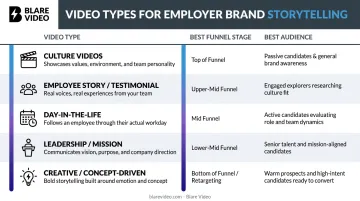
To make the choice easier, here's a quick-reference breakdown:
| Video Type | Best Funnel Stage | Best Audience |
|---|---|---|
| Culture Videos | Top of funnel | Passive candidates |
| Employee Story / Testimonial | Mid-funnel | Role-specific candidates |
| Day-in-the-Life | Top to mid-funnel | Early-career candidates |
| Leadership / Mission | Mid to bottom funnel | Senior professionals |
| Creative / Concept-Driven | Any stage | Brand-aware candidates |
Tips for Creating Compelling Employer Branding Videos
Start with Objective and Persona
Before anything else — format, length, tone, cast — answer two questions:
- What do you want the viewer to feel or do after watching?
- Who exactly are you trying to reach?
Every creative decision flows from there. If your Employer Value Proposition centers on career growth, the video should show that growth happening — through promotions, mentorship, skill development — not just claim it in a voice-over.
Hook the Viewer in the First 5–10 Seconds
Attention drops fast on every platform. Opening options that work:
- A candid employee moment that catches people off guard
- A bold visual that doesn't look like a typical corporate video
- A question the target candidate would immediately recognize as their own
- A surprising or counterintuitive statement about the company
What doesn't work: a slow logo reveal, a generic establishing shot, or 10 seconds of background music before anyone speaks.
Keep It Short and Focused
Wistia's State of Video report shows videos under one minute average 52% engagement — meaning people watch more than half the video. That number drops sharply as length increases.
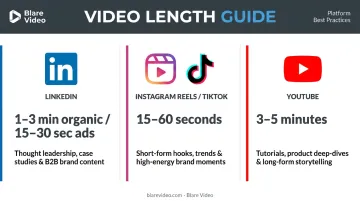
Platform guidance for length:
- LinkedIn: 1–3 minutes for organic; 15–30 seconds for ads
- Instagram Reels / TikTok: 15–60 seconds
- YouTube: 3–5 minutes for deeper storytelling
One core message per video outperforms trying to cover everything in one film. A series of focused videos typically outperforms a single comprehensive piece.
Prioritize Authenticity Without Sacrificing Quality
Candidates today are skeptical of overly polished, corporate-feeling content. Natural lighting and an employee speaking candidly often outperform a scripted studio shoot — because candidates can tell the difference.
That said, authenticity and quality aren't mutually exclusive. Professional audio, thoughtful framing, and clean editing make authentic moments land rather than feel accidental. Blare Video combines unscripted interviews with professional camera systems (Sony FX6, RED Raptor), skilled directing, and structured post-production — proof that both goals reinforce each other.
Optimize Per Platform
The same video shouldn't be dropped identically across every channel. Key differences:
- LinkedIn: Horizontal format, professional tone, slightly longer runtime acceptable
- Instagram / TikTok: Vertical format, fast hooks, sound-off captions critical
- YouTube: Longer form, searchable titles, playlist organization matters
Blare Video can produce multiple aspect ratios — horizontal, vertical, and square — from a single shoot day, which means companies with multi-platform distribution needs don't have to choose between channels or budget for separate shoots.
Real-World Employer Branding Video Examples Worth Learning From
Apple — "Join Us. Be You."
Apple's employer brand video leads not with perks or benefits but with a cultural identity statement: the company is where "individual imaginations gather together." The message signals clearly who belongs there — independent thinkers, non-conformists, people driven by craft.
When your cultural identity is distinct enough, leading with values attracts self-selecting candidates who already share them. The video does the filtering work before anyone applies.
Bolt — "Come Build With Us"
Where Apple leads with aspiration, Bolt takes the opposite approach. Its 2023 employer brand film reportedly opens by addressing the clichés of the genre head-on, then pivots to what culture actually means at a company that grew from a small Estonian startup to operations across 45 countries. That honesty functions as a credibility signal.
Acknowledging what your culture isn't can be more convincing than listing what it is. Candidates have seen enough foosball-table footage to be suspicious of it.
Google — Life at Google Series
Rather than a single employer brand video, Google operates an entire YouTube channel — "Life at Google" — organized by playlists: hiring process, working at Google, day-in-the-life by role, and more. A product manager video, a software engineer video, and an office-life video can each speak to a different candidate without any one video needing to do everything.
A multi-video series allows depth without overload. Role-specific content outperforms generic "great place to work" messaging because it answers the question candidates are actually asking: is this right for me specifically?
What these three examples share:
- Lead with identity, not perks — values and culture carry more weight than benefits lists
- Use honesty as a differentiator — acknowledging trade-offs builds candidate trust
- Match format to scale — one video works for a focused message; a series works when roles vary widely
Frequently Asked Questions
What should a brand video include?
At minimum: authentic employee testimonials, candid culture footage, mission or values shown through real examples, and role-specific day-in-the-life content. The videos that work best feel like a genuine window into the workplace, not a marketing reel.
How do you do employer branding?
Start by defining your Employer Value Proposition — the specific reasons someone would choose to work at your company over a competitor. Then communicate it consistently across channels, with video being one of the most effective formats for bringing that EVP to life for candidates at scale.
What are the 4 P's of employer branding?
Per Universum's 2024 framework, the 4 P's are People, Purpose, Place, and Product. These inform what to prioritize in an employer branding video — who works there, why the work matters, what the environment is like, and what the company actually builds or delivers.
What are the 5 pillars of EVP?
According to Gartner, the five EVP pillars are: competitive compensation, comprehensive benefits, growth opportunities, positive work culture, and work-life balance. A strong employer branding video should reflect at least two or three of these visually and narratively, not just name them.
What is the difference between an employer branding video and a recruitment video?
Employer branding videos build emotional connection with the company as a whole, operating at the awareness and consideration stage. Recruitment videos are role-specific and drive direct applications. Both serve different stages of the candidate journey and work best in combination.